RE: IMPLEMENTATION OF THE COMPETENCY BASED CURRICULUM (CBÇ)
AT SENIOR SCHOOL
As you are aware, the first cohort of the Competency Based Education learners are expected to join Senior School in January 2026. Senior School is the fourth (4th) level of Basic Education in the Competency Based Education (CBE) coming after the Pre-Primary School (PP1 and PP2), Primary School (Grades 1 to 6) and Junior School (Grades 7 to 9) levels.
The subjects at Senior School are classified according to three pathways namely: –
- Science, Technology, Engineering and Mathematics (STEM)
- Arts and Sports Science
- Social Science.
The essence of Senior School is to offer learners a pre-tertiary/pre-university/ pre-career experience during which the learners have an opportunity to choose subjects from the pathways where they shall have demonstrated interest and/or potential at the earlier levels.
Senior School (Grades 10 to 12) comprises three years of education for learners generally in the age bracket of Fifteen (15) to Seventeen (17) years, with the learners completing this level expected to demonstrate the CBC Vision of being engaged, empowered and ethical citizens ready to participate in the socio-economic development of the nation or proceed to further education.
At this level, learners shall take Seven (7) subjects as recommended by the Presidential Working Party on Educational Reforms (PWPER, 2023). These shall comprise of four compulsory subjects namely:
- English
- Kiswahili
- Core Mathematics/Essential Mathematics
- Community Service Learning (CSL)
For clarity, all the learners shall take English, Kiswahili and Community Service Learning (CSL). Learners pursuing the STEM pathway shall take Core Mathematics while those who shall have chosen any of the other two pathways will take Essential Mathematics. If a learner who is not pursuing the STEM pathway opts to take Core Mathematics, they should be allowed to do so depending on their Junior School assessment results.
In addition to the compulsory learning areas, the learner will select three more subjects. It is advised that a learner takes at least two subjects from the chosen pathway.
This means that a learner may take up to three more subjects from the chosen pathway or take two subjects from the chosen pathway and one subject from another pathway. However, it should be anticipated that a situation may arise where a learner’s career choice requires that they take one subject in each pathway. Such a situation should be permitted.
The choices of subjects shall be guided by the learner’s anticipated career, aptitude, interest and personality with guidance by the leadership of the Senior School. Table 1 below provides a list of all the subjects on offer at Senior School under the CBC, for which curriculum designs have been developed by the Kenya Institute of Curriculum Development (KICD).
Table 1: List of subjects at Senior School (Grades 10, 11 and 12)
| Compulsory Subjects | Arts & Sports
Science |
Social Sciences | Science, Technology,
Engineering & Mathematics (STEM) |
| 1. English
2. Kiswahili/KSL 3. Core Mathematics/ Essential Mathematics 4. Community Service Learning (CSL) |
1. Sports and
Recreation 2. Music and Dance 3. Theatre and Film 4. Fine Arts
|
1. Literature in English
2. Indigenous Languages 3. Fasihi ya Kiswahili 4. Sign Language 5. Arabic 6. French 7. German 8. Mandarin Chinese 9. Christian Religious Education 10. Islamic Religious Education 11. Hindu Religious Education 12. Business Studies 13. History and Citizenship 14. Geography |
1. Biology
2. Chemistry 3. Physics 4. General Science 5. Agriculture 6. Computer Studies 7. Home Science 8. Aviation 9. Building Construction 10. Electricity 11. Metalwork 12. Power Mechanics 13. Woodwork 14. Media Technology 15. Marine and Fisheries Technology
|
Note:
- a) Physical Education (PE) and Information communication and Technology (ICT) will be
offered to all learners to facilitate learning and acquisition of life skills.
- b) Every school shall offer Pastoral/Religious Programme of Instruction (P/RPI) to enhance
moral, spiritual and character development of the learners. NO school should force learners to participate in religious rites and activities that are contrary to their beliefs as per Circular Ref No: MOE.HOS/3/10/18 dated 4th March, 2022.
GUIDELINES FOR TIMETABLING AND ROUTINE IN SENIOR SCHOOL
Introduction
Developing an effective timetable and daily routine is essential for fostering a productive learning environment where both learners and educators can interact to achieve intended learning outcomes. A well-structured timetable ensures that all learning areas are covered comprehensively and promotes implementation of balanced academic and co-curricular activities. These guidelines outline procedures for developing timetables that optimize utilization of time, teaching and learning experiences, enhance student engagement, and support the achievement of overall educational goals in institutions of learning.
Timetabling process
- All schools shall establish a time tabling committee comprising of the following:
- a) Deputy Head of the institution – Chair person
- b) Senior Masters in charge of pathways
- c) Heads of subjects
- d) Class Teachers of grades 10,11 & 12.
- The timetabling committee shall hold planning meetings at the beginning of every term to develop or review the school timetable.
- The timetable shall be presented to the Head of Institution for approval.
- The approved timetable shall be displayed in all administrative offices, classes, laboratories and notice boards.
- Every teacher shall extract their respective timetable for use in implementing the curriculum.
Timetabling guidelines for Senior School (Grade 10,11 and 12).
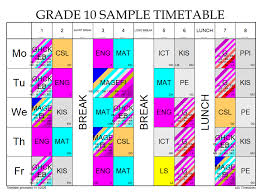
- There shall be 8 lessons per day derived from the core, elective and support subjects.
- PE shall have 3 lessons per week, ICT, 2 lessons per week, while lesson Study and P/RPI one (1) lesson per week
- Cumulatively there shall be a total number of 40 lessons per week.
- Each lesson shall be 40 minutes.
- Reporting time for grade 10, 11 and 12 in Senior Schools shall be at 8.00 am.
- The Lessons at this level shall start at 8.20 am and end at 3.20 pm.
- The time between 8.00 am and 8.20 am shall be utilized for roll call, assembly and/or house/class meetings where applicable.
- When plotting lessons on the timetable, the committee shall ensure that subjects with similar skills, knowledge or concepts do not follow one another.
- Plotting of lessons shall observe balance in distribution of subjects for morning and afternoon hours across the week.
- All core subjects (English, Kiswahili/KSL, Core Mathematics/Essential Mathematics and CSL) shall be plotted as single lessons.
- Support subjects (PE, ICT) shall be plotted as single subjects.
- There shall be only one double lesson per week for Arts & Sports Science and STEM subjects.
- Non-formal programmes shall be plotted on the timetable after the last lesson at 3.20 pm.
- Health breaks shall be provided after every two lessons where the first break shall be 10 minutes, the second one 30 minutes and lunch break for one hour.
Plotting of lessons shall adhere to the allocation per subject as tabulated in the table below
Table 2. Lesson distribution at senior school
| Subjects | No. of Lessons Per Week
(40minutes per lesson) |
| Core Subjects 4 | |
| 1. English | 5 |
| 2. Kiswahili | 5 |
| 3. Core Mathematics/Essential Mathematics | 5 |
| 4. Community Service Learning (CSL) | 3 |
| Elective Subjects | |
| 5. Option 1 | 5 |
| 6. Option 2 | 5 |
| 7. Option 3 | 5 |
| * Physical Education | 3 |
| * ICT Skills | 2 |
| * Learner Personal/Group Study | 1 |
| *Pastoral/Religious Programme Instruction | 1 |
| Total Number of Lessons | 40 |
Related posts:
Best Meru County Senior SchooL: C1 National, C2 Extra-County, C3 County and C4 Sub-County
COMPETENCY-BASED CURRICULUM FOR STAGE-BASED LEARNERS AT VOCATIONAL LEVEL
Best Murang’a County Senior Schools {C1 National, C2 Extra-County, C3 County and C4 Sub-County
List of Senior School Subjects & Subject Combinations (Grades 10, 11 & 12 – CBC Kenya)
KJSEA & Senior School Admission Criteria (2025 Guide)
About the Author
