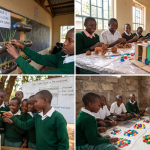
The Competency-Based Curriculum (CBC) at the vocational level is designed for learners following the Stage-Based Pathway who have profound Intellectual Disability, Deaf-blindness, Severe Autism, Severe Cerebral Palsy, and Multiple Disabilities.
The Stage-Based Pathway for learners with special needs is organised into four levels, namely:
Foundational Level
Intermediate Level
Pre-Vocational Level
Vocational Level
The Vocational Level is the final level of the Stage-Based Pathway. It provides robust preparation for learners with special needs and disabilities by equipping them with practical skills and technical competencies that prepare them for the world of work and self-reliance.
The pioneer cohort of Pre-Vocational learners is expected to transition to Special Stage-Based Vocational Schools in January 2026.
2. TRANSITION TO VOCATIONAL LEVEL
Learners shall transition from the Pre-Vocational Level to the Vocational Level based on the outcomes of:
Classroom assessment
School-based assessment
Summative assessment
This includes the Kenya Pre-Vocational Level Education Assessment (KPLEA) administered by the Kenya National Examinations Council (KNEC).
3. VOCATIONAL LEVEL TRAINING
Vocational Level training offers a range of learning areas where learners specialise in one skill area aimed at enabling them to acquire competencies relevant to the labour market.
At this level:
Each learner selects one vocational learning area based on individual ability and interest.
The decision on the learner’s choice of skill area shall be made in collaboration between the institution and the parent/guardian.
In addition to the vocational skill, learners are expected to study support subjects which include:
Physical Education (PE) and Sports to promote physical fitness and healthy living.
Religious Education (Christian Religious Education, Islamic Religious Education, or Hindu Religious Education) to instil moral values and life skills that enable learners to cope with life challenges.
4. PASTORAL AND RELIGIOUS INSTRUCTION
Every Special Stage-Based Vocational School shall offer a Pastoral/Religious Programme of Instruction to enhance the moral, spiritual, and character development of the learner.
Note:
No school shall force learners to participate in religious rites or activities that are contrary to their beliefs, in accordance with Circular Ref. No. MoE.HQs/3/10/18 dated 4th March 2022.
5. VOCATIONAL LEARNING AREAS AND SUPPORT SUBJECTS
Table 1: Vocational Learning Areas
S/No Vocational Learning Area
1 Basic Automotive Maintenance
2 Massage Therapy
3 Barbering
4 Floriculture and Floral Art
5 Dress Making
6 Tailoring
7 Fabric Decoration
8 Crocheting
9 Pedicure and Manicure
10 Sculpture Making
11 Wax Technology
12 Soap and Detergent Making
13 Leather Work
14 Plumbing
15 Embroidery
16 Panel Beating
17 Paper Craft
18 Hair Dressing
19 Ornament and Jewellery Making
20 House Keeping
21 Laundry Work
22 Playing Musical Instruments
23 Basic Metal Work
24 Painting
25 Carpentry
26 Pottery and Ceramics
27 Food Packaging and Value Addition
28 Picture Framing
29 Basic Masonry
30 Printing Technology and Office Operations
31 Animal Rearing
32 Knitting
33 Concrete Works
34 Beauty Therapy
35 Basic Electronics Repair and Maintenance
36 Event Layout and Decorations
37 Cooking
38 Crop Farming
39 Weaving
40 Basic Welding and Fabrication
Table 2: Support Subjects
S/No Support Subject
41 Physical Education (PE) and Sports
42 Christian Religious Education
43 Hindu Religious Education
44 Islamic Religious Education
TIME ALLOCATION AT VOCATIONAL LEVEL
The focus at the Vocational Level is to prepare learners for entry into the labour market by providing them with relevant skills and certification. Learning at this level is individualised to meet the diverse needs of learners with special needs and disabilities.
Time allocation is therefore flexible and depends on the completion and mastery of specific tasks and acquisition of skills. The suggested duration of 40 minutes per lesson serves as a guide.
Lesson Distribution per Week at Vocational Level
| S/No | Vocational Skill Area / Support Subjects / P-RPI | Number of Lessons per Week (40 Minutes per Lesson) |
|---|---|---|
| 1 | Vocational Skill Area | 32 |
| 2 | Physical Education and Sports | 4 |
| 3 | Religious Education (CRE / IRE / HRE) | 3 |
| 4 | Pastoral/Religious Programme of Instruction (P/RPI) | 1 |
| Total Number of Lessons | 40 |
School Requirements at Vocational Level
The school shall ensure the following:
-
Eight (8) lessons per day for five days, totalling 40 lessons per week.
-
Provision of individualised learning for all learners.
-
Allocation of time based on the completion and mastery of specific tasks and skills.
Time Allocation for Subjects at Vocational Level
The subjects and allocation of lessons at the Vocational Level are outlined in Table 3.9.2.
Table 3.9.2: Time Allocation for Subjects at Vocational Level
| S/No | Skill Area and Support Subjects | Number of Lessons per Week (40 Minutes per Lesson) |
|---|---|---|
| 1 | Vocational Skill Area | 30 |
| 2 | Core Subjects | |
| i. Physical Education and Sports | 5 | |
| ii. Religious Education (CRE / IRE / HRE) | 3 | |
| iii. Life Skills | 2 | |
| Total | 40 |
Implementation of the Vocational Level Timetable
The Vocational Level timetable shall be implemented as follows:
-
Official operating hours shall be from 8:00 a.m. to 4:00 p.m., Monday to Friday, as provided for in the Basic Education Regulations, 2015.
-
Activities conducted before the start of lessons and after lessons shall be clearly indicated on the timetable.
-
For Religious Education (CRE, IRE, or HRE), learners shall select the learning area based on their faith.
About the Author

Related posts:
TSC Promotion Vacancies 2026: TSC Advert No. 78–107/2026 Announces 34,499 Promotion Opportunities fo...
STEM Learning Area – Pure Sciences Track: Physics, Chemistry & Biology
Best Bungoma County Senior Schools { C1 National, C2 Extra-County, C3 County and C4 Sub-County
KNEC CBA Portal 2026 Guide: How to Login, Reset Password, and Upload Scores Easily