Grade 10 Media Technology Notes Term 1, Term 2 and Term 3 (1)2026
- Introduction to Media Technology
Concepts and Terminologies in Media Technology
- Media
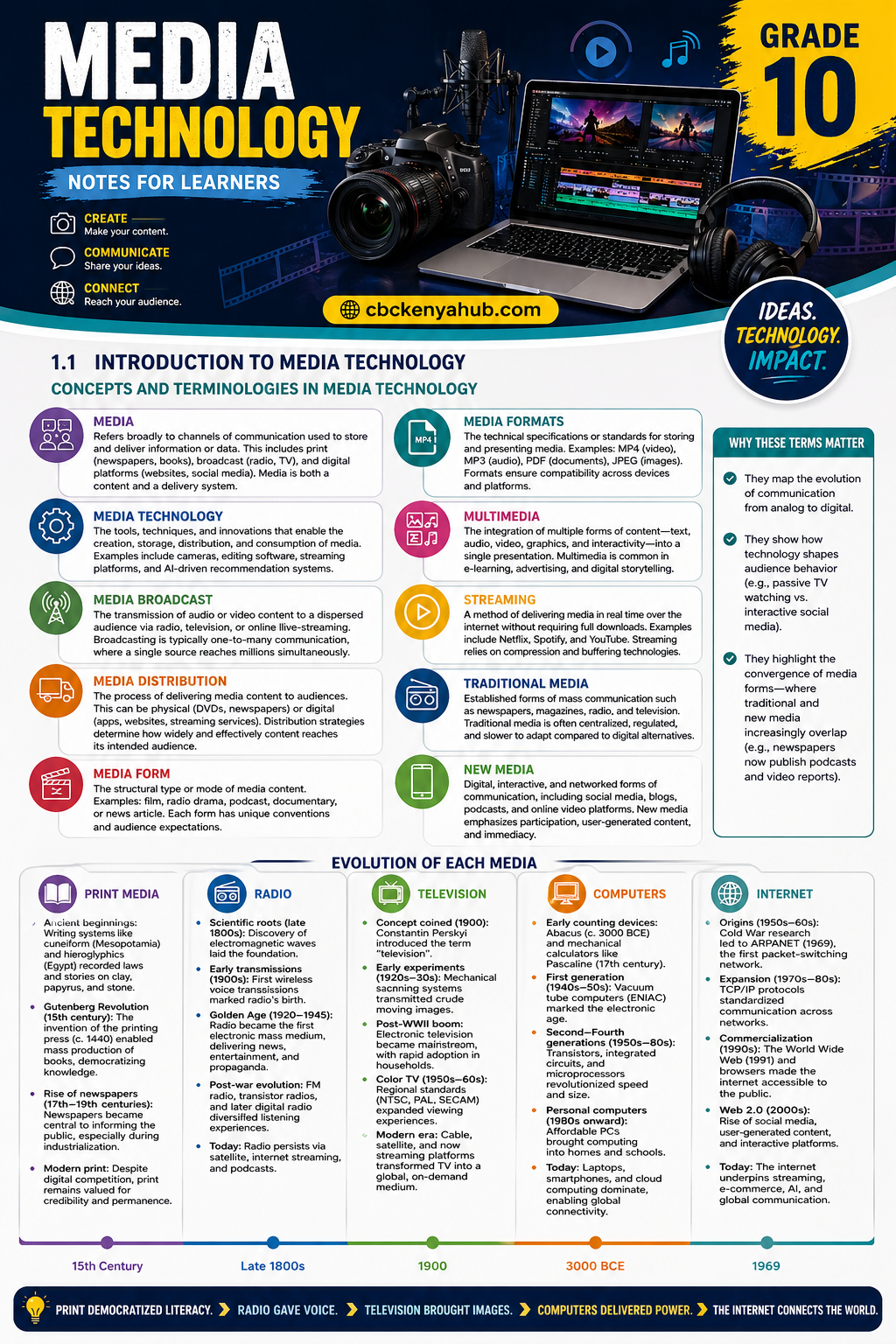
Refers broadly to channels of communication used to store and deliver information or data. This includes print (newspapers, books), broadcast (radio, TV), and digital platforms (websites, social media). Media is both a content and a delivery system.
· Media Technology
The tools, techniques, and innovations that enable the creation, storage, distribution, and consumption of media. Examples include cameras, editing software, streaming platforms, and AI- driven recommendation systems.
· Media Broadcast
The transmission of audio or video content to a dispersed audience via radio, television, or online live-streaming. Broadcasting is typically one-to-many communication, where a single source reaches millions simultaneously.
· Media Distribution
The process of delivering media content to audiences. This can be physical (DVDs, newspapers) or digital (apps, websites, streaming services). Distribution strategies determine how widely and effectively content reaches its intended audience.
· Media Form
The structural type or mode of media content. Examples: film, radio drama, podcast, documentary, or news article. Each form has unique conventions and audience expectations.
· Media Formats
The technical specifications or standards for storing and presenting media. Examples: MP4 (video), MP3 (audio), PDF (documents), JPEG (images). Formats ensure compatibility across devices and platforms.
· Multimedia
The integration of multiple forms of content—text, audio, video, graphics, and interactivity—into a single presentation. Multimedia is common in e-learning, advertising, and digital storytelling.
· Streaming
A method of delivering media in real time over the internet without requiring full downloads. Examples include Netflix, Spotify, and YouTube. Streaming relies on compression and buffering technologies.
· Traditional Media
Established forms of mass communication such as newspapers, magazines, radio, and television. Traditional media is often centralized, regulated, and slower to adapt compared to digital alternatives.
· New Media
Digital, interactive, and networked forms of communication, including social media, blogs, podcasts, and online video platforms. New media emphasizes participation, user-generated content, and immediacy.
Why These Terms Matter
- They map the evolution of communication from analog to
- They show how technology shapes audience behavior (e.g., passive TV watching interactive social media).
- They highlight the convergence of media forms—where traditional and new media increasingly overlap (e.g., newspapers now publish podcasts and video reports).
Evolution of each media
Print Media
- Ancient beginnings: Writing systems like cuneiform (Mesopotamia) and hieroglyphics (Egypt) recorded laws and stories on clay, papyrus, and stone.
- Gutenberg Revolution (15th century): The invention of the printing press (c. 1440) enabled mass production of books, democratizing knowledge.
- Rise of newspapers (17th–19th centuries): Newspapers became central to informing the public, especially during industrialization.
- Modern print: Despite digital competition, print remains valued for credibility and
Radio
- Scientific roots (late 1800s): Discovery of electromagnetic waves laid the
- Early transmissions (1900s): First wireless voice transmissions marked radio’s
- Golden Age (1920–1945): Radio became the first electronic mass medium, delivering news, entertainment, and propaganda.
- Post-war evolution: FM radio, transistor radios, and later digital radio diversified listening
- Today: Radio persists via satellite, internet streaming, and
Television
- Concept coined (1900): Constantin Perskyi introduced the term “television”.
- Early experiments (1920s–30s): Mechanical scanning systems transmitted crude moving
- Post-WWII boom: Electronic television became mainstream, with rapid adoption in
- Color TV (1950s–60s): Regional standards (NTSC, PAL, SECAM) expanded viewing
- Modern era: Cable, satellite, and now streaming platforms transformed TV into a global, on- demand medium.
Computers
- Early counting devices: Abacus (c. 3000 BCE) and mechanical calculators like Pascaline (17th century).
- First generation (1940s–50s): Vacuum tube computers (ENIAC) marked the electronic
- Second–Fourth generations (1950s–80s): Transistors, integrated circuits, and microprocessors revolutionized speed and size.
- Personal computers (1980s onward): Affordable PCs brought computing into homes and
- Today: Laptops, smartphones, and cloud computing dominate, enabling global
Internet
- Origins (1950s–60s): Cold War research led to ARPANET (1969), the first packet-switching
- Expansion (1970s–80s): TCP/IP protocols standardized communication across
- Commercialization (1990s): The World Wide Web (1991) and browsers made the internet accessible to the public.
- Web 0 (2000s): Rise of social media, user-generated content, and interactive platforms.
- Today: The internet underpins streaming, e-commerce, AI, and global
DOWNLOAD FULL DOCUMENT
Grade 10 Media Technology Notes Term 1, Term 2 and Term 3 (1)2026
About the Author

Related posts:

Grade 10 Biology notes
Download comprehensive Grade 7 Integrated Science Notes covering the whole year. Includes detailed e...
GRADE 10 GEOGRAPHY NOTES

GRADE 10 CBE KENYA ENGLISH COMPREHENSIVE NOTES AND GRAMMAR