How Senior School Simulators Are Redefining Kenya’s Competency-Based Education (CBE)
Introduction
Kenya is currently experiencing one of the most significant educational transformations in its history. For decades, the country’s education system was built around the well-known 8-4-4 structure, which emphasized academic achievement, examination performance, and theoretical knowledge. While the system produced many successful professionals and contributed significantly to national development, it also faced criticism for placing excessive emphasis on memorization and examination results rather than practical skills and competencies.
The introduction of the Competency-Based Education (CBE) system marks a bold shift from traditional learning methods toward a more practical, learner-centered, and skills-oriented approach. Unlike the previous system, CBE focuses on what learners can actually do with the knowledge they acquire rather than simply measuring their ability to recall information during examinations.
This transformation comes at a critical time when the world is rapidly changing due to technological advancements, globalization, artificial intelligence, automation, and the emergence of new industries. The skills required by employers today are vastly different from those demanded twenty years ago. Modern workplaces increasingly seek individuals who can solve problems, think critically, collaborate effectively, communicate clearly, and adapt to new technologies.
Recognizing these changes, Kenya has embarked on an ambitious journey to reform its education system to prepare learners for the demands of the twenty-first century.
Why Education Systems Must Evolve
Education systems around the world are constantly evolving because societies themselves are changing. Throughout history, education has adapted to meet the needs of different eras.
The Agricultural Era
In traditional societies, education focused on survival skills such as:
- Farming
- Animal husbandry
- Hunting
- Craftsmanship
- Community leadership
Knowledge was passed down from one generation to another through observation and apprenticeship.
The Industrial Era
As industrialization spread across the world, education shifted toward producing workers who could operate machines, follow instructions, and work in factories.
Schools emphasized:
- Discipline
- Obedience
- Reading and writing
- Arithmetic
- Standardized procedures
This model suited the needs of industrial economies where large numbers of workers performed repetitive tasks.
The Information Age
The rise of computers and the internet transformed economies worldwide. Success increasingly depended on:
- Digital literacy
- Innovation
- Creativity
- Communication skills
- Technological competence
Information became widely available, reducing the importance of memorizing facts and increasing the importance of applying knowledge effectively.
The Fourth Industrial Revolution
Today, the world is experiencing the Fourth Industrial Revolution (4IR), characterized by technologies such as:
- Artificial Intelligence (AI)
- Robotics
- Big Data
- Internet of Things (IoT)
- Virtual Reality (VR)
- Augmented Reality (AR)
- Automation
- Machine Learning
- Biotechnology
- Renewable Energy Systems
These technologies are transforming industries, creating new jobs, and eliminating others.
As a result, education systems must prepare learners for careers that may not even exist today.
Kenya’s Educational Journey
The 7-4-2-3 System
Before the introduction of the 8-4-4 system, Kenya used the 7-4-2-3 structure:
- 7 years of primary education
- 4 years of lower secondary education
- 2 years of upper secondary education
- 3 years of university education
This system served the country for several years but eventually faced criticism for being too selective and limiting access to higher education.
The 8-4-4 System
In 1985, Kenya introduced the 8-4-4 education system:
- 8 years of primary school
- 4 years of secondary school
- 4 years of university education
The new system aimed to provide practical skills and improve access to education.
Initially, the 8-4-4 curriculum included vocational subjects such as:
- Agriculture
- Home Science
- Woodwork
- Metalwork
- Art and Design
- Business Education
However, over time, examination pressure caused many schools to focus heavily on tested subjects.
As national examinations became increasingly important, teaching gradually shifted toward:
- Memorization
- Drilling
- Exam preparation
- Content coverage
This often left little room for creativity, innovation, and practical learning experiences.
The Need for Reform
Several factors contributed to the decision to reform Kenya’s education system.
1. Skills Mismatch
Many employers reported that graduates possessed academic qualifications but lacked practical workplace skills.
Common concerns included:
- Poor communication skills
- Limited problem-solving abilities
- Insufficient technical competence
- Lack of innovation
This created a gap between education outcomes and labor market needs.
2. Youth Unemployment
Kenya has a young population with thousands of students graduating annually.
Despite holding certificates and degrees, many young people struggled to find employment because they lacked industry-relevant competencies.
Educational reforms were therefore necessary to improve employability.
3. Technological Advancement
Rapid technological changes require workers who can adapt quickly to new tools and systems.
Traditional classroom methods alone are no longer sufficient.
Students need exposure to:
- Digital technologies
- Simulation environments
- Emerging technologies
- Practical applications
4. Global Competitiveness
Countries that invest heavily in modern education tend to experience faster economic growth.
To compete globally, Kenya must produce graduates capable of participating in:
- International trade
- Scientific research
- Innovation ecosystems
- Digital economies
Introduction of Competency-Based Education (CBE)
Competency-Based Education was designed to address many of the shortcomings associated with traditional educational models.
The fundamental principle behind CBE is simple:
Education should focus on developing competencies rather than merely delivering content.
A competency combines:
- Knowledge
- Skills
- Values
- Attitudes
A learner is considered successful when they can apply what they have learned in real-life situations.
Core Principles of CBE
Learner-Centered Education
Under CBE, learners take an active role in the learning process.
Instead of merely listening to teachers, students:
- Investigate
- Experiment
- Collaborate
- Create
- Present findings
Learning becomes more engaging and meaningful.
Practical Application
CBE emphasizes real-world problem solving.
Students are encouraged to:
- Build projects
- Conduct experiments
- Solve authentic challenges
- Develop prototypes
This approach strengthens understanding and retention.
Continuous Assessment
Rather than relying solely on final examinations, CBE uses ongoing assessments.
Teachers evaluate learners through:
- Observations
- Projects
- Portfolios
- Presentations
- Practical activities
This provides a more complete picture of learner achievement.
Individual Growth
Every learner develops at a different pace.
CBE recognizes individual strengths and encourages personalized learning pathways.
This allows students to pursue areas where they demonstrate talent and interest.
Understanding Senior School Under CBE
Senior School represents a major innovation within the new education framework.
Learners entering Grade 10 select pathways aligned with their interests, strengths, and career aspirations.
The three major pathways are:
STEM Pathway
Focuses on:
- Science
- Technology
- Engineering
- Mathematics
Potential careers include:
- Engineering
- Medicine
- Aviation
- Architecture
- Information Technology
- Robotics
Social Sciences Pathway
Focuses on:
- Business Studies
- Economics
- Languages
- Humanities
- Social Studies
Potential careers include:
- Law
- Journalism
- Public Administration
- International Relations
Arts and Sports Science Pathway
Focuses on:
- Creative Arts
- Performing Arts
- Sports Sciences
Potential careers include:
- Professional Sports
- Music
- Film Production
- Design
- Sports Management
The Emergence of Educational Technology
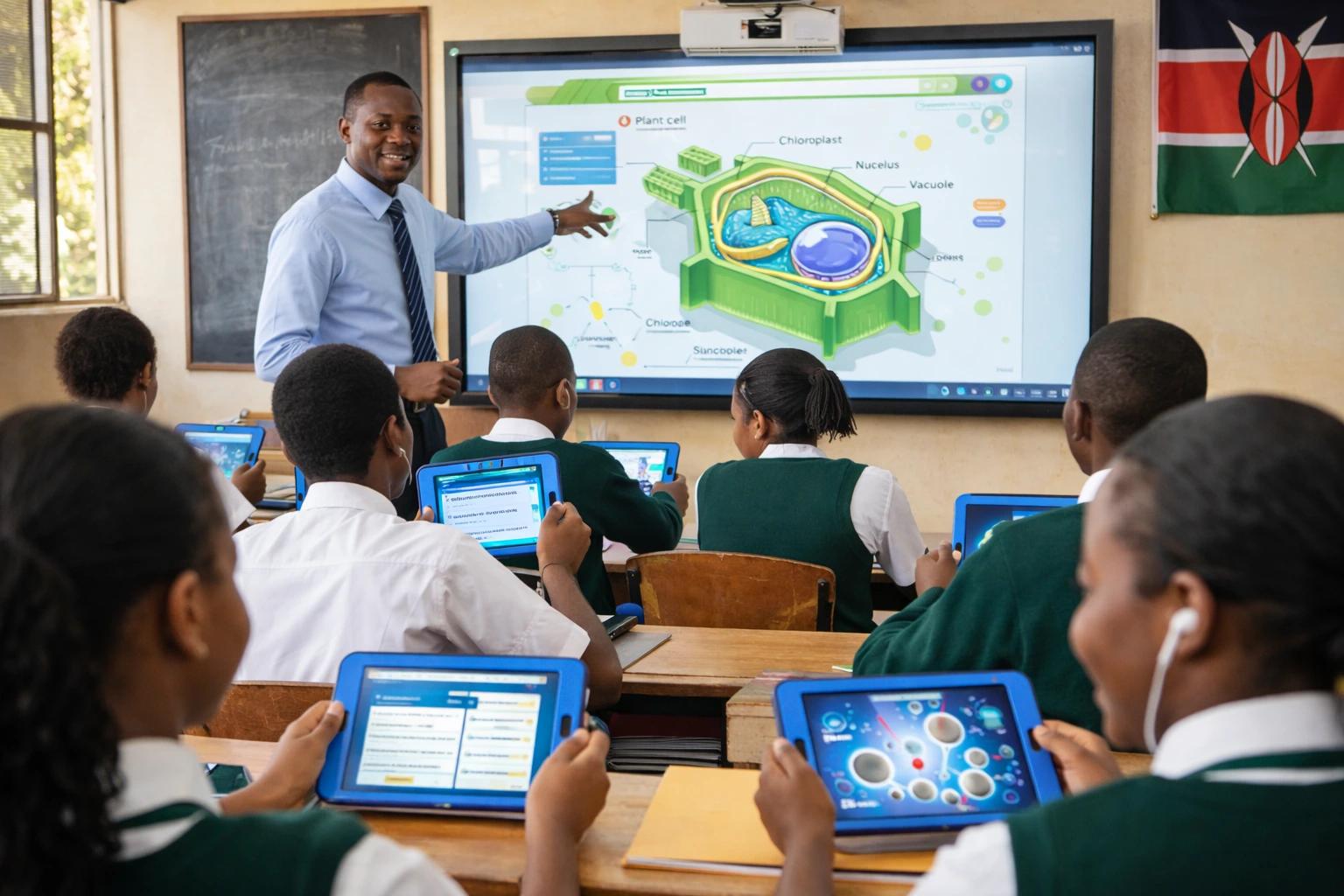
One of the most exciting aspects of Kenya’s education transformation is the increasing integration of technology into learning.
Digital technologies are becoming central components of educational delivery.
These technologies include:
- Learning Management Systems
- Smart Classrooms
- Artificial Intelligence Tools
- Robotics Kits
- Coding Platforms
- Digital Laboratories
- Educational Simulators
Among these innovations, educational simulators are emerging as some of the most transformative tools available.
What Are Educational Simulators?
Educational simulators are computer-based systems that replicate real-world environments, processes, and equipment.
They allow learners to practice skills in virtual settings without the risks and costs associated with physical training.
Examples include:
- Flight simulators
- Maritime navigation simulators
- Engineering simulators
- Medical simulators
- Industrial process simulators
These tools provide highly realistic learning experiences that bridge the gap between theory and practice.
Why Simulators Matter in Modern Education
Traditional teaching methods often struggle to provide practical exposure in highly technical fields.
For example:
Teaching aviation using textbooks alone cannot fully convey the experience of piloting an aircraft.
Similarly, explaining maritime navigation on a chalkboard cannot replicate the challenges of navigating a vessel through changing weather conditions.
Simulators solve this problem by creating immersive learning environments.
Students can:
- Practice repeatedly
- Learn from mistakes
- Build confidence
- Develop technical skills
All within a safe and controlled environment.
Kenya’s Opportunity
The increasing availability of affordable digital technologies creates an unprecedented opportunity for Kenya.
Schools that once lacked access to expensive technical equipment can now leverage:
- Virtual Reality
- Artificial Intelligence
- Cloud Computing
- Simulation Software
to provide world-class learning experiences.
This democratization of technology has the potential to reduce educational inequalities and expand opportunities for learners across the country.
Conclusion
Kenya’s transition to Competency-Based Education represents more than a curriculum change—it is a national transformation strategy aimed at preparing young people for the future.
As the country embraces learner-centered education, digital innovation, and practical skills development, educational simulators are emerging as powerful tools that can bridge the gap between classroom learning and real-world application.
The success of this transformation will depend on effective implementation, adequate infrastructure, teacher preparedness, and sustained investment in educational technology.
In the next chapter, we will examine the limitations of the 8-4-4 system and explore why Kenya decided to replace one of Africa’s most recognizable education models with Competency-Based Education.
Chapter 1: Introduction to Kenya’s Education Transformation
How Senior School Simulators Are Redefining Kenya’s Competency-Based Education (CBE)
Introduction
Kenya is currently experiencing one of the most significant educational transformations in its history. For decades, the country’s education system was built around the well-known 8-4-4 structure, which emphasized academic achievement, examination performance, and theoretical knowledge. While the system produced many successful professionals and contributed significantly to national development, it also faced criticism for placing excessive emphasis on memorization and examination results rather than practical skills and competencies.
The introduction of the Competency-Based Education (CBE) system marks a bold shift from traditional learning methods toward a more practical, learner-centered, and skills-oriented approach. Unlike the previous system, CBE focuses on what learners can actually do with the knowledge they acquire rather than simply measuring their ability to recall information during examinations.
Kenya’s Education Transformation


The transformation comes at a critical time when the world is rapidly changing due to technological advancements, globalization, artificial intelligence, automation, and the emergence of new industries. The skills required by employers today are vastly different from those demanded twenty years ago.
Modern workplaces increasingly seek individuals who can:
- Solve problems creatively
- Think critically
- Communicate effectively
- Collaborate in teams
- Adapt to new technologies
- Innovate continuously
Recognizing these changes, Kenya has embarked on an ambitious journey to reform its education system to prepare learners for the demands of the twenty-first century.
Why Education Systems Must Evolve
Education systems around the world are constantly evolving because societies themselves are changing.
The Agricultural Era
In traditional societies, education focused on survival skills such as:
- Farming
- Animal husbandry
- Hunting
- Craftsmanship
- Leadership
Knowledge was passed from one generation to another through observation and apprenticeship.
The Industrial Era
As industrialization spread across the world, education shifted toward producing workers who could operate machines and work efficiently in factories.
Schools emphasized:
- Discipline
- Literacy
- Numeracy
- Standardized procedures
The Information Age
The rise of computers and the internet transformed economies worldwide.
Success increasingly depended on:
- Digital literacy
- Innovation
- Communication
- Creativity
Evolution of Education Through Time


Today, the world is experiencing the Fourth Industrial Revolution (4IR), characterized by technologies such as:
- Artificial Intelligence (AI)
- Robotics
- Internet of Things (IoT)
- Virtual Reality (VR)
- Augmented Reality (AR)
- Automation
- Biotechnology
These technologies are transforming industries and creating entirely new career pathways.
Kenya’s Educational Journey
The 7-4-2-3 System
Before the introduction of 8-4-4, Kenya used the 7-4-2-3 system:
- 7 years primary education
- 4 years lower secondary
- 2 years upper secondary
- 3 years university
Although effective in some respects, it eventually faced criticism for limited access to higher education.
The 8-4-4 System
Introduced in 1985, the 8-4-4 system sought to provide practical skills and broader educational opportunities.
The structure consisted of:
- 8 years primary education
- 4 years secondary education
- 4 years university education
Initially, learners studied practical subjects such as:
- Agriculture
- Home Science
- Woodwork
- Metalwork
- Business Education
- Art and Design
However, examination pressure gradually transformed many schools into examination preparation centers.
Traditional 8-4-4 Learning Environment


As national examinations became increasingly important, teachers focused heavily on:
- Memorization
- Content coverage
- Revision drills
- Examination techniques
While this improved examination performance, it often limited innovation, creativity, and practical skill development.
Why Kenya Needed Educational Reform
Several factors contributed to the shift toward Competency-Based Education.
1. Skills Mismatch
Many employers reported that graduates possessed academic certificates but lacked workplace competencies.
Common concerns included:
- Weak communication skills
- Limited problem-solving abilities
- Insufficient practical experience
- Lack of innovation
2. Youth Unemployment
Every year, thousands of young people entered the job market with qualifications but struggled to secure employment.
Industries increasingly demanded:
- Technical skills
- Digital competencies
- Workplace readiness
- Entrepreneurial abilities
3. Technological Advancement
Rapid technological change requires workers who can adapt to emerging tools and systems.
Traditional teaching methods alone are no longer sufficient.
Students need exposure to:
- Artificial Intelligence
- Robotics
- Coding
- Automation
- Data Analysis
Future Careers Driven by Technology


Introduction of Competency-Based Education (CBE)
Competency-Based Education was designed to address the limitations of traditional education systems.
The central philosophy is:
Education should focus on developing competencies rather than merely transmitting content.
A competency combines:
- Knowledge
- Skills
- Values
- Attitudes
Under CBE, learners are assessed based on what they can do rather than simply what they can remember.
Core Principles of CBE
Learner-Centered Learning
Students actively participate in learning through:
- Research
- Experiments
- Projects
- Collaboration
- Innovation
Practical Application
Learners solve real-world problems and develop solutions.
Examples include:
- Designing prototypes
- Conducting scientific investigations
- Building digital projects
- Creating business models
Continuous Assessment
Instead of relying solely on final examinations, teachers evaluate learners continuously through:
- Projects
- Presentations
- Portfolios
- Practical activities
Competency-Based Learning in Action


Understanding Senior School Under CBE
Senior School introduces specialized pathways that allow learners to pursue their interests and talents.
STEM Pathway
Focuses on:
- Science
- Technology
- Engineering
- Mathematics
Potential careers include:
- Engineering
- Aviation
- Medicine
- Architecture
- Information Technology
- Robotics
Social Sciences Pathway
Focuses on:
- Economics
- Business Studies
- Languages
- Humanities
Potential careers include:
- Law
- Journalism
- Public Administration
- Diplomacy
Arts and Sports Science Pathway
Focuses on:
- Performing Arts
- Creative Arts
- Sports Science
Potential careers include:
- Professional Sports
- Film Production
- Music
- Design
Senior School Pathways


The Rise of Educational Simulators
One of the most exciting innovations within Senior School is the introduction of educational simulators.
These computer-based systems replicate real-world environments and allow learners to gain practical experience without the costs and risks associated with physical training facilities.
Examples include:
- Flight simulators
- Maritime simulators
- Engineering simulators
- Medical simulators
- Industrial process simulators
Modern Educational Simulators


Through simulation technology, a learner can experience piloting an aircraft, navigating a ship, operating industrial machinery, or troubleshooting engineering systems while sitting inside a classroom.
This represents a revolutionary shift from traditional theory-based learning.
Kenya’s Opportunity in the Digital Age
The increasing affordability of digital technologies presents a unique opportunity for Kenya.
Through:
- Artificial Intelligence
- Virtual Reality
- Cloud Computing
- Educational Simulators
- Smart Classrooms
schools can provide world-class learning experiences regardless of their geographical location.
A student in a rural school can potentially access the same simulation-based training as a learner in a major urban institution.
This democratization of technology could significantly reduce educational inequality while improving workforce readiness.
The Future of Kenyan Education

Conclusion
Kenya’s transition to Competency-Based Education represents far more than a curriculum change. It is a national strategy aimed at preparing young people for a future shaped by technology, innovation, and global competition.
As educational simulators, artificial intelligence, virtual reality, and practical skills training become integrated into Senior School learning, Kenya is positioning itself to produce graduates who are not only knowledgeable but also highly competent and industry-ready.
The next chapter explores why the 8-4-4 system was replaced and examines the specific educational challenges that prompted the shift toward Competency-Based Education.
About the Author

Related posts:
From 8-4-4 to CBE – Why Kenya Decided to Change Its Education System

Why Competency-Based Education (CBE) Is Reshaping Learning in Kenya

Junior Secondary School (JSS) Career Paths: How the ST Grading Framework Solves the JSS Dilemma
A Step-by-Step Guide to KEMIS Onboarding for All Roles