
Introduction
Choosing secondary schools is one of the most important decisions for Grade 9 learners transitioning to Senior School. The schools selected today can greatly influence a learner’s academic growth, career opportunities, exposure, and future success.
The Ministry of Education allows learners to select 12 schools during the placement process. Making informed choices ensures that every learner has a better chance of joining a school that matches their abilities, interests, and aspirations.
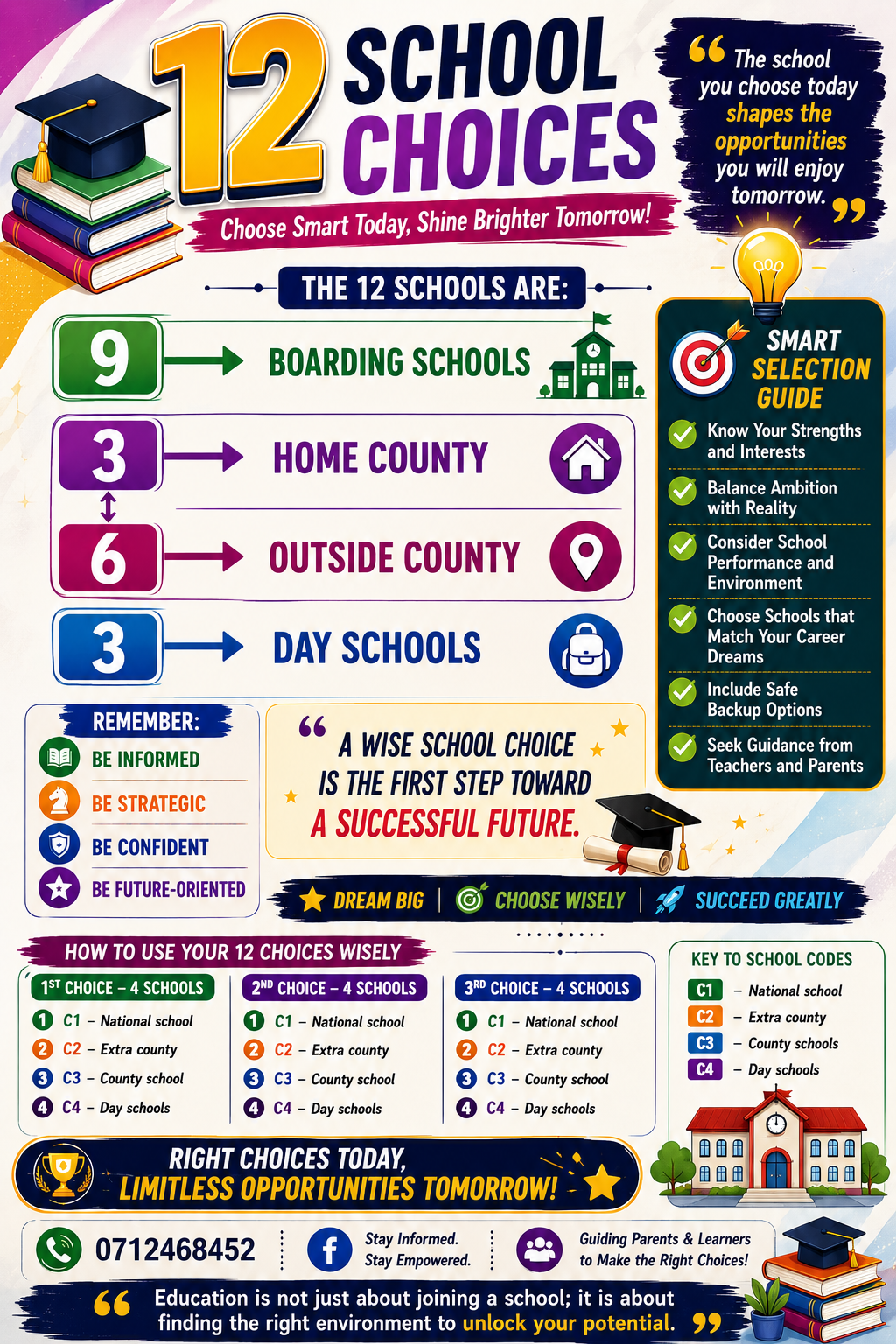
“Choose Smart Today, Shine Brighter Tomorrow.”
Understanding the 12 School Choices
The 12 schools are distributed as follows:
- 9 Boarding Schools
- 3 Home County Schools
- 6 Outside County Schools
- 3 Day Schools
This balanced selection system gives learners an opportunity to access schools within and outside their counties while also providing backup options.
1. Boarding Schools (9 Schools)
Boarding schools provide learners with:
- Better study environments
- Wider exposure and networking opportunities
- Access to diverse co-curricular activities
- Enhanced discipline and independence
Parents should consider:
- School performance trends
- Available pathways and subjects
- School culture and discipline
- Distance from home
- Affordability
2. Home County Schools (3 Schools)
These are schools located within the learner’s county.
Benefits include:
- Reduced transport costs
- Easier parental monitoring
- Familiar environment and culture
- Lower adjustment challenges
Home county schools are ideal for learners who prefer studying closer to home.
3. Outside County Schools (6 Schools)
Selecting schools outside the county offers learners opportunities to:
- Experience different cultures
- Access specialized facilities and programs
- Increase chances of placement in competitive institutions
Learners should research schools carefully before selecting them.
4. Day Schools (3 Schools)
Day schools serve as important backup options.
Advantages include:
- Lower school expenses
- Strong family support systems
- Reduced boarding-related challenges
Parents are encouraged not to ignore day schools since many continue to perform exceptionally well academically.
How to Choose Schools Wisely
1. Know Your Strengths and Interests
Learners should select schools that align with:
- Academic abilities
- Talents and passions
- Preferred career pathways
For example:
- Learners interested in Medicine may prefer schools with strong STEM programs.
- Those interested in Business, Education, Journalism, or Law should consider schools with strong Social Sciences pathways.
- Learners interested in Music, Sports, Theatre, or Fine Arts should select schools with strong Arts and Sports programs.
2. Balance Ambition with Reality
While every learner may dream of joining top national schools, it is important to include schools across different categories.
A balanced list increases placement chances.
3. Consider School Performance and Environment
Parents should investigate:
- KCSE performance trends
- Discipline records
- Availability of laboratories and facilities
- Teacher-student support systems
- Co-curricular achievements
A good school environment contributes significantly to learner success.
4. Match Schools with Career Dreams
Different schools have varying strengths.
Consider schools that support pathways such as:
STEM Pathway
- Engineering
- Medicine
- ICT
- Agriculture
- Aviation
Social Sciences Pathway
- Business Studies
- Law
- Education
- Journalism
Arts and Sports Science Pathway
- Music
- Theatre Arts
- Sports Science
- Fine Arts
5. Include Safe Backup Options
One of the biggest mistakes parents make is selecting only highly competitive schools.
Always include:
- County schools
- Extra-county schools
- Day schools
This ensures the learner secures placement even if highly competitive choices are unavailable.
Recommended School Selection Strategy
First Choice Category (4 Schools)
- National School (C1)
- Extra County School (C2)
- County School (C3)
- Day School (C4)
Second Choice Category (4 Schools)
- National School (C1)
- Extra County School (C2)
- County School (C3)
- Day School (C4)
Third Choice Category (4 Schools)
- National School (C1)
- Extra County School (C2)
- County School (C3)
- Day School (C4)
This approach creates a balanced and strategic selection process.
Understanding School Codes
| Code | Category |
|---|---|
| C1 | National Schools |
| C2 | Extra County Schools |
| C3 | County Schools |
| C4 | Day Schools |
Understanding these categories helps parents and learners make informed decisions during school selection.
Important Tips for Parents and Learners
Be Informed
Research every school before selecting it.
Be Strategic
Avoid choosing schools randomly.
Be Confident
Trust your learner’s abilities and potential.
Be Future-Oriented
Think beyond KCSE and consider long-term career aspirations.
Common Mistakes to Avoid
- Selecting schools based on peer influence.
- Choosing only top national schools.
- Ignoring school pathways and subject offerings.
- Failing to include day schools as backup options.
- Choosing schools without consulting teachers and parents.
Final Thoughts
The secondary school selection process is more than just filling out forms; it is about shaping a learner’s future.
Parents, teachers, and learners should work together to make informed and strategic choices.
Right Choices Today, Limitless Opportunities Tomorrow.
Education is not simply about joining any school; it is about finding the right environment where every learner can unlock their full potential and build a successful future.
Need guidance on school selection and career pathways?
Contact: 0712468452
Dream Big | Choose Wisely | Succeed Greatly
About the Author

Related posts:
TSC Projected Salary scale Notches Effective July 2026 Under CBA Phase II

Best Machakos County Senior Schools {C1 National, C2 Extra-County, C3 County and C4 Sub-County
Best Baringo County Senior Schools (2025 Guide): C1 National, C2 Extra-County, C3 County and C4 Sub-...

How to Check 2025 KCSE Results Online free and Via SMS