
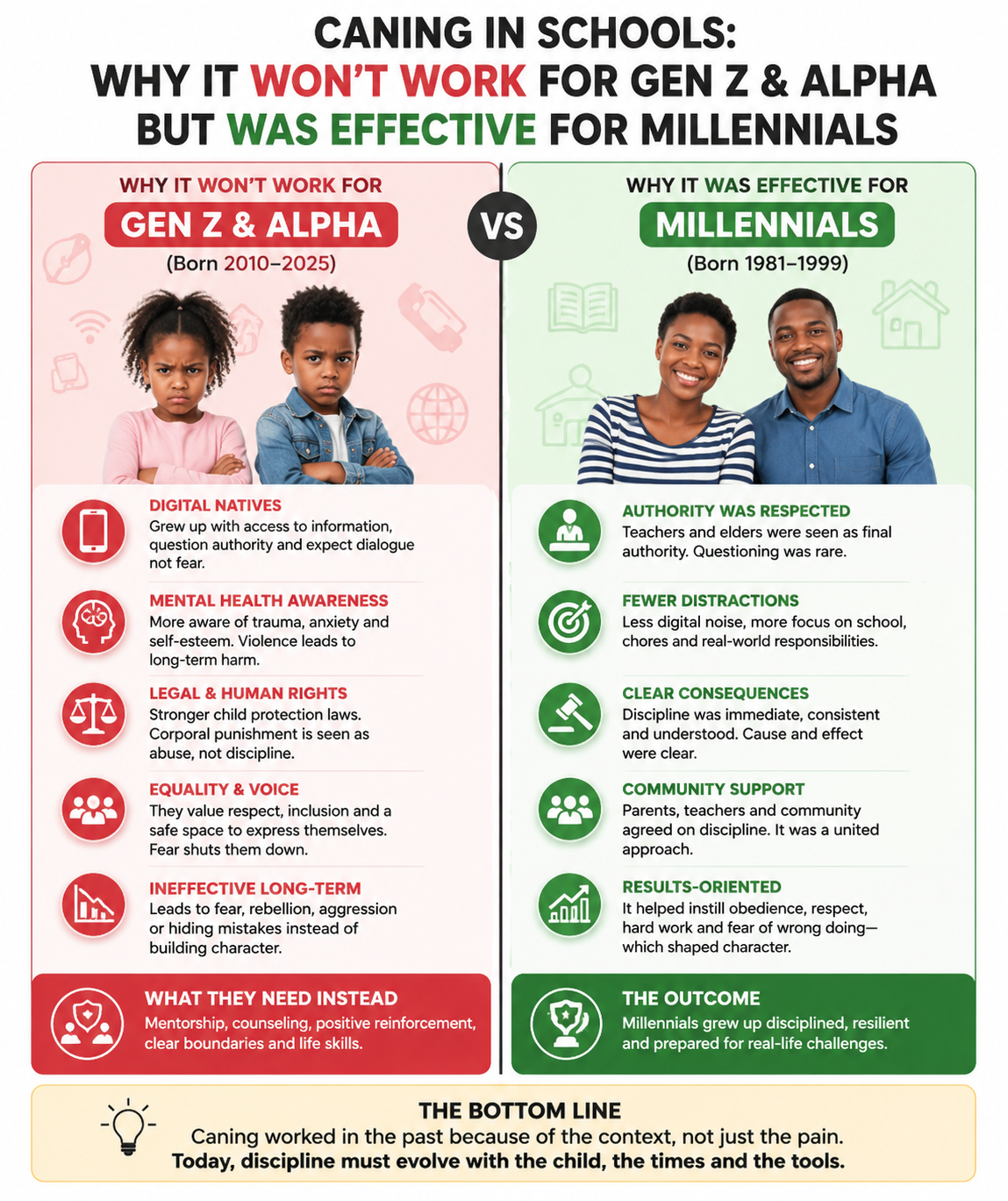
For decades, corporal punishment was deeply embedded in educational systems across Africa. From rural primary schools to urban secondary institutions, caning was widely accepted as a legitimate method of maintaining order, enforcing discipline, and shaping character.
Many parents, teachers, and community leaders still argue that strict disciplinary measures helped raise responsible adults. They often point to their own experiences and those of Millennials as evidence that caning promoted respect, obedience, and resilience.
However, education does not exist in isolation. Schools evolve alongside society, and today’s learners are growing up in a world that differs significantly from the one their parents experienced.
Generation Z, born between approximately 1997 and 2012, and Generation Alpha, born from 2013 onward, are entering classrooms shaped by digital technology, changing family structures, increased awareness of mental health, and stronger child protection laws.
As African education systems adopt competency-based curricula and prepare learners for a rapidly changing global economy, an important question emerges: Can disciplinary approaches designed for previous generations effectively serve today’s students?
The conversation is no longer about whether caning was common in the past. Instead, it is about whether corporal punishment remains relevant, effective, and appropriate in modern African classrooms.
Understanding Why Many Millennials Viewed Caning as Effective
To understand current debates surrounding corporal punishment, it is important to consider the context in which many African Millennials grew up.
For previous generations, school discipline operated within a broader social framework that emphasized respect for authority and collective responsibility.
A Shared Community Approach to Discipline
The African proverb, “It takes a village to raise a child,” reflected a widely accepted social reality. Parents, teachers, religious leaders, and elders often held similar views about acceptable behavior and appropriate consequences.
Children received consistent messages about discipline at home, at school, and within their communities. This alignment created a unified system of expectations.
Strong Respect for Authority Figures
In many African societies, teachers occupied positions of significant authority and respect. Questioning adults was often viewed as disrespectful, and compliance with instructions was expected.
As a result, disciplinary actions—including caning—were rarely challenged by learners or parents.
Limited Exposure to External Influences
Unlike today’s students, Millennials grew up before the widespread adoption of smartphones, social media, and instant internet access.
Their understanding of discipline was largely shaped by local cultural norms rather than global conversations about children’s rights, mental health, and educational psychology.
Limited Awareness of Mental Health
Conversations about emotional wellbeing, trauma, anxiety, and child development were less common in schools and households.
Many learners were expected to endure difficult experiences without openly discussing their emotional impact.
Looking Beyond Nostalgia
While some adults remember caning as an effective disciplinary measure, others recall experiences of fear, humiliation, resentment, and emotional distress.
Research increasingly suggests that compliance achieved through fear does not necessarily translate into genuine self-discipline or positive character development.
The fact that many individuals succeeded despite corporal punishment does not automatically mean they succeeded because of it.
Why Corporal Punishment Struggles in Modern African Classrooms
Today’s learners experience the world differently from previous generations.
Applying disciplinary methods designed for the social realities of the 1980s and 1990s to students in the 2020s creates significant challenges.
Generation Z and Alpha Are Digital Natives
Modern learners have access to information at an unprecedented scale.
Through smartphones, social media platforms, and online communities, they engage with global perspectives on education, rights, identity, and personal wellbeing.
These generations are more likely to question decisions, seek explanations, and expect meaningful dialogue.
Discipline based primarily on fear often clashes with their expectations for communication and mutual respect.
Greater Awareness of Mental Health and Wellbeing
Across Africa, conversations about mental health are becoming more visible in schools, communities, and public policy.
Educational psychologists increasingly recognize that harsh disciplinary methods can negatively affect learners’ emotional wellbeing.
Studies have linked corporal punishment to several adverse outcomes, including:
– Increased anxiety and chronic stress
– Reduced self-esteem and confidence
– Higher levels of aggression
– Greater likelihood of avoidance behavior
– Lower academic engagement
– Damaged teacher-student relationships
Students learn best in environments where they feel physically and emotionally safe.
Fear may produce short-term compliance, but it rarely fosters long-term motivation or responsible decision-making.
Stronger Child Protection Frameworks
Many African countries have introduced laws and policies that strengthen children’s rights and prohibit corporal punishment in schools.
Regional and international frameworks, including the African Charter on the Rights and Welfare of the Child, continue to influence educational policy across the continent.
As legal expectations evolve, schools must adopt disciplinary approaches that protect learners while maintaining high standards of behavior.
Failure to comply with child protection regulations can expose institutions to legal and reputational risks.
Competency-Based Education Requires Different Approaches
Many African education systems are shifting toward competency-based learning models that emphasize:
– Critical thinking
– Creativity
– Collaboration
– Communication
– Problem-solving
– Emotional intelligence
These competencies flourish in environments where learners feel safe to ask questions, share ideas, make mistakes, and participate actively.
Fear-based discipline can discourage curiosity and inhibit the development of essential twenty-first-century skills.
Traditional Discipline Versus Positive Discipline
Traditional disciplinary systems often focus on punishment for past mistakes.
Positive discipline, on the other hand, focuses on helping learners develop the skills necessary to make better decisions in the future.
Traditional Discipline| Positive Discipline
Focuses on punishment| Focuses on learning and growth
Relies on fear and external control| Builds internal self-regulation
Emphasizes obedience| Encourages responsibility
Damages trust relationships| Strengthens communication
Produces short-term compliance| Promotes long-term behavior change
Positive discipline does not mean lowering standards or tolerating misconduct.
Instead, it involves holding students accountable in ways that promote learning, responsibility, and personal growth.
Effective Alternatives to Caning in African Schools
Many schools across Africa are successfully implementing evidence-based approaches that maintain order while supporting learner wellbeing.
Restorative Practices
Restorative approaches encourage learners to understand how their actions affect others and to take responsibility for repairing harm.
Instead of focusing solely on punishment, restorative conversations promote empathy, accountability, and conflict resolution.
Social-Emotional Learning
Social-emotional learning equips students with essential life skills, including:
– Self-awareness
– Emotional regulation
– Empathy
– Communication
– Responsible decision-making
These skills help learners manage behavior more effectively both inside and outside the classroom.
Positive Reinforcement
Recognizing and rewarding appropriate behavior encourages students to repeat positive actions.
Simple strategies such as praise, recognition systems, and leadership opportunities can significantly improve school culture.
Clear Rules and Consistent Expectations
Students perform better when expectations are clearly communicated and consequences are fair, predictable, and consistently applied.
Consistency builds trust and reduces confusion.
Guidance, Counseling, and Mentorship
Behavioral challenges often reflect underlying issues such as stress, family difficulties, peer pressure, or emotional struggles.
Providing access to counseling and mentorship enables schools to address the root causes of misconduct rather than simply punishing symptoms.
Strong Parent-Teacher Partnerships
Effective discipline requires collaboration between schools and families.
Regular communication helps parents and teachers identify concerns early and develop consistent support strategies.
Building Future-Ready Learners
African education systems face the important task of preparing learners for a complex and rapidly changing world.
Tomorrow’s workforce will require individuals who can think critically, collaborate effectively, adapt to change, and solve problems creatively.
These qualities are unlikely to emerge from environments driven by fear and intimidation.
Instead, they develop through supportive relationships, meaningful accountability, and opportunities for personal growth.
Discipline remains an essential pillar of educational success, but the methods used to achieve it must evolve alongside the learners they serve.
Conclusion
The debate over corporal punishment in African schools often reflects a tension between tradition and transformation.
While many adults remember caning as a normal part of their education, modern research and changing social realities suggest that traditional approaches are becoming less effective for Generation Z and Generation Alpha.
What appeared to work for previous generations was shaped by a unique cultural, technological, and social context that no longer exists.
Today’s learners need discipline that teaches responsibility rather than fear, accountability rather than submission, and self-regulation rather than obedience.
By embracing positive discipline strategies, African schools can create safe, inclusive learning environments that nurture emotionally intelligent, resilient, and globally competitive citizens.
The future of education in Africa depends not on preserving outdated practices, but on developing approaches that prepare learners for the challenges and opportunities of the twenty-first century.
About the Author

Related posts:
List of Senior School Subjects & Subject Combinations (Grades 10, 11 & 12 – CBC Kenya)

. BASIC INFRASTRUCTURE FOR SENIOR SCHOOL

Grade 10 Competency-Based Assessments (CBA) in Kenya: Complete Guide for Teachers and Principals (20...

Junior Secondary School (JSS) Career Paths: How the ST Grading Framework Solves the JSS Dilemma