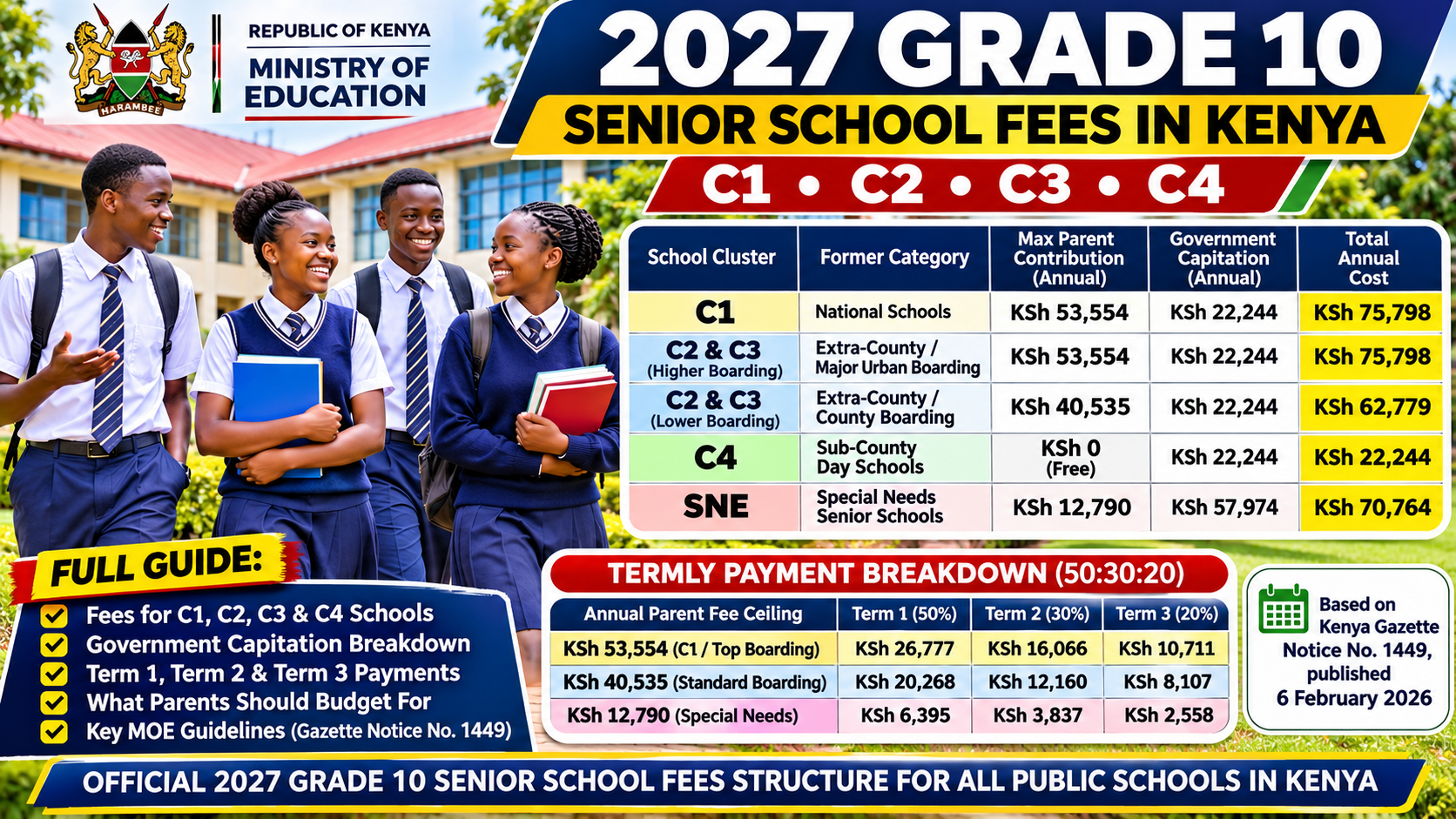
Parents preparing for the 2027 Grade 10 admission exercise can now use the government’s published senior school fees structure to plan for their children’s transition to senior secondary education. The Ministry of Education has established a standardised framework governing government capitation, parental contributions, boarding fees and school operational expenses in public senior schools.
Under the Competency-Based Education (CBE) system, public senior schools are organised into four clusters: Cluster 1 (C1), Cluster 2 (C2), Cluster 3 (C3) and Cluster 4 (C4). The new classification replaces the traditional National, Extra-County, County and Sub-County school labels used under the previous education system.
The financial arrangements for these institutions are particularly important as thousands of learners prepare to join Grade 10 and begin specialised learning under the three senior school pathways: STEM, Social Sciences, and Arts and Sports Science.
Through Kenya Gazette Notice No. 1449, published on 6 February 2026, Education Cabinet Secretary Julius Migos Ogamba issued the official fees structure for all public senior schools in Kenya. The guidelines took effect on 5 January 2026 and apply to learners under both the Competency-Based Education and the remaining 8-4-4 system.
Under the published arrangement, the government provides KSh 22,244 annually for an ordinary public senior school learner. Parents in boarding schools contribute according to the institution’s previously approved fee ceiling, while public day senior schools have a zero parental contribution for the gazetted school fees.
The highest annual parental contribution for ordinary public boarding schools is KSh 53,554, while the lower approved ceiling is KSh 40,535.
For Special Needs Education (SNE) senior schools, parents contribute a maximum of KSh 12,790, with the government providing KSh 57,974.
This article explains the complete 2027 Grade 10 school fees structure, government capitation, C1–C4 school classification, termly payment schedules, boarding charges and the rules schools must follow when demanding payments from parents.
2027 Grade 10 School Fees in Kenya: Quick Summary
Parents looking for the latest Grade 10 school fees in Kenya should understand the following annual amounts.
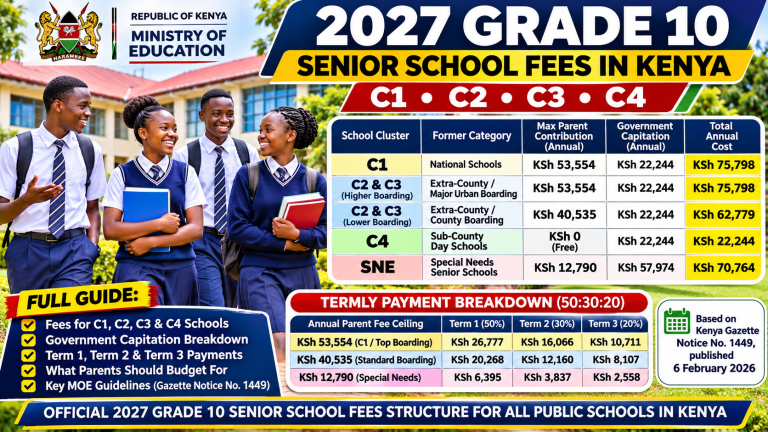
| Public senior school category | Government capitation | Maximum parent contribution | Total annual allocation |
|---|---|---|---|
| Higher-ceiling boarding schools | KSh 22,244 | KSh 53,554 | KSh 75,798 |
| Lower-ceiling boarding schools | KSh 22,244 | KSh 40,535 | KSh 62,779 |
| Public day senior schools | KSh 22,244 | KSh 0 | KSh 22,244 |
| Special Needs senior schools | KSh 57,974 | KSh 12,790 | KSh 70,764 |
Important: These are annual figures. The total annual allocation includes the government’s contribution and the maximum approved parental contribution. It does not mean parents should pay the entire combined amount.
The figures are maximum ceilings, not compulsory minimum charges. Schools previously approved to charge lower amounts are encouraged to maintain their existing rates.
1. New C1, C2, C3 and C4 Senior School Classification in Kenya
The introduction of the senior school system under CBE has brought changes to how public secondary schools are organised and identified.
Instead of relying on the former National, Extra-County, County and Sub-County classifications, the new system uses four clusters.
The clusters help organise the senior school network and provide a framework for placement, school capacity and the provision of learning opportunities.
Cluster 1 (C1) Senior Schools
C1 institutions include highly competitive senior schools, many of which were previously identified as national schools.
These schools attract learners from different parts of the country and generally have extensive educational facilities and established academic programmes.
Parents considering C1 schools should check the institution’s boarding status, approved fee ceiling, available pathways and subject combinations.
Cluster 2 (C2) Senior Schools
C2 institutions provide additional opportunities for learners seeking senior school admission in schools with established educational facilities.
Some institutions previously classified as Extra-County schools fall within this cluster.
Parents should confirm the applicable fee category with the individual school rather than assuming that all C2 institutions charge the same amount.
Cluster 3 (C3) Senior Schools
C3 schools serve learners from different communities and regions.
Many institutions previously classified as County schools are represented in this category.
Their suitability depends on the pathways offered, available facilities, subject combinations and the learner’s educational interests.
Cluster 4 (C4) Senior Schools
C4 schools are mainly associated with day-school provision and local access to senior school education.
These institutions are particularly important in expanding access to Grade 10 education and reducing the financial burden associated with boarding school attendance.
Under the gazetted fee structure, public day senior schools have no parental contribution towards the approved school fees.
Does the school cluster determine the exact amount parents pay?
Parents should distinguish between school classification and the gazetted financial arrangements.
Gazette Notice No. 1449 identifies boarding schools by their previously approved maximum fee ceilings of KSh 53,554 and KSh 40,535. It does not itself establish a universal cluster-by-cluster fee assignment.
Consequently, parents should confirm the school’s actual approved fee category before making payments.
2. C1 Senior School Fees in Kenya for 2027
Cluster 1 schools remain among the most sought-after institutions in the senior school placement exercise.
Many parents expect these institutions to have higher operational and boarding requirements because of their facilities, student population and educational programmes.
For a boarding institution previously approved to charge the maximum KSh 53,554 parental contribution, the annual financial arrangement is as follows:
| Description | Amount |
|---|---|
| Government capitation | KSh 22,244 |
| Parent contribution | KSh 53,554 |
| Total annual allocation | KSh 75,798 |
The maximum annual amount payable by parents under this category is KSh 53,554.
The government contributes the remaining KSh 22,244 towards the approved school vote heads.
However, parents should not automatically assume that every C1 school charges the maximum amount. The applicable approved fee structure must be confirmed with the institution.
3. C2 and C3 Senior School Fees for 2027
C2 and C3 schools provide important opportunities for learners joining senior school under the CBE system.
Their fees depend on the institution’s approved boarding category.
The Gazette Notice provides two main boarding fee ceilings.
Higher-ceiling boarding category
| Description | Amount |
|---|---|
| Government contribution | KSh 22,244 |
| Maximum parent contribution | KSh 53,554 |
| Total allocation | KSh 75,798 |
Lower-ceiling boarding category
| Description | Amount |
|---|---|
| Government contribution | KSh 22,244 |
| Maximum parent contribution | KSh 40,535 |
| Total allocation | KSh 62,779 |
Parents should obtain the approved fee structure from the school to establish which category applies.
The government has also directed schools charging below the published ceilings to maintain their existing rates.
4. C4 Day Senior Schools: Parents to Pay Zero School Fees
One of the most significant provisions in the 2026 senior school fees structure concerns public day schools.
Under the gazetted framework, the government covers the entire approved operational allocation for public day senior schools.
Parents therefore have a zero contribution towards the gazetted school fees.
The annual funding arrangement is:
| Description | Amount |
|---|---|
| Government capitation | KSh 22,244 |
| Parent contribution | KSh 0 |
| Total annual allocation | KSh 22,244 |
This arrangement supports the government’s commitment to expanding access to affordable basic education.
However, parents should understand the distinction between school fees and personal requirements.
Families may still need to budget for:
- School uniforms and shoes.
- Personal clothing and toiletries.
- Transport to and from school.
- Lunch arrangements, where applicable.
- Other personal requirements specified in the approved admission instructions.
A school should not introduce unauthorised compulsory tuition or operational levies contrary to the gazetted structure.
The zero parental contribution is particularly important for households seeking affordable Grade 10 placement options.
5. Special Needs Senior Schools Fees Structure for 2027
The government has provided a separate financial arrangement for public senior schools serving learners with special educational needs.
These institutions receive additional government support to cater for specialised learning and learner support requirements.
The annual allocation is:
| Description | Amount |
|---|---|
| Government contribution | KSh 57,974 |
| Parent contribution | KSh 12,790 |
| Total annual allocation | KSh 70,764 |
The parental contribution is allocated towards boarding equipment and stores and maintenance and improvement.
The government covers teaching and learning materials, medical and insurance, co-curricular activities, administration, SMASSE and the specialised top-up allocation.
This arrangement recognises the additional resources required to support learners with special educational needs.
6. Grade 10 School Fees: Term 1, Term 2 and Term 3 Payment Breakdown
One of the most important requirements under Gazette Notice No. 1449 is the distribution of parental contributions across the three school terms.
Schools are required to spread the annual parental contributions using a 50:30:20 ratio.
This means:
- Term 1: 50% of annual parental fees.
- Term 2: 30% of annual parental fees.
- Term 3: 20% of annual parental fees.
The arrangement is intended to make school fee payments more predictable for parents.
A. Termly fees for boarding schools charging KSh 53,554
| School term | Percentage | Amount |
|---|---|---|
| Term 1 | 50% | KSh 26,777 |
| Term 2 | 30% | KSh 16,066 |
| Term 3 | 20% | KSh 10,711 |
| Annual total | 100% | KSh 53,554 |
Parents whose children join institutions under the higher approved ceiling should use this schedule when planning their annual school fees.
B. Termly fees for boarding schools charging KSh 40,535
| School term | Percentage | Amount |
|---|---|---|
| Term 1 | 50% | KSh 20,268 |
| Term 2 | 30% | KSh 12,160 |
| Term 3 | 20% | KSh 8,107 |
| Annual total | 100% | KSh 40,535 |
The figures are rounded to whole shillings to ensure that the three instalments add up to the exact annual parental contribution.
C. Termly fees for Special Needs senior schools
| School term | Percentage | Amount |
|---|---|---|
| Term 1 | 50% | KSh 6,395 |
| Term 2 | 30% | KSh 3,837 |
| Term 3 | 20% | KSh 2,558 |
| Annual total | 100% | KSh 12,790 |
Public day senior schools have no parental school fee contribution under the gazetted arrangement.
7. Government Capitation Per Learner: How the KSh 22,244 Is Shared
Many parents know that the government provides KSh 22,244 per ordinary public senior school learner annually. However, understanding how this money is distributed is equally important.
The allocation is divided among several school vote heads.
| Government vote head | Annual allocation |
|---|---|
| Tuition, teaching and learning materials and examinations | KSh 4,144 |
| Medical and insurance | KSh 2,000 |
| Co-curricular activities | KSh 1,500 |
| SMASSE | KSh 200 |
| Administration and other vote heads | KSh 9,400 |
| Maintenance and improvement | KSh 5,000 |
| Total | KSh 22,244 |
Tuition and teaching materials – KSh 4,144
This allocation supports teaching and learning materials, examinations and other approved educational requirements.
Medical and insurance – KSh 2,000
The government allocation supports the medical and insurance vote head for learners.
Co-curricular activities – KSh 1,500
This amount supports co-curricular programmes that contribute to the holistic development of learners.
SMASSE – KSh 200
The Strengthening of Mathematics and Science in Secondary Education programme receives KSh 200 per learner.
Administration and other vote heads – KSh 9,400
This allocation supports approved administrative and other school operational requirements, including learning and teaching materials, EWC and P.E.
Maintenance and improvement – KSh 5,000
The allocation supports school maintenance and improvement of facilities.
The government funding is intended to ensure that essential operational requirements are supported through the approved education financing framework.
8. Breakdown of Parental Contributions in Boarding Senior Schools
The Gazette Notice also provides a detailed breakdown of how parental contributions should be allocated in public boarding senior schools.
Schools previously approved for KSh 53,554
| Vote head | Government | Parent | Total |
|---|---|---|---|
| Teaching, learning materials and examinations | 4,144 | 0 | 4,144 |
| Boarding equipment and stores | 0 | 30,385 | 30,385 |
| Maintenance and improvement | 5,000 | 2,000 | 7,000 |
| Other vote heads | 9,400 | 20,371 | 29,771 |
| Activity fees | 1,500 | 798 | 2,298 |
| Medical and insurance | 2,000 | 0 | 2,000 |
| SMASSE | 200 | 0 | 200 |
| Total | 22,244 | 53,554 | 75,798 |
Schools previously approved for KSh 40,535
| Vote head | Government | Parent | Total |
|---|---|---|---|
| Teaching, learning materials and examinations | 4,144 | 0 | 4,144 |
| Boarding equipment and stores | 0 | 25,385 | 25,385 |
| Maintenance and improvement | 5,000 | 2,000 | 7,000 |
| Other vote heads | 9,400 | 12,900 | 22,300 |
| Activity fees | 1,500 | 250 | 1,750 |
| Medical and insurance | 2,000 | 0 | 2,000 |
| SMASSE | 200 | 0 | 200 |
| Total | 22,244 | 40,535 | 62,779 |
The figures show that government capitation and parental contributions are intended to cover different components of school expenditure.
Parents should not be required to pay again for vote heads that are already fully covered by government capitation.
9. Can Schools Charge Extra Admission Fees in 2027?
The question of additional school levies is a major concern for parents preparing for Grade 10 admission.
The government has issued a clear directive through Gazette Notice No. 1449.
It states that:
“No public school shall charge tuition fees or any other extra fees or levies contrary to the fees structure stipulated hereinabove.”
The notice further states that schools charging below the published ceilings are encouraged to maintain their rates.
This means that the published maximum parental contribution should not be interpreted as permission for every school to increase its existing fees.
Public senior schools must operate within their approved financial arrangements.
Parents should request clarification where schools demand compulsory payments described as:
- Extra admission fees.
- Unapproved development levies.
- Additional tuition charges.
- Compulsory examination levies outside the approved structure.
- Unapproved infrastructure contributions.
- Additional administrative fees.
- Other compulsory charges that contradict the gazetted framework.
Any future variation to the gazetted fees must be approved by the Cabinet Secretary for Education and published in the Kenya Gazette.
Parents who encounter questionable charges should request written explanations and seek clarification from the relevant Ministry of Education offices.
10. What Should Parents Budget for Grade 10 Admission in 2027?
Although the government has provided a standardised fee structure, parents should understand that the annual parental contribution is not the only possible household expenditure associated with school admission.
Families should plan for personal requirements separately.
The following table provides a simple budgeting guide.
| School category | Maximum annual school contribution | Other expenses to consider |
|---|---|---|
| Higher-ceiling boarding | KSh 53,554 | Uniforms, personal effects and transport |
| Lower-ceiling boarding | KSh 40,535 | Uniforms, personal effects and transport |
| Public day senior school | KSh 0 | Uniforms, lunch, transport and personal effects |
| Special Needs senior school | KSh 12,790 | Personal and learner-specific requirements |
Essential items parents should prepare
Depending on the school’s admission instructions, parents may need to purchase:
- School uniforms.
- School shoes and sports shoes.
- Personal clothing.
- Bedding and personal effects for boarding learners.
- Toiletries and hygiene products.
- Learning materials specified by the school.
- Transport arrangements.
- Other approved personal requirements.
Parents should avoid purchasing unnecessary items before receiving the official joining instructions.
11. How to Choose the Best Senior School for Grade 10
The introduction of the CBE senior school system means that school selection should go beyond traditional academic performance and school reputation.
Parents should consider whether the institution provides the learning opportunities required by the learner.
Check the available senior school pathways
Senior school education is organised around three major pathways:
1. STEM pathway
Science, Technology, Engineering and Mathematics is designed for learners interested in scientific, technological and mathematical careers.
2. Social Sciences pathway
This pathway provides learning opportunities in areas related to humanities, social sciences and related professional fields.
3. Arts and Sports Science pathway
This pathway supports learners interested in creative arts, performance, sports and related professional opportunities.
Parents should confirm the subject combinations offered by the selected school before accepting placement.
Consider school facilities
A suitable senior school should have the necessary facilities to support its approved learning programmes.
These may include:
- Science laboratories.
- Computer laboratories.
- Workshops.
- Libraries.
- Sports facilities.
- Arts and creative learning spaces.
- Adequate classrooms.
- Appropriate boarding facilities.
Consider the learner’s interests and abilities
The best senior school is not necessarily the institution with the highest cluster classification.
Parents should prioritise the learner’s interests, abilities, career ambitions and the subject combinations available at the institution.
12. Will the Grade 10 School Fees Change in 2027?
The current published financial framework is Gazette Notice No. 1449, issued under Sections 28(1) and 29(1) and (2) of the Basic Education Act.
The notice took effect on 5 January 2026 and revoked the previous Gazette Notice No. 1555 of 2015.
It applies to public senior school learners under both CBE and the 8-4-4 systems.
The notice provides that future variations must be approved by the Cabinet Secretary for Education and gazetted accordingly.
Therefore, parents planning for the 2027 academic year should use the published fee structure as their reference unless an official subsequent variation is issued.
It is important to distinguish between proposed fee changes, media reports and legally gazetted changes.
Parents should rely on official Ministry of Education circulars and Kenya Gazette publications when confirming new fees.
13. Frequently Asked Questions About 2027 Grade 10 School Fees in Kenya
How much are Grade 10 school fees in Kenya in 2027?
Under the published fee structure, public day senior schools have a zero parental contribution. Public boarding schools have maximum annual parental contributions of KSh 53,554 or KSh 40,535, depending on the previously approved fee ceiling.
How much does the government pay per Grade 10 learner?
The government provides KSh 22,244 annually for an ordinary public senior school learner.
Are C4 senior schools free?
Public day senior schools have no parental contribution towards the gazetted school fees. The government covers the KSh 22,244 annual allocation.
How much do parents pay in C1 schools?
For a boarding institution under the higher approved ceiling, the maximum annual parental contribution is KSh 53,554.
What is the annual fee for C2 and C3 schools?
The amount depends on the institution’s previously approved fee category. The published boarding ceilings are KSh 53,554 and KSh 40,535.
How much are boarding school fees per term?
For the KSh 53,554 category, the termly contributions are KSh 26,777, KSh 16,066 and KSh 10,711.
For the KSh 40,535 category, the termly contributions are KSh 20,268, KSh 12,160 and KSh 8,107.
How much do parents pay in Special Needs schools?
Parents contribute a maximum of KSh 12,790 annually, while the government provides KSh 57,974.
Can schools increase fees without government approval?
No. Any future variation to the published fee structure must be approved by the Cabinet Secretary for Education and gazetted.
Are the published fees compulsory minimum payments?
No. The figures are maximum ceilings. Schools charging below the ceilings are encouraged to maintain their existing approved rates.
Do parents pay the government capitation directly?
No. Government capitation is a government contribution towards approved school vote heads. Parents pay their applicable approved contribution to the institution through the authorised payment arrangements.
Conclusion: What Every Parent Should Know About 2027 Grade 10 School Fees
The 2027 Grade 10 admission exercise will be an important milestone in the implementation of Competency-Based Education in Kenya.
The government’s published senior school fees structure provides parents with a framework for understanding the financial requirements of public senior school education.
Public day senior schools have a zero parental contribution towards the gazetted school fees, with the government providing KSh 22,244 per learner annually.
For boarding schools, parents contribute a maximum of KSh 53,554 or KSh 40,535, depending on the school’s previously approved fee category.
Special Needs senior schools have a separate arrangement, with parents contributing a maximum of KSh 12,790 while the government provides KSh 57,974.
The 50:30:20 payment arrangement also provides a predictable way of spreading parental contributions across the three school terms.
Most importantly, parents should remember that the published amounts are maximum ceilings, not compulsory minimum payments. Public schools are not permitted to introduce unauthorised additional levies contrary to the gazetted structure.
As Grade 10 admission approaches, parents should confirm their children’s placement, verify the school’s approved fee category, examine the available subject combinations and obtain official joining instructions before making payments.
For more updates on Grade 10 placement, CBE pathways, senior school admission, KJSEA results, school fees, subject combinations, Ministry of Education circulars and education news in Kenya, keep visiting CBC Kenya Hub.
OFFICIAL SOURCE AND REFERENCES
- Kenya Gazette Notice No. 1449, dated 12 January 2026 and published on 6 February 2026.
- Basic Education Act, Cap. 211, Sections 28 and 29.
- Ministry of Education, Senior School Fees Structure.
- Ministry of Education guidelines on implementation of senior school education.
Disclaimer: This article is an educational guide based on the published Gazette Notice. Parents should confirm any subsequent officially gazetted amendments before making financial commitments.
About the Author

Related posts:

20,000 Permanent and Pensionable JSS Teaching Jobs Slated for January 2026
Best Kitui County Senior Schools { C1 National, C2 Extra-County, C3 County and C4 Sub-County
Best Busia County Senior Schools { C1 National, C2 Extra-County, C3 County and C4 Sub-County}

Ministry of Education Releases 2027 National and Post-National Co-Curricular Activities Calendar: Fu...