Kenya’s teaching profession is entering a new era following the announcement of revised Teachers Service Commission (TSC) Career Progression Guidelines (CPG), which replace the 2018 framework.
On November 12, 2026, President William Ruto announced during the Kenya Comprehensive School Heads Association (KECSHA) conference in Mombasa that the Salaries and Remuneration Commission (SRC) had approved the revised guidelines.
The announcement is significant for thousands of public school teachers who have experienced career stagnation, particularly those who have remained in the same job group for years despite acquiring additional qualifications, professional experience and teaching responsibilities.
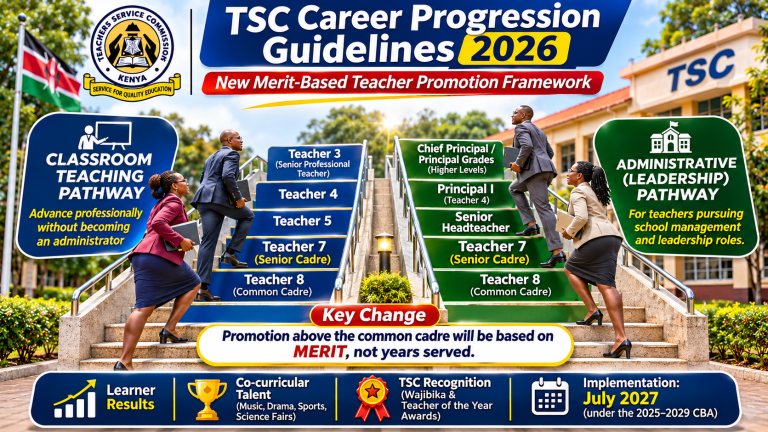
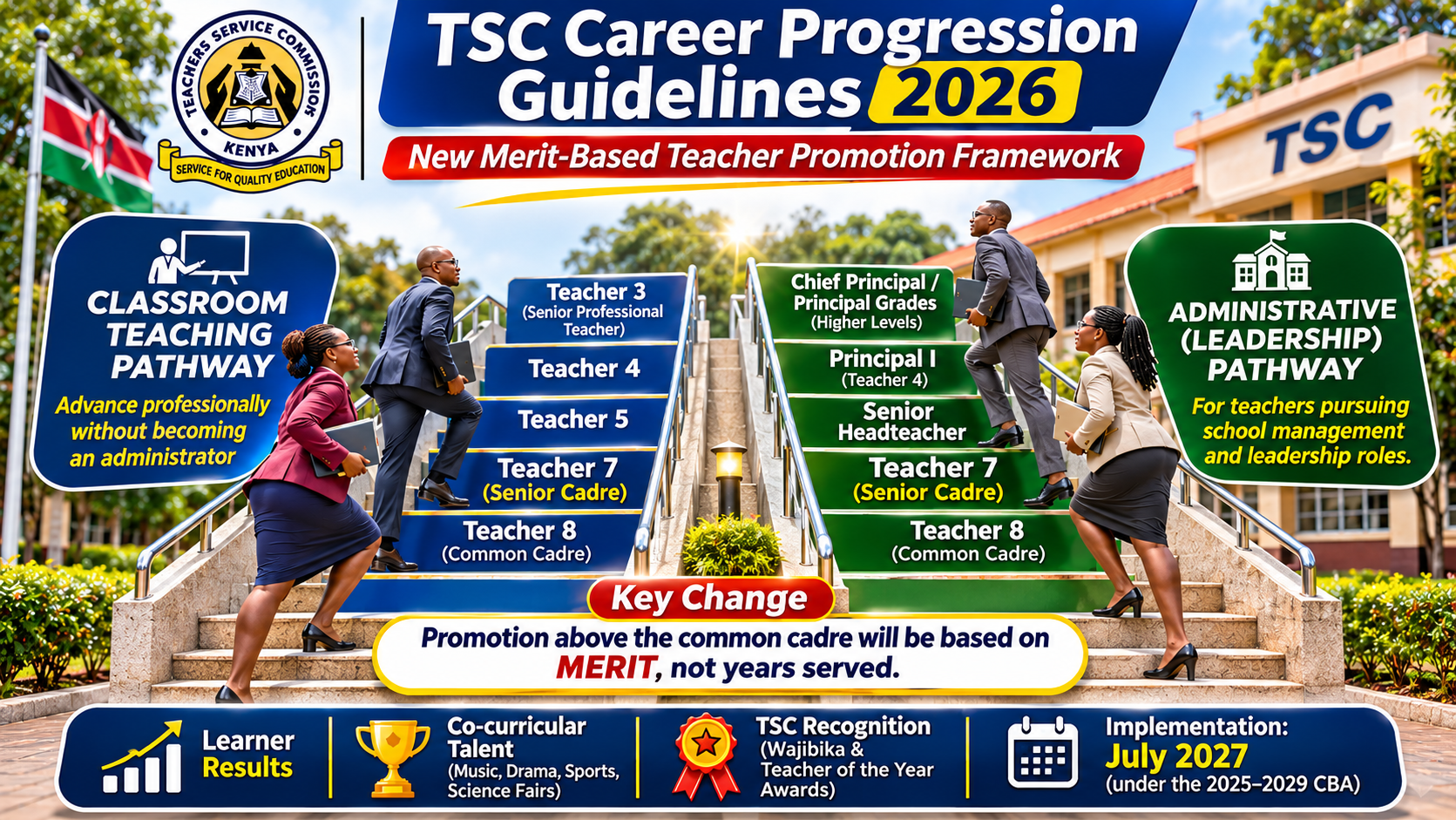
The new framework introduces two major career pathways: classroom teaching and school administration. It also places greater emphasis on professional performance, learner achievement, co-curricular contributions and recognition of excellence.
For teachers seeking TSC promotions, understanding the new grading structure, salary implications, merit-based promotion criteria and implementation timelines will be essential.
This guide explains the reported changes, who stands to benefit, how teacher salaries could be affected and what educators should do before the expected July 2027 implementation.
1. What Are the New TSC Career Progression Guidelines 2026?
The Career Progression Guidelines are the framework used by the Teachers Service Commission to determine how teachers advance through professional grades and administrative positions.
The previous 2018 guidelines established the career structure for teachers serving in public educational institutions.
However, changes in Kenya’s education system, particularly the introduction of Competency-Based Education (CBE), created the need for a revised professional development and promotion framework.
The new guidelines seek to address several longstanding challenges:
- Career stagnation among experienced teachers.
- Limited promotion opportunities due to a shortage of administrative positions.
- Inadequate recognition of classroom teaching expertise.
- The need to recognise professional performance and innovation.
- The need to align teacher career structures with the changing education system.
According to reports following the November 12 announcement, the revised framework creates separate career pathways for classroom teachers and school administrators.
Teachers will therefore have opportunities to progress professionally without necessarily becoming deputy principals, principals or chief principals.
2. New TSC Teacher Promotion Rules: Merit Over Years of Service
One of the biggest changes expected under the new Career Progression Guidelines is the increased emphasis on merit when promoting teachers beyond the common cadre.
Previously, years of service, professional qualifications, available vacancies and other promotion requirements played significant roles in teacher career progression.
The revised framework places greater emphasis on demonstrated professional achievement.
The reported merit indicators include:
A. Learner Academic Performance
Teachers will be expected to demonstrate their contribution to improved learner outcomes.
Evidence may include:
- Improved examination performance.
- Effective curriculum implementation.
- Improved learner assessment.
- Demonstrated teaching effectiveness.
- Academic mentorship and learner support.
This means that teachers will need to maintain evidence of their contribution to learner development rather than relying exclusively on their years of teaching experience.
B. Co-Curricular Activities and Talent Development
Participation in co-curricular activities is another important area of professional contribution.
Teachers who mentor learners in activities such as the following may demonstrate additional professional achievements:
- Music and drama festivals.
- Sports and athletics.
- Science and engineering fairs.
- Mathematics competitions.
- Environmental conservation activities.
- Innovation and entrepreneurship projects.
For example, a Chemistry teacher who mentors learners to develop innovative scientific projects for national science fairs demonstrates professional contribution beyond ordinary classroom instruction.
C. TSC Professional Recognition and Awards
Professional recognition is also expected to contribute to merit-based career progression.
Reported examples include:
- Wajibika Awards.
- Teacher of the Year Awards (TOYA).
- Other recognised professional achievements.
These initiatives recognise teachers who demonstrate excellence in teaching, professional responsibility and service delivery.
However, the final weighting of academic performance, co-curricular achievements and professional awards has not yet been officially published.
3. Two New TSC Career Pathways: Classroom Teaching vs School Administration
Perhaps the most significant reform is the introduction of two distinct career pathways.
Under the previous arrangement, teachers seeking the highest professional grades often had to move into administrative positions.
This created challenges for experienced educators who preferred classroom teaching.
The new structure seeks to address this limitation.
Pathway 1: Classroom Teaching Career Progression
The classroom teaching pathway will allow teachers to advance professionally while continuing with their instructional responsibilities.
Teachers will be able to pursue higher professional grades without necessarily becoming school administrators.
This means an experienced classroom teacher could progress to a professional level equivalent to that of a chief principal.
The pathway recognises teachers who specialise in:
- Curriculum delivery.
- Subject mastery.
- Learner assessment.
- Instructional leadership.
- Research and innovation.
- Mentorship and professional development.
Pathway 2: Administrative Career Progression
The second pathway targets teachers interested in school management and institutional leadership.
It covers responsibilities such as:
- Headship.
- Deputy headship.
- School administration.
- Staff supervision.
- Curriculum coordination.
- Institutional management.
- Educational leadership.
Teachers following this pathway will advance through administrative positions according to the applicable qualifications, requirements and promotion procedures.
The distinction between the two pathways is important because teachers will have greater flexibility in choosing how they develop their careers.
4. New TSC Job Groups and Teacher Grading Structure
The revised framework is also expected to reorganise existing teacher grades.
Some positions will be consolidated to reduce the number of career levels and simplify progression.
The reported changes include the following:
| Existing position or grade | Reported proposed arrangement |
|---|---|
| Senior Master IV | Merged with Senior Master III at Teacher 5 |
| Classroom teachers | Separate professional progression pathway |
| School administrators | Separate administrative progression pathway |
| Primary school heads | Redesignation into the principal career structure |
| Senior Headteachers | Reported progression into the Principal ladder |
The proposed restructuring is intended to address inconsistencies in the previous grading system.
However, teachers should wait for the official TSC transition document before making conclusions about their individual grade placement.
5. TSC Promotions for Primary School Teachers
Primary school teachers are among the groups expected to experience significant changes.
The proposed framework seeks to improve recognition of primary school teaching responsibilities and provide clearer progression opportunities.
Reported changes include:
- Improved progression for diploma-qualified primary school teachers.
- Recognition of senior teaching responsibilities.
- A revised administrative pathway for primary school heads.
- Redesignation of heads of institutions into principal positions from July 2027.
The reported Principal ladder also includes Senior Headteachers progressing towards Principal I, associated with Teacher 4 in the proposed arrangement.
These changes could improve career progression opportunities for primary school administrators.
The final grade conversion arrangements, particularly for teachers who have upgraded their academic qualifications, will need clarification from TSC.
6. TSC Teacher Salary Scales 2027: Will Teachers Receive Higher Salaries?
Teacher salary scales are among the most searched topics following the announcement of the revised Career Progression Guidelines.
Many teachers want to know whether the new job groups will result in higher basic salaries, additional allowances and improved retirement benefits.
The new framework is expected to be incorporated into the 2025–2029 Collective Bargaining Agreement (CBA), with implementation anticipated from July 2027.
However, teachers should distinguish between career progression approval and the publication of new salary scales.
As of November 19, 2026, the detailed salary bands associated with the revised grades have not been officially published.
The financial implications will depend on the final job evaluation, grade mapping and remuneration arrangements.
What Will Determine the New Teacher Salaries?
The following issues will be important:
- The final grading structure.
- The salary attached to each new grade.
- The transition of serving teachers into the revised structure.
- Responsibility allowances for administrative duties.
- The applicable CBA salary adjustments.
- Retirement and pension implications.
Teachers should avoid relying on unofficial salary tables circulating online.
The actual monthly salary will only be established once TSC communicates the approved remuneration structure.
7. Teacher Allowances and Retirement Benefits Under the New Framework
Apart from basic salary, teachers are also interested in how the new career structure will affect allowances and retirement benefits.
The proposed distinction between classroom and administrative career pathways raises important questions about remuneration.
An important reported principle is that teachers at equivalent professional levels may receive comparable basic salaries, while administrators receive differentiated allowances for additional responsibilities.
This could benefit experienced classroom teachers who previously had limited opportunities to reach higher professional grades.
Teachers should pay particular attention to:
- Administrative responsibility allowances.
- House allowance.
- Commuter allowance.
- Hardship allowance, where applicable.
- Leave allowance.
- Pensionable earnings.
- Retirement benefits.
The final SRC job evaluation and TSC remuneration communication will determine the applicable arrangements.
8. Government Allocates KSh 4 Billion for TSC Teacher Promotions
The revised career progression framework comes alongside additional government funding for teacher promotions.
President William Ruto announced an additional KSh 4 billion to facilitate teacher career progression.
The government also announced plans to promote 50,000 teachers during the 2026/2027 financial year.
This is a significant development for teachers who have remained in the same job groups for extended periods.
However, the 50,000 promotion target should not be interpreted as an automatic promotion entitlement for every serving teacher.
Promotions will still depend on the applicable requirements, available opportunities and TSC procedures.
9. Who Will Benefit Most From the New TSC Promotion Guidelines?
The revised framework could benefit several categories of teachers.
Teachers with Strong Academic Performance
Teachers who consistently demonstrate improved learner outcomes may have stronger evidence of professional effectiveness.
Teachers Involved in Science and Innovation Projects
Teachers who mentor learners in science fairs, engineering competitions and innovation exhibitions may demonstrate valuable contributions to education.
Teachers with Co-Curricular Achievements
Sports coaches, music and drama patrons, and teachers involved in talent development may benefit from the recognition of activities beyond classroom instruction.
Experienced Classroom Teachers
Teachers who have spent years teaching without securing administrative positions could benefit from the new classroom career pathway.
Teachers with Professional Recognition
Teachers who have received recognised professional awards may have additional evidence of excellence.
10. Who Could Be Disadvantaged by the New Merit-Based Promotion System?
Despite the expected benefits, the revised framework could also create challenges.
Teachers who have relied mainly on seniority may face increased competition from colleagues with stronger professional performance records.
Other possible concerns include:
- Teachers with limited opportunities for co-curricular participation.
- Teachers working in schools with inadequate learning facilities.
- Teachers in institutions with limited access to science competitions.
- Teachers with strong experience but limited professional recognition.
- Teachers affected by the merging of existing grades.
Equity will be particularly important.
For example, a teacher working in a well-equipped national school may have more opportunities to participate in science fairs and other competitions than a teacher in a poorly resourced institution.
TSC will therefore need transparent assessment procedures that recognise differences in school environments and available opportunities.
11. How Teachers Can Prepare for TSC Promotions Under the New Guidelines
Teachers should begin strengthening their professional portfolios while awaiting the official implementation documents.
The following activities may help demonstrate professional achievement.
| Professional area | Evidence to maintain |
|---|---|
| Teaching effectiveness | Lesson preparation, assessments and learner progress |
| Academic performance | Subject performance analysis and improvement records |
| Science and innovation | Research projects and science fair participation |
| Sports | Coaching records and competition achievements |
| Music and drama | Learner mentorship and festival participation |
| Professional development | Relevant training certificates |
| Leadership | Departmental and institutional responsibilities |
| Innovation | Teaching resources and educational innovations |
| Professional recognition | Certificates and recognised awards |
| Appraisal | TPAD records and supporting evidence |
Why TPAD Records Will Matter
The Teacher Performance Appraisal and Development (TPAD) system remains an important tool for documenting professional performance.
Teachers should ensure that their appraisal records accurately reflect their teaching responsibilities, curriculum delivery, professional development and contributions to learner achievement.
Maintaining proper documentation will be important as the new promotion assessment procedures become clearer.
12. What Happens to Teachers Who Already Hold Higher Job Groups?
One of the concerns arising from the restructuring is the possibility of teachers with different existing grades being placed at the same new professional level.
For example, the reported consolidation of Senior Master IV and Senior Master III at Teacher 5 may affect how teachers understand their previous career progression.
Some experienced teachers may question whether their years of service, additional qualifications and previous promotion achievements will be adequately recognised.
The final transition arrangements should clarify:
- How existing grades will be converted.
- Whether teachers retain their existing remuneration.
- How additional qualifications will be recognised.
- Whether serving administrators retain their responsibilities.
- How promotion eligibility will be determined.
Until TSC releases these details, teachers should not assume that grade consolidation automatically means salary reduction.
13. TSC Career Progression Guidelines Implementation Date: July 2027
The expected implementation date is July 1, 2027.
The revised framework is intended to be incorporated into the 2025–2029 CBA, alongside the scheduled salary review.
Teachers should expect further communication concerning:
- Publication of the final Career Progression Guidelines.
- Communication of the revised job structures.
- Completion of the relevant SRC job evaluation and remuneration processes.
- Publication of salary implications.
- Grade transition arrangements.
- Implementation procedures by TSC.
Although SRC approval was announced on November 12, teachers are still waiting for the complete implementation and remuneration details.
14. Frequently Asked Questions About the New TSC Career Progression Guidelines 2026
Has SRC approved the new TSC Career Progression Guidelines?
President William Ruto announced on November 12, 2026, that SRC had approved the revised guidelines during the KECSHA conference in Mombasa.
When will the new TSC Career Progression Guidelines take effect?
The expected implementation date is July 1, 2027, subject to the completion and communication of the implementation arrangements.
Will TSC promote teachers based on years of service?
The revised framework places greater emphasis on merit and professional achievement for competitive promotions beyond the common cadre. The final assessment requirements will be contained in the official guidelines.
Can a classroom teacher become a chief principal without being an administrator?
Yes. The revised framework introduces a separate classroom teaching career pathway that allows teachers to advance to the equivalent professional level without taking administrative positions.
Will TSC introduce new teacher salary scales in 2027?
The new framework is expected to be incorporated into the 2025–2029 CBA in July 2027. However, the detailed salary scales have not yet been officially published.
Will teachers automatically be promoted under the new guidelines?
No. The revised framework does not mean that every teacher will automatically receive a promotion. Teachers will still need to satisfy the applicable professional and promotion requirements.
Will science fair participation help teachers get promoted?
Science and innovation mentorship are among the reported co-curricular contributions that may demonstrate professional achievement. The exact scoring and assessment criteria remain subject to official publication.
What is the difference between the classroom and administrative pathways?
The classroom pathway allows teachers to progress through professional teaching grades, while the administrative pathway recognises teachers who pursue institutional leadership and management responsibilities.
Conclusion: A New Direction for Teacher Salaries and Career Progression in Kenya
The revised TSC Career Progression Guidelines represent an important shift in how Kenya recognises and rewards teaching professionals.
By introducing separate classroom and administrative career pathways, the reforms seek to eliminate the traditional limitation that required teachers to move into management positions to advance professionally.
The emphasis on learner performance, innovation, co-curricular activities and professional recognition could also encourage teachers to strengthen their contributions to education.
However, the success of the reforms will depend on transparent promotion criteria, fair assessment, appropriate remuneration and equitable implementation across all public schools.
For teachers, the best preparation is to strengthen professional competence, maintain accurate performance records, mentor learners and document achievements.
The next major milestone is the publication of the detailed guidelines and salary implications ahead of the expected July 2027 implementation.
Kenya’s teaching profession is moving towards a career system in which professional excellence, classroom expertise and institutional leadership can all contribute to career advancement.
About the Author