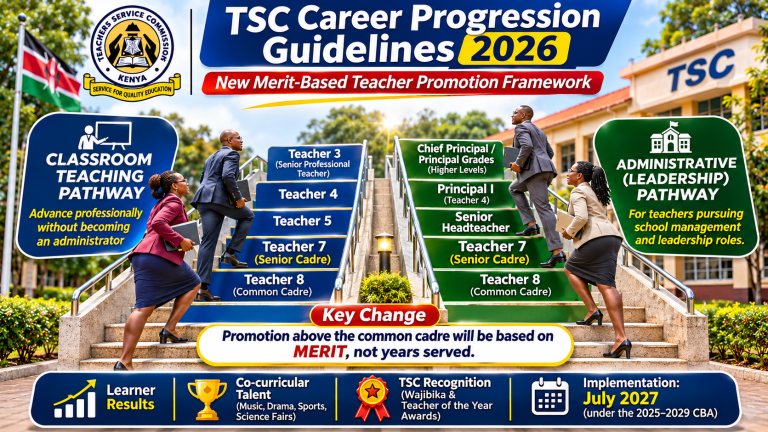
The issue of teacher promotions remains one of the most discussed concerns among teachers in Kenya, particularly following the introduction of the Competency-Based Education (CBE) system and the establishment of junior schools.
Many teachers who transitioned from primary schools to junior schools expected the deployment to come with improved career progression opportunities. However, the Teachers Service Commission (TSC) has clarified that moving from a primary school to a junior school does not automatically amount to a promotion.
This clarification has raised important questions among teachers, especially those serving in junior schools who have remained in Job Group C3 despite gaining additional experience and fulfilling the required service period.
Under the applicable career progression framework, graduate teachers appointed to the relevant junior school grade progress from Job Group C2 to C3 after serving for three years, subject to the prescribed requirements. Subsequent promotions, however, are competitive.
1. Transfer to Junior School Does Not Guarantee Promotion
One of the major misconceptions among teachers is that deployment from a primary school to a junior school automatically qualifies them for a higher job group.
The TSC has clarified that deployment is an administrative arrangement intended to facilitate the implementation of the education system. It does not necessarily change a teacher’s employment grade.
For example, a teacher who was previously serving in a primary school may be deployed to teach Grade 7, Grade 8, or Grade 9 learners. However, the teacher’s existing job group does not automatically change because of the new deployment.
This means that teachers must distinguish between the following terms:
- Deployment: Assignment of a teacher to a particular school level or teaching responsibility.
- Promotion: Advancement to a higher job grade following the applicable TSC requirements.
- Career progression: Movement through established professional grades and salary structures.
- Re-designation: A change in a teacher’s designation or career category in accordance with the applicable Commission procedures.
Understanding these differences is important for teachers seeking career advancement within the TSC.
2. How Junior School Graduate Teachers Progress from C2 to C3
Under the applicable career progression guidelines for junior school graduate teachers, progression from Job Group C2 to C3 follows a three-year service period, subject to the relevant requirements.
This provides an established progression pathway for eligible teachers serving in the relevant grade.
However, teachers should understand that reaching C3 is not the same as securing an automatic promotion to the next job group.
The progression framework distinguishes between time-based advancement at the initial stages and subsequent competitive promotion opportunities.
Teachers should therefore ensure that their employment records, professional qualifications, performance records, and other relevant documentation are properly maintained.
3. Why Many Junior School Teachers Remain at Job Group C3
The continued presence of many teachers at Job Group C3 has generated concerns about career advancement and professional recognition.
Several factors help explain why teachers may remain at this grade for extended periods.
A. Subsequent Promotions Are Competitive
Unlike the initial progression from C2 to C3, advancement beyond C3 is competitive.
Teachers may meet the minimum service requirements but still have to compete for available promotional opportunities.
This means that completing the required years of service does not automatically guarantee advancement.
B. Availability of Promotional Vacancies
Promotional opportunities depend partly on the availability of approved positions within the established TSC staffing structure.
Where the number of eligible teachers exceeds the available promotional vacancies, competition becomes inevitable.
Consequently, some qualified teachers may continue serving in their current job groups while waiting for suitable promotional opportunities.
C. Professional Qualifications and Experience
Professional qualifications, teaching experience, performance, and compliance with applicable career progression requirements remain important considerations in teacher advancement.
Teachers should ensure that their academic and professional records are updated and that they meet the requirements for the promotional grade they intend to pursue.
D. Competitive Selection Procedures
Teachers seeking promotion beyond C3 should understand that they may be required to participate in competitive selection procedures.
These may include applications, interviews, assessment of professional experience, and verification of relevant documents, depending on the applicable promotion guidelines.
Teachers should regularly follow official TSC communications for announcements concerning promotional vacancies and application procedures.
4. Does Teaching in Grade 7, 8, or 9 Change a Teacher’s Job Group?
No. Teaching a particular grade in junior school does not automatically determine a teacher’s job group.
A teacher’s employment grade is determined by the applicable TSC appointment and career progression framework, rather than simply the class or grade assigned to them.
For instance, a teacher may be teaching Grade 9 learners while remaining in Job Group C3.
Similarly, being responsible for additional academic activities, learner assessments, curriculum implementation, or departmental responsibilities does not automatically result in promotion.
However, these responsibilities can contribute to professional experience and performance records, which may be relevant during competitive promotion processes.
5. What Should Teachers Do to Improve Their Promotion Opportunities?
Teachers serving in junior schools should take practical steps to prepare for future promotion opportunities.
The following measures can help:
1. Keep professional records updated
Maintain updated academic certificates, professional qualifications, appointment letters, performance appraisal records, and other relevant employment documents.
2. Understand the applicable career progression guidelines
Teachers should familiarize themselves with the requirements for their current and prospective job groups.
3. Improve professional competencies
Participate in relevant professional development activities, curriculum implementation programs, workshops, and approved training opportunities.
4. Maintain good performance records
Teachers should consistently demonstrate professional competence, effective lesson delivery, learner assessment, classroom management, and adherence to professional standards.
5. Monitor TSC promotion advertisements
Teachers should regularly check official TSC announcements for promotional vacancies, application deadlines, and interview requirements.
6. Apply when eligible
Meeting the prescribed requirements should encourage teachers to apply for advertised promotional opportunities rather than assuming that promotion will happen automatically.
6. Deployment Versus Promotion: What Is the Difference?
The distinction between deployment and promotion is particularly important in the current CBE education structure.
| Deployment | Promotion |
|---|---|
| Involves assignment to a particular school level or responsibility. | Involves advancement to a higher job grade. |
| Does not automatically change the job group. | Changes the teacher’s employment grade when approved. |
| May be undertaken to address staffing needs. | Follows established career progression procedures. |
| Does not necessarily result in a salary increase. | Usually comes with the salary and benefits attached to the new grade. |
Teachers should therefore avoid assuming that a change in teaching level automatically translates into improved employment terms.
7. What Does the C3 Promotion Situation Mean for Junior School Teachers?
The situation has important implications for teachers serving in junior schools.
First, it means that deployment to junior school should not be confused with career advancement. Teachers must continue following the established promotion procedures.
Second, the competitive nature of subsequent promotions means that teachers need to prepare early by maintaining professional records and meeting the requirements for higher grades.
Third, the issue raises broader questions about career progression opportunities for teachers implementing the Competency-Based Education curriculum.
As junior schools continue expanding and the education sector adjusts to the new curriculum structure, teachers will remain interested in how the TSC manages professional development, staffing, deployment, and promotion opportunities.
8. Where Can Teachers Get Official TSC Promotion Information?
Teachers seeking clarification on their career progression should rely on official communication from the Teachers Service Commission.
The TSC provides information on teacher recruitment, career progression, promotions, deployment, professional conduct, and other employment matters.
Teachers can access official updates through the Commission’s website:
TSC Official Website: https://www.tsc.go.ke/
They should also consult relevant career progression guidelines, circulars, and official promotion advertisements before making decisions concerning their employment status.
It is important to distinguish between reported promotion information and formally issued TSC policies.
Frequently Asked Questions About Junior School Teachers’ Promotion
1. Does deployment to junior school automatically promote a teacher?
No. Deployment from primary school to junior school does not automatically result in promotion or movement to a higher job group.
2. How long does it take a graduate junior school teacher to move from C2 to C3?
Under the applicable career progression framework, eligible graduate junior school teachers progress from C2 to C3 after three years, subject to the prescribed requirements.
3. Is promotion from C3 automatic after three years?
No. Subsequent advancement beyond C3 is competitive and depends on the applicable promotion requirements and available opportunities.
4. Can a junior school teacher remain in C3 for many years?
Yes. Since subsequent promotions are competitive, a teacher may remain in C3 while waiting for an available promotional opportunity and meeting the relevant selection requirements.
5. Does teaching Grade 9 automatically qualify someone for C4?
No. The grade a teacher teaches does not automatically determine their employment grade. Promotion follows the TSC career progression framework.
6. Where can teachers check their promotion status?
Teachers should consult the TSC and use the official communication channels provided by the Commission for information on their employment and promotion status.
Conclusion
The promotion of junior school teachers remains an important issue within Kenya’s education sector. Although the transition from C2 to C3 provides an established progression pathway for eligible graduate teachers, advancement beyond C3 is competitive.
The TSC’s clarification that deployment to junior school is not an automatic promotion is therefore an important distinction for teachers to understand.
As the Competency-Based Education system continues to develop, teachers will be keen to see how career progression opportunities, promotional vacancies, and professional development are managed to support the growing responsibilities of junior school educators.
For now, teachers should remain informed about the applicable TSC guidelines, maintain their professional records, and take advantage of officially advertised promotion opportunities.
Follow CBCKenyaHub.com for the latest TSC updates, teacher promotions, salary information, CBE developments, KNEC announcements, and education news in Kenya.
About the Author

Related posts:

KNEC CBA Portal 2026 Guide: How to Login, Reset Password, and Upload Scores Easily
TSC Promotion Guidelines 2026/2027 PDF Download: Official Interview Scoring Guide, Eligibility & Pro...

Best Baringo County Senior Schools (2025 Guide): C1 National, C2 Extra-County, C3 County and C4 Sub-...
TSC Projected Salary scale Notches Effective July 2026 Under CBA Phase II