For years, the conversation around public school teaching in Kenya has been weighed down by the same painful frustrations: structural career stagnation, the agonizingly slow pace of promotions, and the financial vulnerability of the internship model.
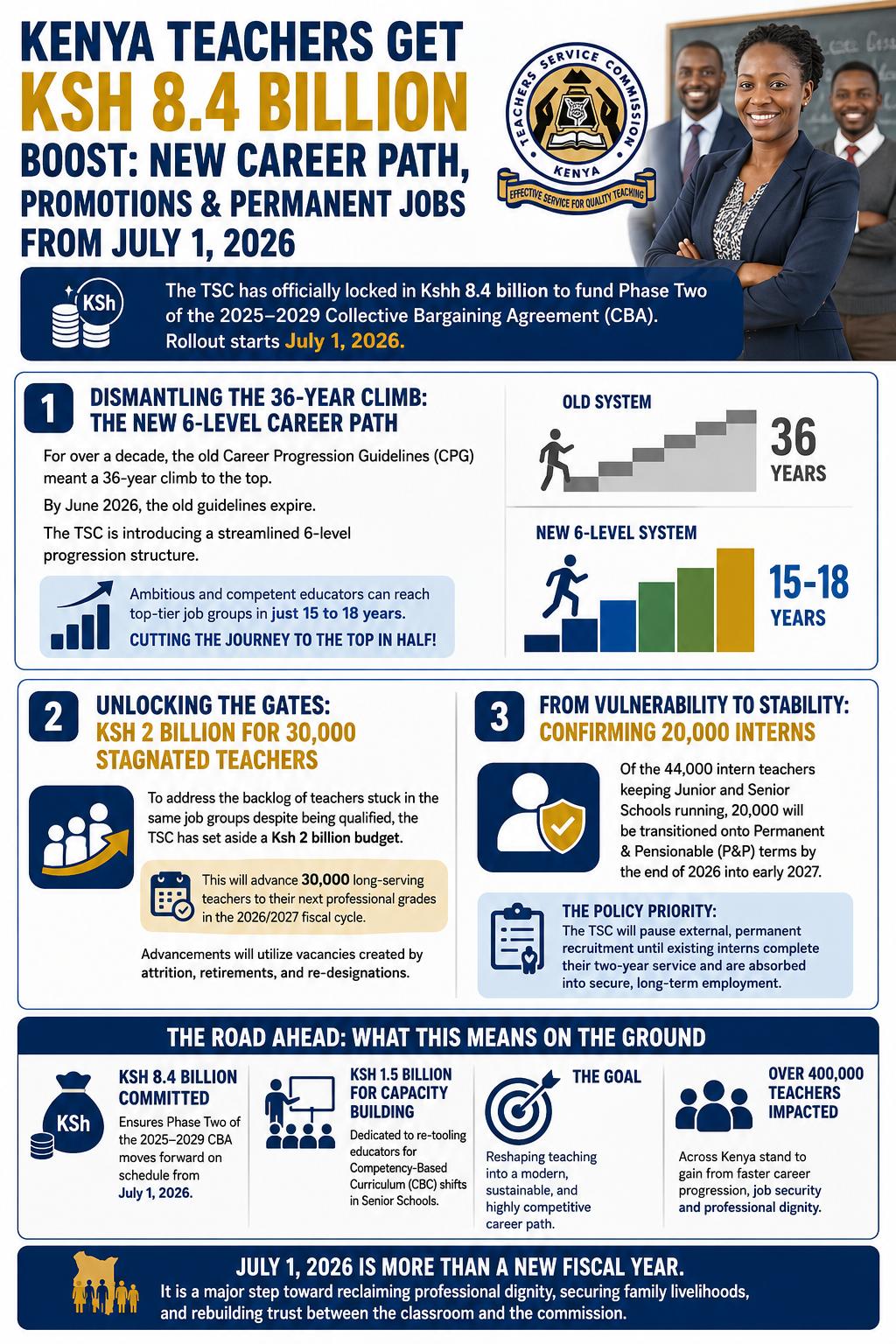
But a massive structural pivot is arriving. The Teachers Service Commission (TSC) has officially locked in Ksh 8.4 billion to fund Phase Two of the 2025–2029 Collective Bargaining Agreement (CBA). Set to roll out starting July 1, 2026, this injection of funds converts state promises into operational reality.
1. Dismantling the 36-Year Climb: The New 6-Level Career Path
For over a decade, the old Career Progression Guidelines (CPG) have been a primary source of teacher burnout. Under the previous system, scaling the ladder from entry-level positions to the highest salary cadre felt less like a career path and more like a lifetime sentence—often taking upwards of 36 years.
By June 2026, the old guidelines are officially hitting their expiration date.
The TSC is shifting to a streamlined 6-level progression structure designed to radically compress that timeline. Under the incoming framework, an ambitious and competent educator can reach top-tier job groups in just 15 to 18 years. This effectively cuts the career journey to the top in half, providing younger teachers with a realistic, motivating roadmap for their dedication.
2. Unlocking the Gates: Ksh 2 Billion for 30,000 Stagnated Teachers
Policy changes mean very little without clear funding to back them up. To handle the massive backlog of teachers who have been stuck in the same job groups for years despite being fully qualified for advancement, the TSC has carved out a Ksh 2 billion budget envelope.
This money is explicitly dedicated to pushing 30,000 long-serving teachers into their next professional grades. According to statements delivered by Acting TSC CEO Eveleen Mitei to the Parliamentary Departmental Committee on Education, these advancements will roll out over the 2026/2027 fiscal cycle, heavily utilizing vacancies created by natural attrition, retirements, and re-designations.
3. From Vulnerability to Stability: Confirming 20,000 Interns
The legal and financial battles surrounding the “intern teacher” framework have been incredibly stressful for the educators on the ground. Recognizing that a school system cannot thrive on temporary, insecure labor, the TSC has formalized a massive transition blueprint.
Of the 44,000 intern teachers currently keeping Junior and Senior Schools running, 20,000 will be transitioned onto Permanent & Pensionable (P&P) terms by the end of 2026 into early 2027.
The Policy Priority: The TSC has made it clear to lawmakers that it will pause any external, permanent recruitment drives until these existing interns have finished their mandatory two-year service periods and are safely absorbed into secure, long-term employment.
The Road Ahead: What This Means on the Ground
While the Treasury continues to hash out the remaining balance of the full Ksh 16.8 billion package, this initial Ksh 8.4 billion ensures Phase Two moves forward on schedule. Combined with an additional Ksh 1.5 billion dedicated to re-tooling educators for Competency-Based Curriculum (CBC) shifts in Senior Schools, the overarching objective is clear: reshaping teaching into a modern, sustainable, and highly competitive career path.
For the over 400,000 teachers registered across Kenya, July 1 is no longer just a new fiscal calendar page. It is a major step toward reclaiming professional dignity, securing family livelihoods, and rebuilding trust between the classroom and the commission.
About the Author