Empowering Young Minds.
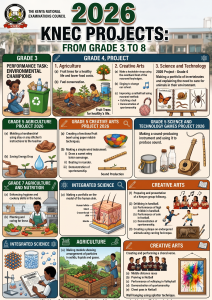
The Kenya National Examinations Council (KNEC) has officially unveiled the school-based project guidelines for the 2026 academic year, spanning from Grade 3 all the way to Grade 8. Rooted firmly in the Competency-Based Curriculum (CBC), these practical assessments are designed to shift learning away from rote memorization and toward hands-on, real-world problem-solving.
By engaging in these projects, learners develop core competencies such as critical thinking, environmental consciousness, citizenship, and technological literacy. Let’s take an in-depth, grade-by-grade look at what students are expected to achieve this year.
🟢 Lower Primary: Grade 3
Environmental Champions: Waste Management
At the foundational level, the focus is heavily geared toward environmental conservation and instilling a sense of responsibility early on.
-
The Core Assignment: Learners are tasked with a Performance Task centered on reusing waste to save the environment.
-
Key Learning Outcomes: Rather than just discussing pollution, students must actively collect clean, recyclable waste materials (like plastic bottles, cartons, or containers) and repurpose them into functional or decorative items. This teaches the basics of a circular economy and fosters a green mindset from a young age.
🟢 Upper Primary: Grades 4 & 5
As learners transition into Upper Primary, the projects become more diversified, blending life skills, science, and the arts.
Grade 4: Lifeskills, Science, and Craftsmanship
Grade 4 features a robust trio of projects designed to teach self-reliance and environmental appreciation:
-
Agriculture: Learners dive into food security by planting and caring for fruit trees. This task aims to teach sustainable living and how homegrown food can lower household costs. Additionally, they explore practical methods for fuel conservation in cooking and heating.
-
Creative Arts & Sports: This multifaceted task tests fine motor skills and physical coordination. Learners will use the overhand knot in the macramé technique to weave a keyholder strap. They will also practice teamwork through group singing to foster school spirit, and improve their physical coordination by creating and playing with a modified netball, focusing on catching skills and sportsmanship.
-
Science and Technology: Students will step into the shoes of biologists to compile a comprehensive portfolio of invertebrates (insects, snails, spiders, etc.), using the opportunity to explain why safeguarding these tiny creatures is vital to our ecosystem.
Grade 5: Innovation, Craft, and Physics
In Grade 5, the curriculum challenges students to think like innovators and designers:
-
Agriculture (Resource Conservation): Students practice patience and precision by molding a handkerchief using clay, or practicing introductory needlework following teacher directives. Parallel to this, they tackle water conservation through a practical initiative dubbed the “Saving Energy Drop”.
-
Creative Arts: Combining utility and design, learners will create a durable fruit bowl using paper-mâché techniques. Musically, they are expected to construct a simple wind instrument from locally available materials, alongside participating in track-and-field basics like relay baton exchanges and rounder games.
-
Science and Technology Games: This project bridges the gap between physics and music. Students will design and build a sound-producing instrument (such as improvised guitars, drums, or shakers) and use it to practically demonstrate how sound waves and vibrations are produced.
🟢 Junior Secondary: Grades 7 & 8
(Note: Grade 6 projects are assessed independently during their specific KPSEA exam cycle).
Junior Secondary School (JSS) projects demand higher cognitive reasoning, detailed scientific reporting, and advanced artistic expression.
Grade 7: Research, Nutrition, and Cultural Heritage
-
Agriculture and Nutrition: This project focuses directly on the home environment. Learners will be assessed on enhancing hygiene and cookery skills in the household—preparing simple, nutritious meals while maintaining strict sanitary standards. Alongside this, they must actively plant and nurture trees to support local reforestation efforts.
-
Integrated Science: Biology takes center stage as students construct a highly detailed, 3D cross-sectional model of the human skin. This project helps them visually map out the epidermis, dermis, sweat glands, and hair follicles, transforming abstract anatomy into a tangible learning experience.
-
Creative Arts: A vibrant, three-part assessment that celebrates culture and athletic skill:
-
Preparing and staging a traditional Kenyan group folksong, preserving oral heritage.
-
Demonstrating physical agility through high-dribble techniques in handball and sole-control in football.
-
Crafting a physical plaque of an endangered animal using wood or soapstone carving techniques to advocate for wildlife conservation.
-
Grade 8: Advanced Chemistry, Sustainability, and Performance
As the seniors of this assessment tier, Grade 8 students tackle sophisticated concepts that mirror real-world professional fields:
-
Integrated Science (Matter & Modeling): Students explore the fundamentals of chemistry by creating physical models that illustrate the arrangement of particles in solids, liquids, and gases. Crucially, they must also maintain an assessment journal to scientifically document their hypotheses, materials used, and observations.
-
Agriculture (Food Security): Moving beyond single plants, Grade 8s are tasked with establishing and managing a functional kitchen garden. This acts as a sustainable solution to food scarcity, teaching students how to layout plots, manage soil fertility, and sustainably grow vegetables for consumption.
-
Creative Arts & Sports: This final project demands high-level artistic execution and physical endurance:
-
Performance: Composing and delivering a unified choral verse.
-
Sports: Demonstrating proficiency in middle-distance races, executing complex netball maneuvers (preiving and chest passes), and mastering volleyball volleys.
-
Visual Arts: Designing and executing an aesthetic interior décor piece—a wall hanging created using the expressive splatter painting technique.
-
The Big Picture: Why These Projects Matter
The 2026 KNEC projects reflect a deliberate shift toward creating holistic individuals. By the time a student completes these assignments, they won’t have just read about science, art, or agriculture—they will have grown food, built models, composed music, and recycled waste.
For teachers and parents, the goal is to act as facilitators. By providing the space, raw materials, and encouragement, we can ensure that our learners build the confidence and self-reliance required to thrive in the modern world.
About the Author

Related posts:
From 8-4-4 to CBE – Why Kenya Decided to Change Its Education System
Best Elgeyo-Marakwet County Senior Schools {C1 National, C2 Extra-County, C3 County and C4 Sub-Count...
TSC Budget 2026: Inside the KSh 424B Education Sector Windfall
Best Mombasa County Senior Schools { C1 National, C2 Extra-County, C3 County and C4 Sub-County