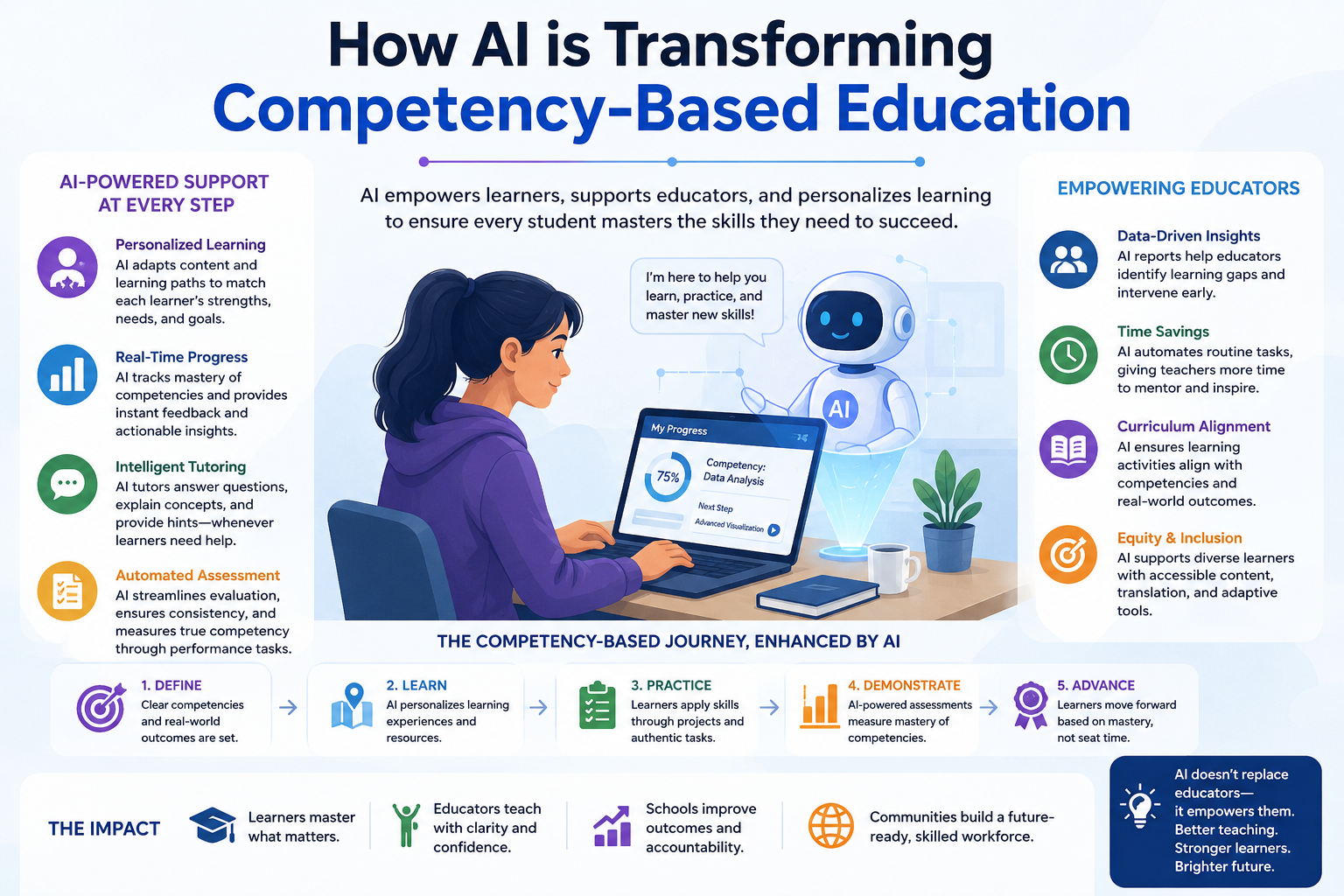
How AI is Transforming Competency-Based Education
As Kenya continues to roll out the Competency-Based Curriculum (CBC) and transitions deeply into Competency-Based Education (CBE), the landscape of learning and assessment is undergoing a radical, exciting transformation.
With the Kenya National Examinations Council (KNEC) rolling out performance tasks and project-based assessments for Grades 4 through 9 as we approach 2026, the traditional classroom is changing. We are witnessing a definitive shift away from rote memorization and toward the practical application of knowledge in real-life situations. Today’s learners are evaluated on their ability to demonstrate creativity, innovation, collaboration, communication, and complex problem-solving skills.
As this educational transition deepens, guided by institutions like the Ministry of Education (MoE), the Kenya Institute of Curriculum Development (KICD), and the Teachers Service Commission (TSC), one thing is becoming increasingly clear: Artificial Intelligence (AI) is poised to become a powerful ally in the Kenyan classroom.
Tools like ChatGPT, Gemini, and others are not here to replace teachers, stifle creativity, or do the work for students. Instead, they are dynamic assistants designed to support research, organization, idea generation, and deeper learning.
Here is a deep dive into how AI can practically and ethically support Kenya’s CBC ecosystem.
The New Learner Profile: Active, Not Passive
Under the CBC framework, the modern Kenyan learner is no longer a passive recipient of information. They are expected to:
- Investigate real-world problems within their communities.
- Conduct independent and group research.
- Create and prototype practical solutions.
- Document their findings and build evidence-based portfolios.
- Work collaboratively with peers.
- Present their projects confidently.
This rigorous, hands-on approach is exactly where AI tools can step in to provide scaffolding. AI can help learners organize their initial scattered thoughts, understand complex concepts more clearly, and explore highly creative approaches to their project-based assessments.
Practical AI Prompts for CBC Subject Areas
To understand how this works in practice, let’s look at how teachers and learners can use simple, targeted AI prompts across various grade levels and subjects.
Grade 4–5: Science & Technology
The AI Prompt:
“Act as an engaging Science teacher. Help me brainstorm a simple, hands-on project about conserving water at home for a Grade 5 learner in Kenya using only locally available materials.”
How AI Supports the Learner: At this stage, learners need structured guidance. AI can help them identify simple, everyday water conservation methods (like reusing water from washing vegetables to water plants). It can generate templates for daily observation tables, outline how to write a neat, structured report, and even give them bullet points to help them practice presenting their findings to the class.
Grade 6: Agriculture
The AI Prompt:
“Generate three creative ideas for a school kitchen garden project using affordable, locally available materials like old jerrycans or gunny bags in Kenya. Include a basic weekly monitoring schedule.”
How AI Supports the Learner: Agriculture in CBC is highly practical. AI can assist by providing step-by-step planting procedures for local crops (like sukuma wiki or spinach) using vertical farming methods. It can help learners create a watering and weeding schedule, generate reflection questions for their portfolio (“What challenges did my seedlings face this week?”), and guide them on how to document plant growth over time.
Grade 7–8: Integrated Science
The AI Prompt:
“Explain the concept of water pollution in simple language suitable for a Grade 7 learner. Then, suggest a safe, low-cost experiment we can conduct at school to demonstrate water filtration.”
How AI Supports the Learner: Junior School science introduces more complex concepts. AI acts as a 24/7 tutor, breaking down dense scientific jargon into easily digestible language. It helps learners safely design experiments, formulate hypotheses, set up data recording formats, and connects their local experiment to broader, global environmental conservation discussions.
Grade 8: Creative Arts & Sports
The AI Prompt:
“Help me create a 5-minute performance script about the importance of teamwork and environmental conservation. Include ideas for a short spoken-word poem in the middle.”
How AI Supports the Learner: For the arts, AI is the ultimate brainstorming partner. It can help learners develop character dialogue, structure their role-play, and suggest themes for songs or spoken word. It helps overcome the “blank page” syndrome, giving learners a foundation that they can then edit, localize, and perform in their own unique voices.
Grade 9: Research & Pathway Projects
The AI Prompt:
“Help a Grade 9 learner create an outline for a research project linking modern technology (like coding or mobile apps) to future agricultural careers in Kenya.”
How AI Supports the Learner: As learners prepare for Senior School pathways, their projects become highly research-intensive. AI can assist in organizing secondary research, exploring emerging career paths, structuring their final presentation, and providing frameworks for basic data interpretation.
A Teacher’s Best Friend: Easing the Administrative Burden
The shift to CBE has undoubtedly increased the planning and assessment workload for educators. AI is a game-changer for teachers seeking to reclaim their time and focus on what they do best: interacting with students.
Teachers can leverage AI to:
- Generate Assessment Rubrics: Quickly build detailed KNEC-aligned rubrics assessing specific competencies (e.g., collaboration, critical thinking).
- Differentiate Learning: Easily tweak a single lesson plan for advanced learners and those who need extra support.
- Overcome Language Barriers: Translate complex instructions or concepts into simpler English or Kiswahili to ensure no learner is left behind.
- Draft Feedback: Generate constructive, personalized portfolio feedback comments based on student performance data.
- Create Project Checklists: Instantly generate project timelines, safety checklists, and step-by-step learner instructions.
The Golden Rule: Responsible AI Usage in Education
As we enthusiastically embrace AI in Kenyan schools, ethical and responsible usage must remain at the forefront.
AI should be a compass, not a calculator that gives the final answer.
It must never replace a learner’s effort, originality, or grit. Learners must still go out into the field to conduct actual observations, get their hands dirty in the soil, actively participate in group discussions, and present authentic work that they genuinely understand.
Similarly, the teacher remains the indispensable heart of the classroom. Technology cannot replicate a teacher’s empathy, their ability to guide moral values and ethics, or their nuanced understanding of a child’s holistic development.
Conclusion: Shaping a Digitally Empowered Generation
The future of Kenyan education is not about replacing teachers with technology; it is about empowering both teachers and learners with superior tools for creativity, innovation, collaboration, and problem-solving.
Kenya’s CBC journey presents a golden opportunity. By responsibly integrating Artificial Intelligence into our schools today, we are not just helping students pass their KNEC assessments—we are equipping them with the digital fluency and critical thinking skills they need to thrive in a rapidly evolving, technology-driven global economy.
Are you a teacher, parent, or educational stakeholder in Kenya? How are you navigating the use of digital tools and AI in the CBC framework? Share your thoughts and experiences in the comments below!
About the Author

Related posts:
CO-CURRICULAR ACTIVITIES IN SENIOR AND VOCATIONAL SCHOOL AND NON-FORMAL PROGRAMMES

TSC Lowers JSS Deployment Cut-Off Marks! Master Checklist of Vetting Documents You Need to Transitio...
Best In-Service Courses for CBC Teachers in Kenya (2026/2027 Guide)
How to Change Grade 10 School Placement Choices Before Admission