Understanding Senior School Pathways
The introduction of Senior School under Kenya’s Competency-Based Education (CBE) framework marks one of the most revolutionary changes in the country’s educational history. For the first time, learners are no longer expected to follow a single academic route. Instead, they are empowered to choose educational pathways that align with their talents, interests, abilities, and future career aspirations.
This represents a fundamental shift from the traditional “one-size-fits-all” approach that characterized the 8-4-4 system.
Under Senior School, learners entering Grade 10 are guided into specialized pathways designed to prepare them for specific careers, industries, and opportunities in the rapidly changing global economy.
Why Pathways Were Introduced
For many years, education systems worldwide treated all learners similarly regardless of their individual strengths.
A student talented in music often studied the same subjects as a future engineer.
A gifted athlete followed the same curriculum as an aspiring doctor.
A creative designer was expected to perform similarly in all academic disciplines.
This approach often resulted in:
- Wasted talent
- Reduced learner motivation
- Poor career alignment
- Limited specialization
The Competency-Based Education framework seeks to solve this challenge by recognizing that every learner possesses unique talents and capabilities.
Every Learner Has Unique Strengths


Pathways allow learners to focus on areas where they demonstrate:
✔ Interest
✔ Talent
✔ Potential
✔ Career ambitions
What is a Senior School Pathway?
A pathway is a structured educational route that groups subjects according to related career fields and competencies.
Instead of studying every subject at the same depth, learners concentrate on areas that best match their future goals.
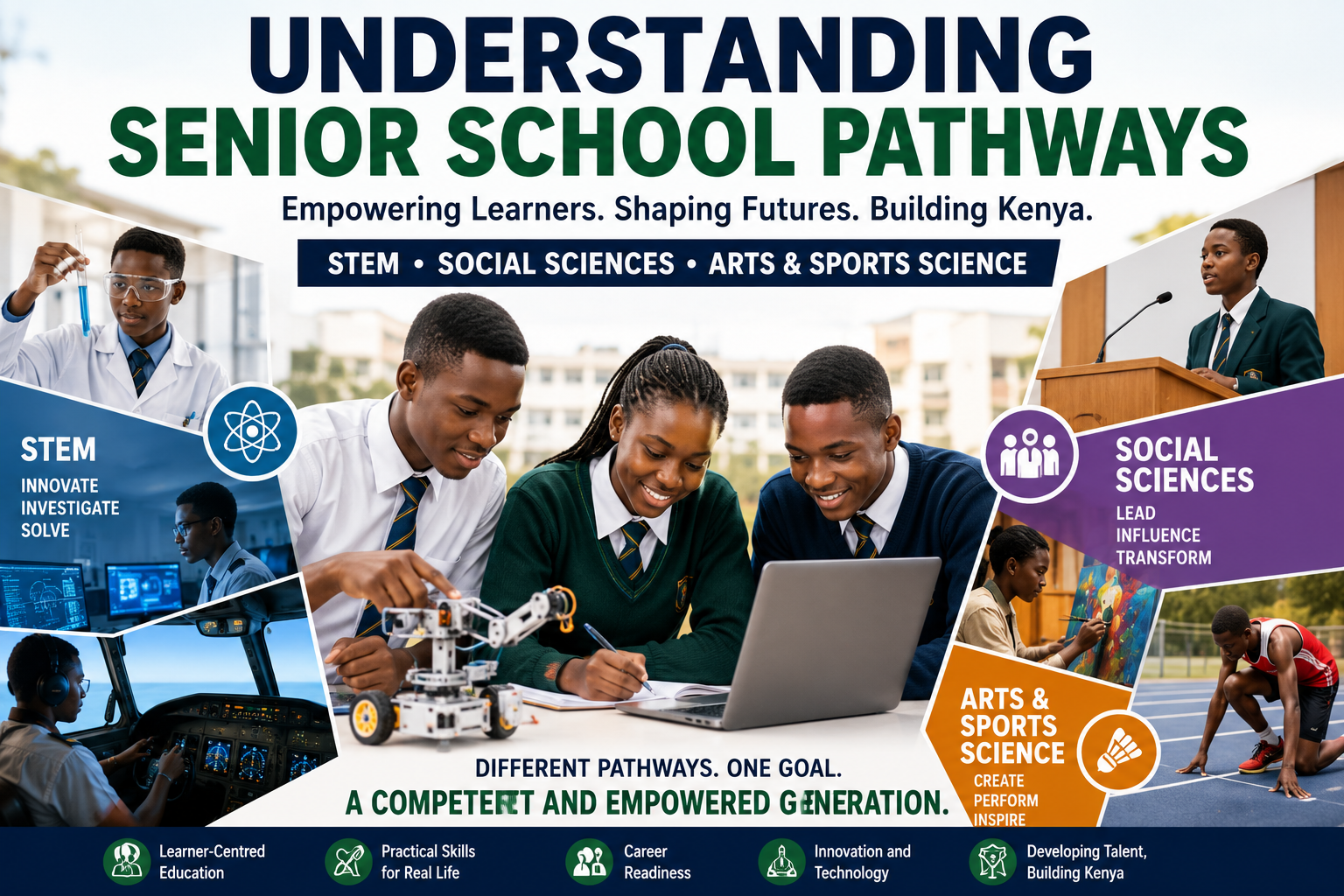
The three major pathways are:
1. STEM (Science, Technology, Engineering and Mathematics)
2. Social Sciences
3. Arts and Sports Science
Each pathway contains specialized tracks and learning experiences.
Structure of Senior School Pathways
                  SENIOR SCHOOL
                        │
 ┌──────────────────────┼──────────────────────┐
 │                      │                      │
 STEM             SOCIAL SCIENCES      ARTS & SPORTS
 │                      │                      │
 Engineering      Business Studies      Sports Science
 Medicine         Languages             Music
 ICT              Humanities            Theatre Arts
 Aviation         Law                   Fine Arts
 Robotics         Journalism            Film Production
The STEM Pathway
The Most Popular Pathway
Recent enrollment figures indicate that approximately 52% of learners entering Senior School have selected the STEM pathway.
This reflects growing interest in science, technology, engineering, and innovation careers.
STEM Learning Environment


What STEM Focuses On
The STEM pathway develops competencies in:
- Scientific inquiry
- Engineering design
- Mathematical reasoning
- Technological innovation
- Problem solving
Learners are encouraged to:
- Conduct experiments
- Build prototypes
- Design systems
- Analyze data
- Solve real-world challenges
STEM Career Opportunities
The STEM pathway opens doors to careers such as:
Engineering
- Civil Engineering
- Mechanical Engineering
- Electrical Engineering
- Mechatronics Engineering
Medicine and Health Sciences
- Medicine
- Dentistry
- Pharmacy
- Nursing
Technology
- Software Development
- Cybersecurity
- Artificial Intelligence
- Data Science
Aviation
- Pilot Training
- Aircraft Engineering
- Air Traffic Management
Environmental Sciences
- Renewable Energy
- Climate Research
- Environmental Engineering
Emerging STEM Careers


STEM and Educational Simulators
One of the most exciting features of Senior School STEM programs is the use of simulation technology.
Instead of simply reading theories, learners can interact with virtual environments.
Examples include:
Aviation Simulators
Students learn:
- Flight controls
- Aircraft navigation
- Airport operations
Engineering Simulators
Learners explore:
- Circuit design
- Mechanical systems
- Structural analysis
Medical Simulators
Students can practice:
- Patient diagnosis
- Emergency response
- Medical procedures
Robotics Simulators
Learners program and test robots virtually before building physical prototypes.
The Social Sciences Pathway
The Social Sciences pathway focuses on understanding human society, communication, governance, economics, and business.
This pathway is ideal for learners interested in:
- Leadership
- Public service
- Law
- Entrepreneurship
- International relations
Social Sciences Learning


Areas of Study
Learners may specialize in:
Business Studies
Topics include:
- Entrepreneurship
- Accounting
- Marketing
- Economics
Languages
Including:
- English
- Kiswahili
- Foreign Languages
Humanities
Such as:
- History
- Geography
- Sociology
- Political Science
Career Opportunities in Social Sciences
Graduates may pursue careers such as:
- Lawyer
- Journalist
- Diplomat
- Economist
- Business Manager
- Public Administrator
- International Relations Specialist
Arts and Sports Science Pathway
This pathway recognizes that creative and athletic talents are valuable national resources.
For decades, artistic and sporting careers were often viewed as secondary to traditional professions.
Today, global industries demonstrate that creative economies contribute billions of dollars annually.
Creative Arts and Sports Development


Areas of Specialization
Sports Science
Learners study:
- Sports Performance
- Coaching
- Fitness Science
- Sports Medicine
Performing Arts
Including:
- Music
- Drama
- Dance
Visual Arts
Such as:
- Graphic Design
- Painting
- Photography
- Animation
Career Opportunities
Potential careers include:
- Professional Athlete
- Sports Manager
- Coach
- Music Producer
- Film Director
- Graphic Designer
- Animator
- Content Creator
How Learners Choose Their Pathways
Pathway selection is not random.
Several factors are considered:
Academic Performance
Learners demonstrate strengths in particular subjects.
Aptitude Assessment
Schools assess talents and abilities.
Career Interests
Learners identify future aspirations.
Teacher Guidance
Teachers provide professional advice.
Parental Support
Parents contribute valuable insights regarding learners’ strengths.
Career Guidance and Pathway Selection


Common Misconceptions About Pathways
Myth 1: STEM is Superior
Reality:
All pathways are important.
A country needs:
- Scientists
- Engineers
- Teachers
- Lawyers
- Artists
- Athletes
- Entrepreneurs
National development requires diverse talents.
Myth 2: Pathways Limit Future Opportunities
Reality:
Pathways provide specialization while still allowing future flexibility.
Many careers involve interdisciplinary knowledge.
Myth 3: Arts and Sports Are Less Valuable
Reality:
The global creative economy generates billions annually through:
- Film
- Music
- Sports
- Design
- Digital Content
The Future of Pathway-Based Learning
Pathways align education more closely with labor market needs.
They allow learners to:
- Develop specialized competencies
- Gain industry exposure
- Build portfolios
- Explore careers early
As educational simulators, artificial intelligence, robotics, and digital technologies become integrated into schools, pathway-based learning will become increasingly practical and industry-focused.
The Future Senior School Classroom


Conclusion
The introduction of Senior School pathways is one of the most transformative aspects of Kenya’s Competency-Based Education system. By allowing learners to pursue STEM, Social Sciences, or Arts and Sports Science based on their interests and abilities, Kenya is moving toward a more personalized, relevant, and future-oriented education model.
Rather than forcing every learner into the same academic mold, the pathway system recognizes that talent comes in many forms and that every pathway contributes to national development.
About the Author

Related posts:

Best Kitui County Senior Schools { C1 National, C2 Extra-County, C3 County and C4 Sub-County
List of Senior School Subjects & Subject Combinations (Grades 10, 11 & 12 – CBC Kenya)
How to Download KCSE and KCPE Certificates Online in Kenya
. BASIC INFRASTRUCTURE FOR SENIOR SCHOOL