Educational Simulators – The Technology Powering Kenya’s New STEM Revolution
The success of Kenya’s Competency-Based Education (CBE) system depends not only on curriculum reform but also on the tools used to deliver learning. As more than half of the pioneer Grade 10 cohort embraces the STEM pathway, schools face a critical challenge: how can learners gain practical exposure to highly technical industries without requiring billions of shillings in infrastructure investment?
The answer lies in one of the most powerful innovations in modern education—educational simulators.
Across the world, simulators have transformed how pilots, engineers, doctors, scientists, and maritime professionals are trained. Today, Kenya is beginning to adopt similar technologies to provide learners with realistic, practical experiences within the classroom.
Educational simulators represent a major shift from traditional teaching methods toward immersive, hands-on learning environments where students can practice, experiment, fail safely, and improve continuously.
What Are Educational Simulators?
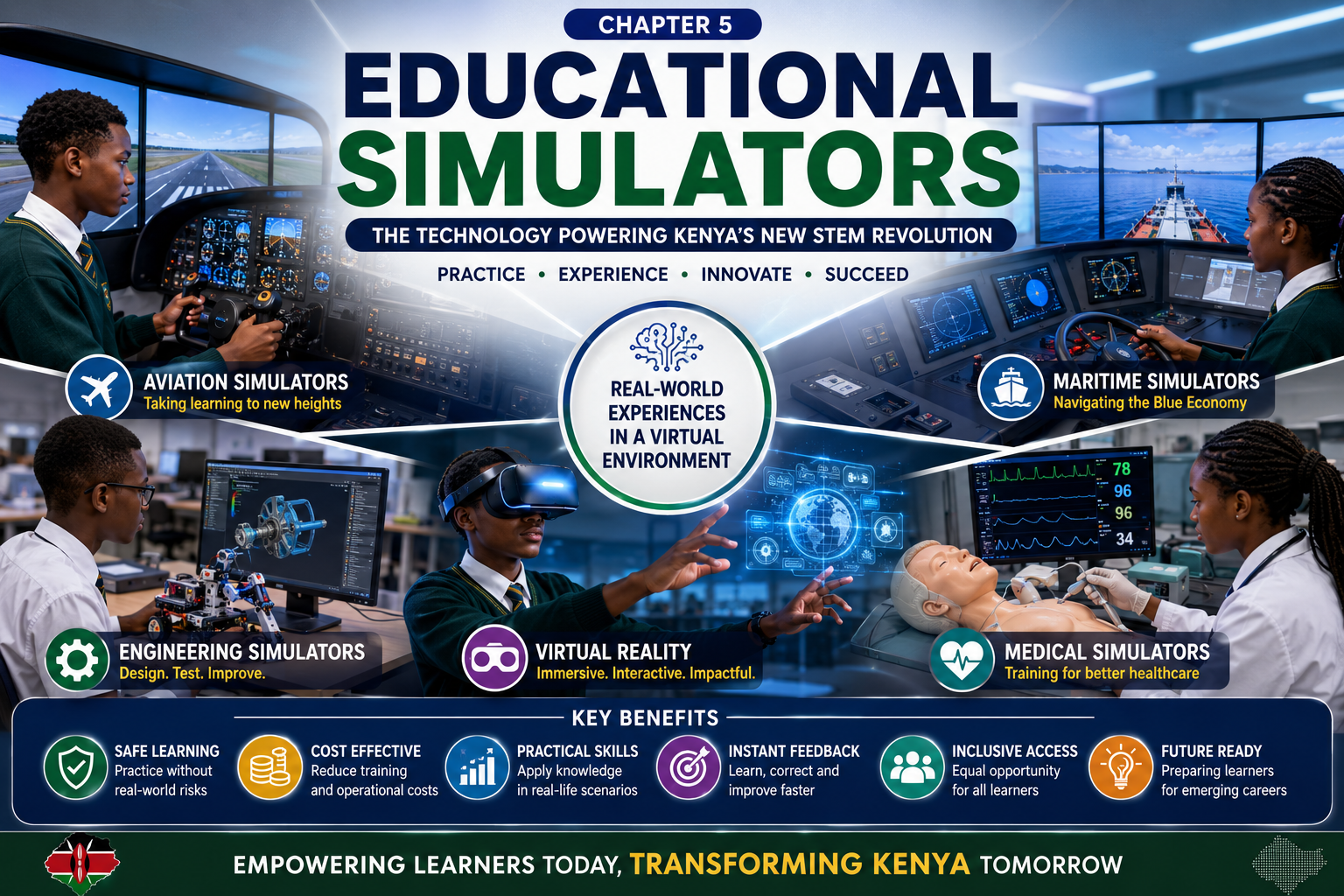
Educational simulators are computer-based systems designed to recreate real-world environments, equipment, processes, and situations.
Rather than simply reading about a concept, learners interact with virtual versions of the actual systems used in industry.
For example:
- A flight simulator replicates an aircraft cockpit.
- A maritime simulator recreates ship navigation.
- An engineering simulator models machines and structures.
- A medical simulator imitates patient care scenarios.
These technologies allow learners to gain experience without the costs, dangers, or logistical challenges associated with real-world training.
The Evolution of Learning Technology


The classroom is evolving from a place of information delivery into an environment of experience and experimentation.
Why Simulators Matter in Competency-Based Education
The philosophy of CBE emphasizes competencies rather than memorization.
Learners are expected to demonstrate:
- Skills
- Knowledge
- Values
- Practical abilities
Traditional teaching methods often struggle to provide opportunities for learners to practice complex technical skills.
Simulators solve this challenge by creating realistic environments where learners can actively apply what they have learned.
Traditional Learning vs Simulation Learning
| Traditional Learning | Simulation Learning |
|---|---|
| Reading about aircraft | Flying a virtual aircraft |
| Studying ship navigation | Navigating a virtual vessel |
| Learning engineering theory | Designing and testing virtual systems |
| Memorizing procedures | Practicing procedures repeatedly |
| Limited practical exposure | Unlimited hands-on experience |
How Simulators Work
Most educational simulators combine:
Computer Software
Creates realistic virtual environments.
Interactive Controls
Allow learners to manipulate equipment.
Real-Time Feedback
Provides immediate information about performance.
Data Analytics
Tracks learner progress and competency development.
Anatomy of a Modern Simulator


Some advanced systems even use:
- Artificial Intelligence (AI)
- Virtual Reality (VR)
- Augmented Reality (AR)
- Motion Sensors
- Haptic Feedback Devices
to create highly immersive experiences.
Aviation Simulators: Bringing Flight Training to Schools
One of the most exciting applications of simulation technology is aviation education.
Traditionally, aviation training required:
- Aircraft
- Airports
- Fuel
- Maintenance facilities
- Certified instructors
These requirements make aviation education extremely expensive.
Flight simulators dramatically reduce these costs.
What Learners Can Practice
Students can learn:
- Aircraft controls
- Flight planning
- Navigation
- Weather management
- Emergency procedures
- Airport operations
without ever leaving the classroom.
Aviation Simulation Learning


For learners interested in aviation careers, simulators provide valuable early exposure to industry practices.
Maritime Simulators and the Blue Economy
Kenya’s Blue Economy strategy seeks to expand opportunities in:
- Shipping
- Port operations
- Marine engineering
- Fisheries
- Maritime logistics
However, maritime training facilities are costly and geographically limited.
Simulation technology offers a practical alternative.
Skills Developed Through Maritime Simulators
Learners can practice:
- Ship navigation
- Harbor operations
- Cargo management
- Weather interpretation
- Maritime safety
These experiences help learners understand the complexity of maritime industries long before entering specialized training institutions.
Maritime Navigation Simulation


Engineering Simulators: Building Future Innovators
Engineering is one of the most simulation-intensive professions in the world.
Before constructing bridges, machines, or buildings, engineers first test their designs digitally.
Senior School learners can benefit from the same approach.
Engineering Simulation Applications
Students may learn:
Structural Engineering
Testing building designs.
Mechanical Engineering
Analyzing moving systems.
Electrical Engineering
Designing circuits.
Mechatronics
Combining mechanics, electronics, and programming.
Engineering Design Through Simulation


Simulation allows learners to experiment freely without risking costly mistakes.
Medical Simulators: Training Future Healthcare Professionals
Medical education increasingly relies on simulation technology.
Doctors and nurses routinely use simulated environments before treating actual patients.
In Senior School, medical simulators can introduce learners to:
- Human anatomy
- Clinical procedures
- Emergency response
- Patient assessment
These experiences enhance understanding and career awareness.
Virtual Reality in Education
Virtual Reality (VR) is rapidly becoming one of the most powerful educational technologies available.
Using VR headsets, learners can enter immersive digital environments.
They can:
- Walk through factories
- Explore human organs
- Visit engineering sites
- Conduct virtual experiments
without leaving the classroom.
Virtual Reality Learning Experiences


VR transforms learning from observation into participation.
Artificial Intelligence and Smart Simulators
The next generation of simulators incorporates Artificial Intelligence.
AI-powered systems can:
- Adapt difficulty levels
- Provide personalized feedback
- Identify learning gaps
- Recommend practice activities
This creates highly individualized learning experiences.
Example
If a learner repeatedly struggles with aircraft navigation, the simulator can:
- Detect the weakness
- Provide additional exercises
- Offer guidance
- Track improvement
This level of personalization was impossible in traditional classrooms.
Advantages of Educational Simulators
1. Safety
Learners can make mistakes without real-world consequences.
2. Cost Effectiveness
Schools avoid the enormous expense of physical training facilities.
3. Accessibility
Students from different regions gain equal opportunities.
4. Repetition
Learners can practice repeatedly until mastery is achieved.
5. Immediate Feedback
Performance data helps learners improve quickly.
Benefits of Simulator-Based Learning


Challenges of Simulator Adoption
Despite their benefits, simulators require significant support.
Infrastructure Needs
Schools need:
- Computers
- Reliable electricity
- Internet connectivity
- Technical support
Teacher Training
Educators must learn how to:
- Operate simulators
- Integrate simulations into lessons
- Assess learner performance
Financial Investment
While cheaper than physical facilities, advanced simulators still require substantial investment.
The Global Perspective
Countries such as:
- Singapore
- South Korea
- Germany
- Finland
have successfully integrated simulation technologies into education and workforce development.
These investments have contributed significantly to innovation and economic competitiveness.
The Future of Simulation in Kenyan Schools
As CBE continues to mature, simulation technologies are expected to expand into:
- Agriculture
- Renewable Energy
- Manufacturing
- Healthcare
- Transportation
- Environmental Science
Future learners may use digital environments to solve authentic community challenges and develop solutions that contribute directly to national development.
The Future Smart Classroom


Conclusion
Educational simulators are poised to become one of the most transformative technologies within Kenya’s Competency-Based Education framework.
By providing realistic, practical, and accessible learning experiences, simulators bridge the gap between theory and practice while supporting the development of competencies required in modern industries.
For the pioneer Grade 10 STEM cohort and future generations, simulation technology offers a glimpse into careers that were once inaccessible to most learners.
As Kenya continues investing in STEM education, educational simulators may become the engines driving a new era of innovation, productivity, and global competitiveness
About the Author

Related posts:
A Step-by-Step Guide to KEMIS Onboarding for All Roles

Best Bungoma County Senior Schools { C1 National, C2 Extra-County, C3 County and C4 Sub-County
TSC Phase 2 Unlocked: Ksh 8.4 Billion, 30,000 Promotions, and Faster Career Paths
Grade 9 subject selection 12 School Choices in Kenya: A Complete Guide for Parents and Learners