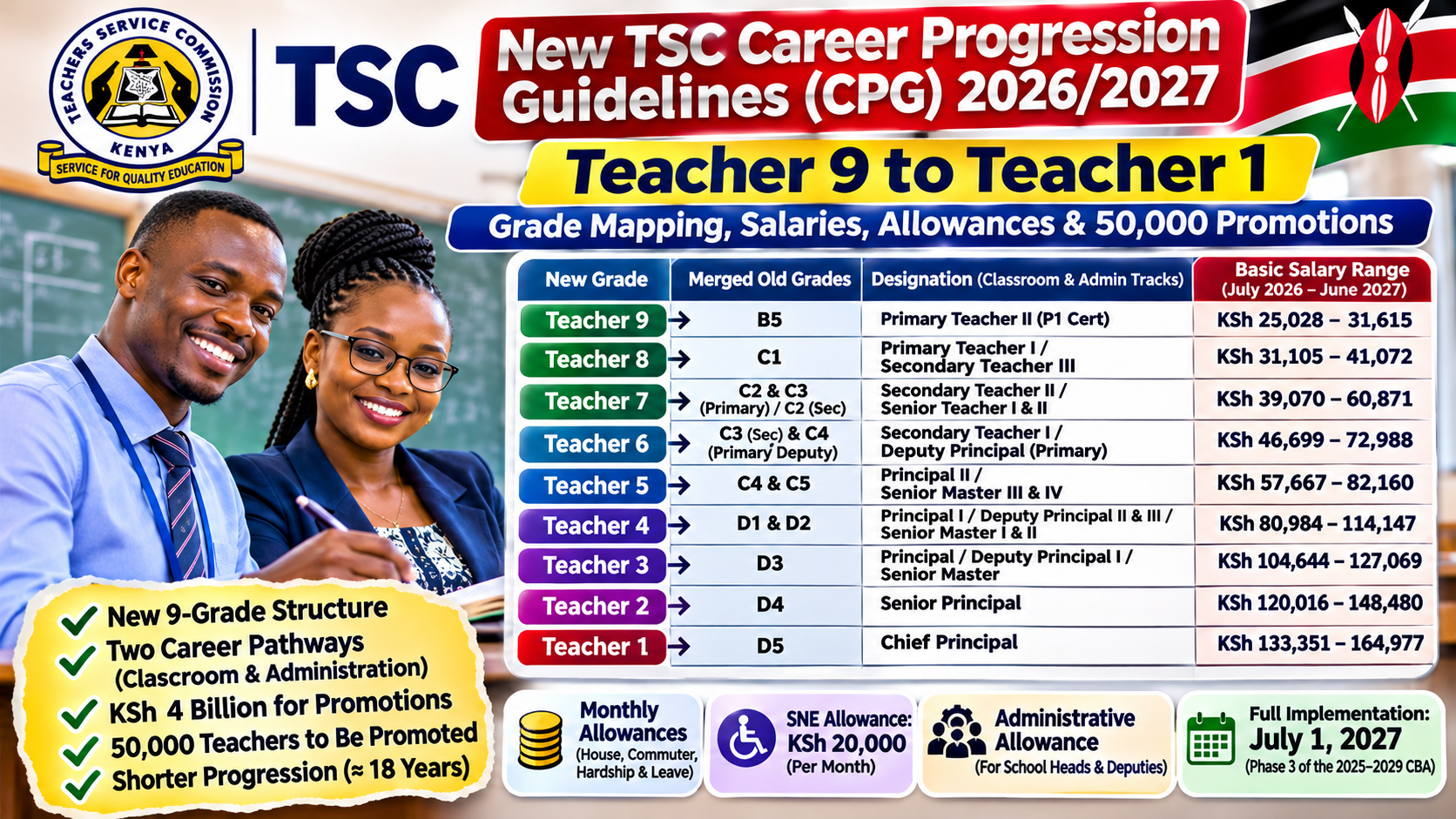
Thousands of teachers across Kenya are anticipating significant changes in their career progression following the approval of revised Teachers Service Commission (TSC) Career Progression Guidelines (CPG) by the Salaries and Remuneration Commission (SRC) in November 2026.
The announcement, made by President William Ruto on November 12, 2026, marks an important development in efforts to address long-standing concerns about teacher promotions and career stagnation.
The government has also announced an additional KSh 4 billion to support teachers’ career progression, with approximately 50,000 teachers targeted for promotion during the 2026/2027 financial year.
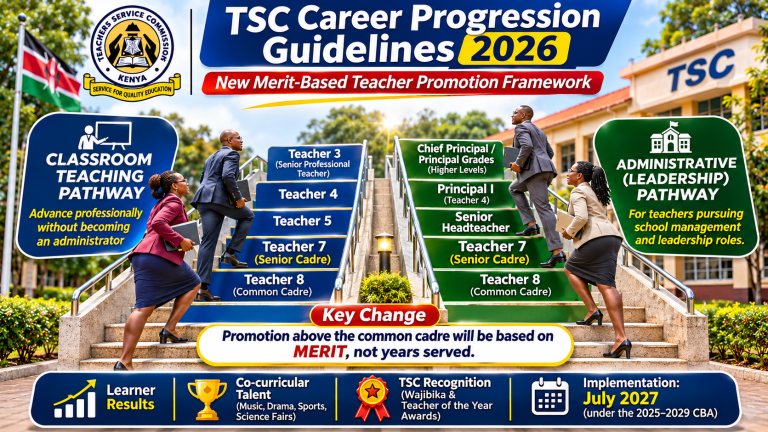
One of the most significant changes under the revised framework is the introduction of two parallel career progression pathways. These will allow classroom teachers to advance professionally without necessarily becoming administrators.
The revised framework also seeks to reduce the number of career progression levels from 56 to 43, creating a more streamlined structure.
1. SRC Approves Revised TSC Career Progression Guidelines
The revised Career Progression Guidelines follow negotiations involving TSC and teachers’ unions, including KNUT, KUPPET and KUSNET.
On November 12, President William Ruto confirmed that SRC had approved the revised framework.
The government subsequently announced an additional KSh 4 billion to facilitate career progression and enable the promotion of 50,000 teachers during the current financial year.
The announcement is particularly important because thousands of teachers have remained in the same job groups for extended periods despite acquiring additional professional experience and qualifications.
2. New TSC Teacher 9 to Teacher 1 Grading Structure
One of the major proposals under the revised framework is the reduction of career progression levels from 56 to 43.
The new arrangement introduces a streamlined grading structure, with Teacher 9 representing the lower end and Teacher 1 representing the highest professional level.
The framework also establishes separate pathways for classroom teachers and administrators.
This means that an experienced classroom teacher will have an opportunity to progress professionally through senior career grades without necessarily leaving classroom teaching for school management.
2.1 Proposed New TSC Grade Mapping: Old Job Groups B5 to D5
The following table illustrates an indicative transition from the existing TSC job groups to the proposed Teacher 9–Teacher 1 structure.
| New CPG Grade | Merged Old TSC Grades | Proposed Designation/Cadre | Entry Rule/Progression | Indicative Basic Salary Range |
|---|---|---|---|---|
| Teacher 9 | B5 | Primary Teacher II (P1 Certificate) | Entry grade for P1 certificate holders | KSh 25,028–31,615 |
| Teacher 8 | C1 | Primary Teacher I / Secondary Teacher III | Diploma and relevant professional progression | KSh 31,105–41,072 |
| Teacher 7 | C2 and C3 (Primary); C2 (Secondary) | Secondary Teacher II / Senior Teacher I and II | Degree entry and common cadre progression | KSh 39,070–60,871 |
| Teacher 6 | C3 (Secondary) and C4 (Primary Deputy) | Secondary Teacher I / Deputy Principal (Primary) | Degree common cadre and competitive progression | KSh 46,699–72,988 |
| Teacher 5 | C4 and C5 | Principal II / Senior Master III and IV | Competitive merit-based promotion | KSh 57,667–82,160 |
| Teacher 4 | D1 and D2 | Principal I / Deputy Principal II and III / Senior Master I and II | Competitive merit-based promotion | KSh 80,984–114,147 |
| Teacher 3 | D3 | Principal / Deputy Principal I / Senior Master | Senior professional grade | KSh 104,644–127,069 |
| Teacher 2 | D4 | Senior Principal | Competitive merit-based progression | KSh 120,016–148,480 |
| Teacher 1 | D5 | Chief Principal | Highest proposed professional grade | KSh 133,351–164,977 |
Important salary clarification: These are indicative figures and proposed grade mappings supplied for explanatory purposes. They should not be interpreted as an officially gazetted salary conversion schedule. Final designations, merged grades, salary points and transition arrangements require confirmation through official TSC and SRC implementation documents.
2.2 Proposed Monthly Allowances Under the New CPG Mapping
Apart from basic salaries, teachers receive various allowances depending on their job groups, workstations and responsibilities.
The following table presents the indicative allowance figures associated with the proposed grade mapping.
| New Grade / Existing Grade Reference | House Allowance Cluster 1 | Cluster 2 | Cluster 3 | Commuter Allowance | Hardship Allowance | Annual Leave Allowance |
|---|---|---|---|---|---|---|
| Teacher 9 (B5) | KSh 6,750 | KSh 4,500 | KSh 3,850 | KSh 4,000 | KSh 6,600 | KSh 4,000 |
| Teacher 8 (C1) | KSh 10,000 | KSh 7,500 | KSh 5,800 | KSh 4,000 | KSh 8,200 | KSh 4,000 |
| Teacher 7 (C2) | KSh 16,500 | KSh 12,800 | KSh 9,600 | KSh 5,000 | KSh 10,900 | KSh 6,000 |
| Teacher 7/6 (C3) | KSh 28,000 | KSh 22,000 | KSh 16,500 | KSh 6,000 | KSh 12,300 | KSh 6,000 |
| Teacher 6/5 (C4) | KSh 28,000 | KSh 22,000 | KSh 16,500 | KSh 8,000 | KSh 14,650 | KSh 6,000 |
| Teacher 5 (C5) | KSh 35,000 | KSh 25,500 | KSh 18,000 | KSh 8,000 | KSh 17,100 | KSh 6,000 |
| Teacher 4 (D1–D2) | KSh 45,000 | KSh 28,000 | KSh 21,000 | KSh 12,000 | KSh 27,300 | KSh 10,000 |
| Teacher 3 (D3) | KSh 45,000 | KSh 28,000 | KSh 21,000 | KSh 14,000 | KSh 31,500 | KSh 10,000 |
| Teacher 2 (D4) | KSh 45,000 | KSh 28,000 | KSh 21,000 | KSh 14,000 | KSh 31,500 | KSh 10,000 |
| Teacher 1 (D5) | KSh 50,000 | KSh 35,000 | KSh 25,000 | KSh 16,000 | KSh 38,100 | KSh 10,000 |
Understanding the allowance clusters:
- Cluster 1: Nairobi.
- Cluster 2: Selected major towns, including Mombasa, Kisumu, Nakuru, Eldoret, Nyeri, Thika, Kisii, Malindi, Kitale and Kakamega.
- Cluster 3: Other designated areas.
The actual workstation classification must be verified against the applicable TSC allowance circular.
2.3 Special Needs Education and Administrative Allowances
The proposed remuneration framework also highlights additional compensation for teachers performing specialised and administrative responsibilities.
Special Needs Education Allowance
Teachers serving in special schools and special education units may qualify for specialised allowances depending on the applicable remuneration provisions.
A KSh 20,000 monthly Disability Guide Allowance has been cited in circulating versions of the proposed allowance structure. However, teachers should await official confirmation of its amount and eligibility conditions.
Administrative Allowance
School heads and deputy administrators may receive differentiated responsibility allowances in recognition of their additional duties.
These responsibilities include institutional management, staff supervision, financial accountability, curriculum implementation and overall school performance.
The final rates and eligibility conditions will depend on the official SRC and TSC implementation documents.
3. How the New CPG Will Affect Classroom Teachers
One of the most significant benefits of the revised guidelines is the introduction of a dedicated classroom teaching pathway.
Previously, teachers seeking promotion to the highest career levels often had limited options outside administrative appointments.
Under the revised framework, classroom teachers will have an opportunity to advance professionally without necessarily becoming deputy principals, principals or headteachers.
Professional achievement and demonstrated excellence are expected to play a greater role in determining progression.
The two pathways will broadly comprise:
A. Classroom Teaching Pathway
This route will enable teachers to advance through professional teaching grades while remaining focused on classroom instruction, learner development and academic excellence.
B. School Administration Pathway
This route will accommodate teachers who pursue leadership and management responsibilities in schools, including deputy headteacher, headteacher, deputy principal and principal positions.
4. Current TSC Salary Scales: July 2026 to June 2027
Although the revised CPG has received approval, teachers should distinguish between the existing salary structure and the proposed new grading arrangement.
The active salary structure for 2026/2027 remains subject to the applicable TSC salary circulars and the 2025–2029 Collective Bargaining Agreement.
The proposed Teacher 9–Teacher 1 conversion figures should not be confused with confirmed individual salary entitlements.
Teachers should consult their latest TSC payslips and official remuneration circulars when determining their current basic salaries and allowances.
5. Will Teachers Receive Automatic Salary Increases Under the New CPG?
This is one of the biggest questions among teachers following the announcement.
The revised guidelines are expected to create better progression opportunities and address disparities in the existing career structure.
However, approval of the guidelines does not automatically mean that every teacher will receive an immediate promotion or salary increase.
The implementation process requires:
- Mapping existing TSC grades to the revised framework.
- Establishing remuneration for the new professional levels.
- Defining promotion and progression requirements.
- Determining how existing teachers will transition.
- Establishing the treatment of teachers already serving in senior positions.
Teachers should therefore wait for official TSC communication before assuming that their current job groups will automatically convert into higher salary grades.
6. KSh 4 Billion Allocation and 50,000 Teacher Promotions
The additional KSh 4 billion announced by President William Ruto is another major development.
The government has indicated that 50,000 teachers will be promoted during the 2026/2027 financial year.
This follows the earlier promotion exercise involving 34,016 advertised opportunities.
The additional funding is expected to support the expanded promotion programme and facilitate career progression across different teaching cadres.
However, the 50,000 promotion target should not be interpreted as 50,000 automatic promotions under the new grading structure.
Actual promotions will depend on TSC advertisements, eligibility requirements, available positions and official implementation arrangements.
7. How the New Guidelines Will Affect Primary School Headteachers
Primary school administrators are among the groups expected to experience significant changes under the revised career framework.
The new structure seeks to harmonise professional progression and recognise leadership responsibilities within the education system.
The revised framework also distinguishes between classroom teaching and administrative progression.
Primary school headteachers, deputy headteachers and senior teachers should follow the final TSC grade-mapping document to establish their respective designations and remuneration.
It would be premature to assume that every existing primary school headteacher will automatically move to a particular new grade before the official conversion schedule is published.
8. New Administrative and Responsibility Allowances
School administrators perform duties beyond ordinary classroom teaching, including:
- Institutional management.
- Staff supervision.
- Financial accountability.
- Curriculum implementation.
- Learner discipline.
- Institutional performance management.
- Government policy implementation.
The revised framework seeks to distinguish administrative responsibilities from professional classroom progression.
The exact rates, eligibility requirements and payment dates for any new administrative allowances should be confirmed through official SRC and TSC remuneration circulars.
9. How Long Will It Take Teachers to Reach the Highest Grade?
The revised framework is also expected to shorten the time required for teachers to reach the highest professional level.
According to announcements surrounding the reforms, the new structure seeks to reduce the career progression period from approximately 30 years to about 18 years.
This is intended to provide teachers with a more predictable professional advancement pathway.
However, reaching the highest grade will not necessarily be automatic after completing a specified number of years.
Progression above the common cadre is expected to consider professional achievement, merit and applicable promotion requirements.
10. What Teachers Should Do as TSC Prepares to Implement the New CPG
Teachers should prepare for the transition by ensuring that their professional records are accurate and updated.
The following actions are recommended:
- Update professional documents and academic qualifications.
- Ensure TPAD records are complete and accurate.
- Maintain evidence of professional development activities.
- Participate in school-based and national educational programmes.
- Keep records of achievements in science fairs, sports, music and drama.
- Follow official TSC promotion advertisements.
- Monitor official communication on the new grading structure.
- Avoid relying on unofficial salary conversion tables.
11. When Will the New TSC Career Progression Guidelines Take Effect?
Although SRC approval was publicly confirmed in November 2026, teachers still require the final implementation details.
The job evaluation and remuneration mapping process is important because it determines how the new professional grades relate to existing TSC job groups and salary structures.
The proposed July 1, 2027 implementation date should be distinguished from the confirmed effective dates of existing salary arrangements.
Teachers should look out for official communication confirming the transition arrangements, new designations, salary mapping and applicable progression requirements.
12. Frequently Asked Questions About the New TSC Career Progression Guidelines
Has SRC approved the new TSC Career Progression Guidelines?
Yes. President William Ruto announced on November 12, 2026, that SRC had approved the revised guidelines.
How much money has the government allocated for teacher promotions?
The government announced an additional KSh 4 billion to facilitate teachers’ career progression.
How many teachers will be promoted in 2026/2027?
The government has announced a target of promoting 50,000 teachers during the 2026/2027 financial year.
What is the new TSC grading structure?
The revised framework introduces a streamlined Teacher 9 to Teacher 1 structure within two parallel career progression pathways.
Will classroom teachers become principals to reach the highest grade?
No. One of the key objectives of the revised framework is to allow classroom teachers to advance professionally without necessarily taking administrative appointments.
Will all teachers receive automatic promotions?
No. Promotion will remain subject to applicable eligibility, merit and implementation requirements.
Will the new CPG increase teachers’ salaries?
The revised framework involves job evaluation and remuneration mapping. Exact salary changes will depend on the final SRC and TSC implementation documents.
When will the new salary structure take effect?
The proposed implementation date is July 1, 2027, subject to official confirmation of the applicable transition and remuneration arrangements.
Conclusion
The approval of the revised TSC Career Progression Guidelines represents a significant development in the management and professional advancement of teachers in Kenya.
The proposed reduction from 56 to 43 career levels, introduction of separate classroom and administrative pathways, and government commitment to promote 50,000 teachers demonstrate a renewed focus on professional development.
The additional KSh 4 billion allocation also provides an important financial commitment towards addressing teacher career stagnation.
For teachers, the biggest anticipated benefit is the opportunity to progress professionally without being compelled to leave classroom teaching for administrative positions.
As TSC prepares the implementation arrangements, teachers should follow official announcements regarding grade conversion, salary mapping, promotion requirements and new allowances.
Stay updated: Follow Teachers Updates for the latest TSC promotion announcements, teacher salary structures, career progression guidelines and education-sector developments in Kenya.
About the Author

Related posts:

KNEC Announces Recruitment of Assessors for 2026 KCSE Oral and Practical Examination Papers

. BASIC INFRASTRUCTURE FOR SENIOR SCHOOL
KJSEA & Senior School Admission Criteria Explained (CBE Kenya)

20,000 Permanent and Pensionable JSS Teaching Jobs Slated for January 2026