Thousands of Kenyan teachers have received a major boost following President William Ruto’s announcement that the Salaries and Remuneration Commission (SRC) has approved the revised Teachers Service Commission (TSC) Career Progression Guidelines (CPGs).
The announcement, made on November 12, 2026, during the Kenya Comprehensive School Heads Association (KECSHA) National Annual General Meeting and Conference in Mombasa, marks a significant milestone in the long-awaited restructuring of teachers’ career progression framework.
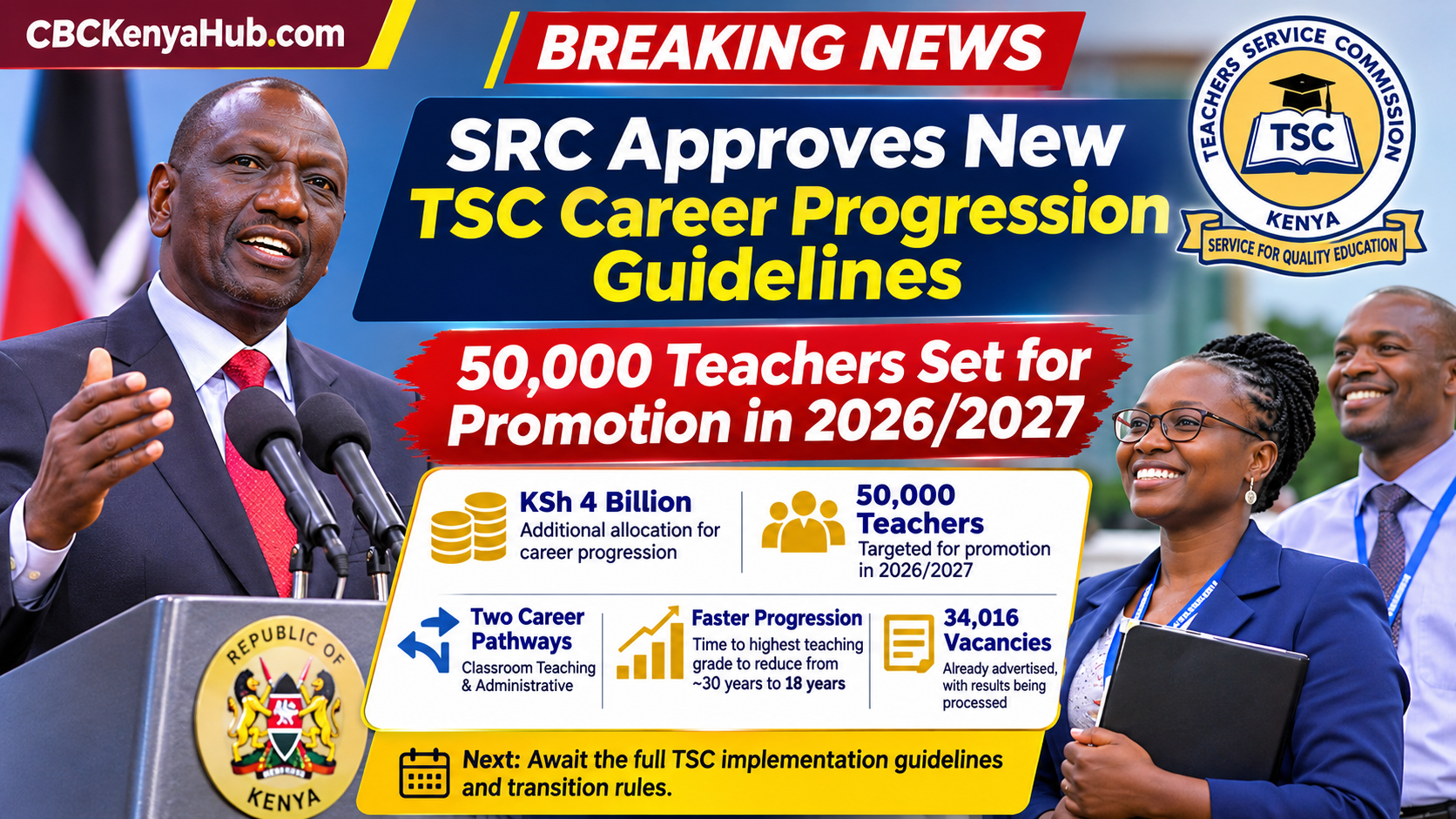
President Ruto announced that the government would provide an additional KSh 4 billion to facilitate teachers’ career progression, alongside plans to promote 50,000 teachers during the 2026/2027 financial year.
The development is expected to address longstanding concerns about career stagnation, limited promotion opportunities and the difficulties teachers have faced advancing through the existing career structure.
For thousands of educators who have remained in the same job groups for years despite gaining additional qualifications and experience, the announcement offers renewed hope.
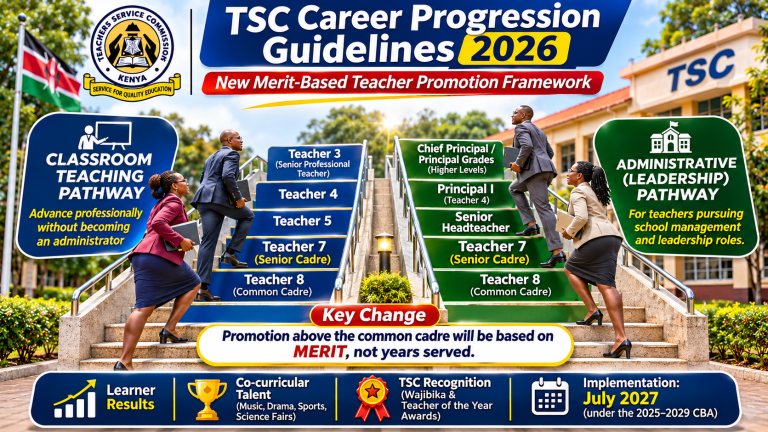
The revised framework is expected to introduce a more flexible career structure, allowing teachers to advance professionally without necessarily moving into school administration.
1. SRC Approves Revised TSC Career Progression Guidelines
The approval by SRC follows an extensive review of the 2018 Career Progression Guidelines, which have attracted criticism from teachers and their unions over promotion bottlenecks.
The Teachers Service Commission had earlier confirmed that it had reviewed the existing guidelines and undertaken public participation to gather views from education stakeholders.
On November 12, President Ruto confirmed that the revised guidelines had been concluded and approved by SRC.
The approval represents an important step towards implementing the proposed reforms.
SRC plays a critical role in advising on remuneration and benefits in the public service. Its involvement is particularly important where changes to job structures and remuneration have financial implications.
Teachers are now waiting for TSC to publish the complete revised guidelines, including the new career structure, promotion requirements, implementation timelines and transitional arrangements.
2. Government Allocates KSh 4 Billion for Teachers’ Career Progression
One of the biggest highlights of the announcement is the additional KSh 4 billion commitment towards teachers’ career progression.
For years, limited funding has been among the major challenges affecting teacher promotions.
Although thousands of teachers have met various professional requirements, promotion opportunities have remained dependent on available vacancies and budgetary allocations.
The additional funding is expected to strengthen the government’s capacity to implement the revised career framework and facilitate the planned promotion exercise.
However, teachers should understand that the KSh 4 billion announcement does not automatically translate into a uniform salary increment for every teacher.
The actual financial benefits will depend on the approved job evaluation, salary structure, promotion arrangements and implementation guidelines.
Teachers will therefore need to wait for official communication from TSC and SRC regarding the specific financial implications.
3. TSC Targets 50,000 Teacher Promotions in 2026/2027
The announcement of 50,000 teacher promotions is another significant development.
President Ruto stated that the government intends to promote 50,000 teachers during the current financial year, describing it as the largest single-year teacher promotion exercise in Kenya’s history.
The planned exercise is particularly important because TSC had previously advertised 34,016 promotion vacancies.
The additional government commitment raises expectations that the promotion exercise could be expanded to accommodate more eligible teachers.
For teachers who have spent years waiting for promotion interviews, the announcement could provide an opportunity to advance to higher professional grades.
The 50,000 target is expected to cover eligible teachers across different cadres, subject to the final implementation arrangements.
However, it is important to distinguish between the overall promotion target and the number of vacancies available in each grade.
TSC will need to communicate the distribution of promotion opportunities, eligibility requirements and the procedures for filling the positions.
Who stands to benefit from the 50,000 promotions?
The promotion exercise is expected to benefit eligible teachers serving in different institutions and professional cadres, including:
- Primary school teachers.
- Junior School teachers.
- Secondary school teachers.
- Senior school teachers.
- Teachers serving in administrative positions.
- Teachers in special needs education institutions.
- Teachers in other recognised teaching cadres.
The actual distribution will depend on the final promotion framework and available positions.
4. New TSC Career Progression Guidelines Introduce Two Career Pathways
Perhaps the most significant structural change in the revised framework is the introduction of two distinct career pathways.
Under the proposed arrangement, teachers will have the opportunity to progress through either the classroom teaching pathway or the administrative pathway.
This is intended to address one of the longstanding challenges in the teaching profession: the perception that teachers must move into administration to achieve meaningful career advancement.
A. Classroom Teaching Career Pathway
The classroom teaching pathway is designed for teachers who prefer to concentrate on teaching, learning, curriculum implementation, assessment and professional development.
Under this arrangement, teachers will have an opportunity to advance professionally while remaining directly involved in classroom instruction.
This is particularly important for experienced teachers who possess strong subject knowledge, pedagogical skills and the ability to mentor other educators but do not necessarily want administrative responsibilities.
The pathway is expected to recognise professional expertise, classroom performance, instructional leadership and contribution to learning outcomes.
B. Administrative Career Pathway
The administrative pathway will cater for teachers interested in school leadership and management.
It will provide opportunities for teachers seeking to take up responsibilities such as:
- Deputy Headteacher.
- Headteacher.
- Deputy Principal.
- Principal.
- Senior school leadership positions.
- Other recognised administrative appointments.
This pathway recognises the increasing responsibilities associated with managing educational institutions.
School administrators play an important role in curriculum implementation, staff supervision, financial management, learner welfare, institutional governance and strategic planning.
The introduction of two pathways is expected to provide teachers with greater professional flexibility.
Important: The exact job titles, grades, entry requirements and progression arrangements under the new pathways should be confirmed through the official TSC guidelines.
5. What Happens to Teachers Currently in Job Groups C1, C2, C3, C4 and C5?
This is one of the most important questions teachers are asking following the SRC approval announcement.
Thousands of teachers currently serving in different grades want to understand whether the revised guidelines will affect their existing job groups.
The new framework is expected to introduce changes to career progression arrangements, but the exact transition process has not yet been fully explained in the public announcement.
Teachers currently serving in the following grades will be particularly interested in the transitional arrangements:
| Current Job Group | Current Career Position | What Teachers Should Watch |
|---|---|---|
| C1 | Entry-level primary teaching grade | New entry and progression requirements |
| C2 | Primary teaching grade | Transition and eligibility arrangements |
| C3 | Primary and other teaching cadres | Recognition of experience and qualifications |
| C4 | Upper primary and secondary teaching cadres | New career progression opportunities |
| C5 | Experienced teaching cadres | Opportunities for advancement under the revised structure |
The table provides a general reference to existing grades, not an official mapping into the new framework.
TSC will need to clarify whether serving teachers will be automatically mapped into corresponding grades or whether additional requirements will apply.
Teachers should also establish whether their years of service, academic qualifications and professional experience will be recognised under the revised framework.
6. Will Teachers Receive Automatic Promotions Under the New CPGs?
The approval of the revised Career Progression Guidelines does not necessarily mean that all teachers will receive automatic promotions.
Promotion is an employment decision that must follow the applicable TSC requirements and approved procedures.
Even with the new framework, teachers should expect eligibility conditions relating to professional qualifications, experience, performance and the responsibilities attached to particular positions.
The revised guidelines are expected to clarify how these requirements will operate under the two career pathways.
Teachers should therefore avoid relying on unofficial job-group mapping charts or social media claims suggesting that particular grades will automatically move to higher positions.
The official TSC implementation circular will be the most reliable source of information.
7. How the New Guidelines Could Reduce Career Stagnation
Career stagnation has remained a major concern among Kenyan teachers.
Under the existing promotion arrangements, some teachers have spent many years in the same job groups despite accumulating substantial professional experience.
The problem has been particularly frustrating for classroom teachers who have demonstrated strong instructional abilities but have had limited opportunities to progress without taking up administrative positions.
The revised guidelines seek to address these challenges by establishing separate professional and administrative pathways.
If implemented effectively, the framework could provide several benefits.
First, greater career flexibility.
Teachers will have more opportunities to advance according to their professional interests and strengths.
Second, recognition of classroom expertise.
Experienced teachers may have better opportunities to progress without abandoning classroom teaching.
Third, improved professional motivation.
Clearer promotion pathways could encourage teachers to invest in professional development and improve instructional performance.
Fourth, better leadership development.
The administrative pathway could provide a more structured approach to developing school leaders.
Finally, improved retention.
A more attractive career structure could help retain experienced teachers within the teaching service.
8. What Happens to the 34,016 TSC Promotion Vacancies Already Advertised?
Before the latest announcement, TSC had advertised 34,016 promotion vacancies across various teaching cadres.
The vacancies attracted considerable interest from teachers seeking advancement.
However, the announcement of 50,000 promotions has raised questions about the relationship between the existing recruitment exercise and the new target.
Teachers want to know whether:
- The existing 34,016 vacancies will remain valid.
- Additional vacancies will be advertised to reach the 50,000 target.
- The current promotion interviews and results will be processed under the existing guidelines.
- Teachers who have already attended interviews will benefit from the revised framework.
- New promotion opportunities will be distributed across the classroom and administrative pathways.
At this stage, teachers should not assume that the 34,016 advertised vacancies have automatically been converted into the new framework.
TSC needs to issue an official clarification on the treatment of the ongoing promotion exercise.
For applicants who have already attended interviews, it is advisable to continue monitoring official TSC communication rather than assuming that the process has been cancelled or replaced.
9. What Teachers Should Do as They Wait for the New CPGs
With SRC approval now publicly confirmed, teachers should prepare for the next phase of implementation.
The following actions are recommended:
1. Update your professional records.
Ensure that your academic certificates, professional qualifications and employment records are accurate.
2. Confirm your current job group.
Understand your current grade and the requirements associated with your next career progression opportunity.
3. Maintain good TPAD records.
Performance management and professional accountability remain important aspects of the teaching service.
4. Develop your professional competencies.
Participate in recognised professional development activities and improve your instructional skills.
5. Monitor TSC announcements.
Pay attention to official circulars regarding the implementation of the revised guidelines.
6. Avoid misinformation.
Do not rely on unverified claims about automatic promotions, salary increases or guaranteed job-group changes.
10. What Teachers Are Waiting for from TSC
Although SRC approval represents a major milestone, several implementation questions remain unanswered.
Teachers are particularly interested in the following information:
| Issue | Clarification Required |
|---|---|
| New job structure | Official grades under the revised framework |
| Career pathways | Detailed classroom and administrative progression ladders |
| Transitional arrangements | How existing teachers will be mapped |
| Promotion criteria | Qualifications, experience and performance requirements |
| Salary implications | New remuneration arrangements, where applicable |
| Promotion vacancies | Distribution of the 50,000 promotion opportunities |
| Existing applications | Treatment of the 34,016 advertised vacancies |
| Implementation date | When the new guidelines will take effect |
Publication of the complete document will help teachers understand their professional prospects and make informed career decisions.
11. What Does the New CPG Mean for Teachers Implementing CBE?
The introduction of the revised career progression framework comes at an important moment in Kenya’s education sector.
The Competency-Based Education (CBE) system requires teachers to develop new instructional approaches, integrate technology, assess competencies and support learners in different educational pathways.
The transition to Senior School has also increased the demand for specialised teaching competencies.
Teachers are expected to demonstrate professional adaptability, creativity, innovation and continuous learning.
A modern career progression framework should therefore recognise the changing responsibilities of teachers.
The classroom pathway could be particularly important in recognising experienced teachers who contribute to curriculum delivery, instructional improvement, mentorship and professional development.
Similarly, the administrative pathway could strengthen leadership in institutions implementing the new education system.
The success of the revised framework will ultimately depend on how effectively it recognises the changing demands of teaching under CBE.
12. Will the New CPGs Improve Teachers’ Salaries?
Another major question concerns remuneration.
Teachers are interested in knowing whether the revised guidelines will result in higher salaries, new allowances or changes in their existing remuneration structures.
The additional KSh 4 billion allocation is intended to facilitate career progression.
However, it should not be interpreted as an across-the-board salary increase.
Any changes to remuneration will depend on the approved job evaluation and the applicable SRC decisions.
Teachers promoted to higher positions may benefit from the remuneration attached to their new grades, subject to the approved salary structure and implementation arrangements.
TSC and SRC will need to provide clear information about the financial implications of the new framework.
13. What Happens Next After SRC Approval?
The next phase will involve translating the approved framework into practical implementation arrangements.
Teachers will be looking to TSC for:
- Publication of the revised Career Progression Guidelines.
- Official communication on the new job structure.
- Detailed career progression pathways.
- Transitional arrangements for serving teachers.
- Clarification of promotion requirements.
- Communication on the 50,000 promotion target.
- Guidance on the existing promotion exercise.
- Implementation timelines.
These steps will be important in ensuring that the revised framework benefits teachers across the country.
The commission will also need to communicate how the new structure will operate across primary schools, Junior Schools, Senior Schools and other teaching institutions.
Frequently Asked Questions (FAQs)
1. Has SRC approved the new TSC Career Progression Guidelines?
Yes. President William Ruto announced on November 12, 2026, that SRC had approved the revised Career Progression Guidelines agreed upon by TSC and teachers’ unions.
2. How much money has the government allocated for the new TSC CPGs?
The government has announced an additional KSh 4 billion to facilitate teachers’ career progression.
3. How many teachers will be promoted in 2026/2027?
The government has announced a target of promoting 50,000 teachers during the 2026/2027 financial year.
4. Will classroom teachers benefit from the new CPGs?
Yes. The revised framework provides for a distinct classroom teaching pathway alongside the administrative pathway.
5. Will teachers automatically move from C1 to C2, C3 or C4?
Automatic movement has not been confirmed. Teachers will need to follow the official transition and promotion requirements published by TSC.
6. Will the new guidelines benefit teachers who have stagnated for years?
The reforms are intended to address career stagnation by providing more flexible professional progression opportunities. The actual benefits will depend on the final implementation requirements.
7. What happened to the 34,016 advertised TSC promotion vacancies?
The government has announced a target of 50,000 promotions. TSC is expected to clarify how the existing 34,016 vacancies will be treated under the new arrangements.
8. When will the new TSC Career Progression Guidelines be implemented?
SRC approval has been publicly announced, but teachers should await the official TSC implementation circular for the effective date and detailed procedures.
9. Will the new CPGs increase teachers’ salaries?
The revised framework may have remuneration implications for teachers progressing to higher grades. However, the KSh 4 billion allocation is not an automatic salary increment for all teachers.
10. Where can teachers get official updates on the new CPGs?
Teachers should monitor official communication from the Teachers Service Commission and the Salaries and Remuneration Commission.
Conclusion: A New Chapter for Kenya’s Teaching Profession
The SRC approval of the revised TSC Career Progression Guidelines represents a significant development for Kenya’s teaching profession.
The additional KSh 4 billion allocation and the government’s target of promoting 50,000 teachers in the 2026/2027 financial year have raised expectations among educators who have waited for meaningful career advancement opportunities.
More importantly, the proposed separation of classroom teaching and administrative career pathways could transform how teachers approach professional growth.
For years, many educators have felt that career advancement required leaving the classroom and pursuing administrative positions.
The new framework seeks to change that perception by recognising classroom expertise as an important professional pathway.
However, the real success of the reforms will depend on transparent implementation, clear promotion criteria, fair transitional arrangements and timely publication of the official guidelines.
Kenyan teachers are now waiting for TSC to turn SRC approval and the presidential announcement into a practical career progression framework that delivers meaningful opportunities across the teaching service.
CBCKenyaHub.com will continue following developments surrounding the revised TSC Career Progression Guidelines, teacher promotions, job-group changes and implementation of the new framework.
About the Author

Related posts:

Best Kitui County Senior Schools { C1 National, C2 Extra-County, C3 County and C4 Sub-County

How Senior School Simulators Are Redefining Kenya's Competency-Based Education (CBE)
Best Elgeyo-Marakwet County Senior Schools {C1 National, C2 Extra-County, C3 County and C4 Sub-Count...
KJSEA 2026 Marking Centres in Kenya: Full List of Schools, Counties and Physical Locations