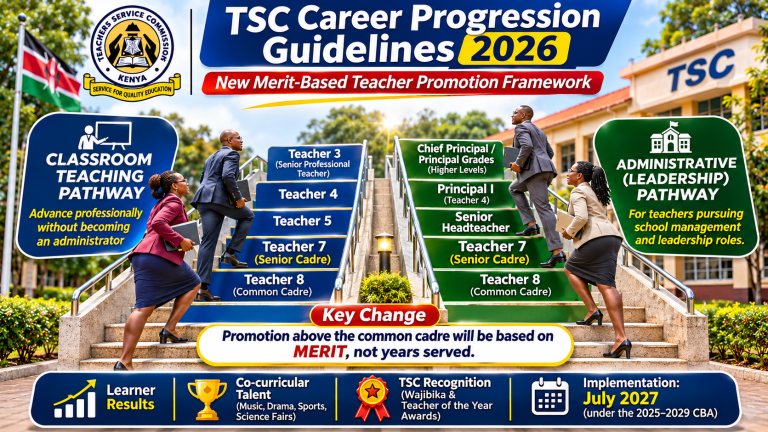

Thousands of teachers across Kenya could soon benefit from a major transformation in their career progression following reports that President William Ruto has approved the revised Teachers Service Commission (TSC) Career Progression Guidelines (CPG).
The reported approval, dated November 10, 2026, comes after months of consultations involving the Teachers Service Commission, teachers’ unions and the Salaries and Remuneration Commission (SRC).
The development is particularly significant for teachers who have experienced prolonged career stagnation under the existing promotion framework, which has been criticised for limiting advancement opportunities, especially for classroom teachers who do not wish to pursue administrative positions.
The latest announcement also comes amid the government’s expanded target of promoting 50,000 teachers during the 2026/2027 financial year.
If formally confirmed and implemented, the revised guidelines could mark one of the most significant changes to teacher career progression since the introduction of the current grading structure.
KSh 4 Billion Set Aside for Teacher Promotions
One of the major developments highlighted in the reported announcement is the proposed allocation of KSh 4 billion to support the implementation of the revised career progression framework.
The funding is expected to strengthen the government’s efforts to address the longstanding promotion backlog affecting teachers in primary, junior secondary and senior secondary schools.
The additional allocation would also support the expanded target of promoting 50,000 teachers during the 2026/2027 financial year.
Initially, the Teachers Service Commission advertised 34,016 promotion opportunities before President Ruto directed the Commission to increase the number to 50,000.
During the 2026 World Teachers’ Day celebrations at Kasarani Gymnasium on October 5, President Ruto pledged that the government would provide additional resources to facilitate the expanded promotion exercise.
The President also announced that the annual teacher promotion budget had been increased from KSh 1 billion to KSh 2 billion.
The expanded promotion target is expected to provide opportunities for teachers across different cadres, subject specialisations and administrative levels.
However, the precise amount and implementation arrangements for the additional funding will need confirmation through official government and TSC communication.
What Are the New TSC Career Progression Guidelines?
The Career Progression Guidelines are the policy framework used by the Teachers Service Commission to determine how teachers advance from one job grade to another.
The existing framework was introduced in November 2017 following changes to the teaching service grading structure.
Under the current arrangement, teachers progress through various job groups depending on their qualifications, experience, performance, availability of promotional opportunities and the requirements of their respective cadres.
However, the framework has attracted criticism from teachers’ unions and education stakeholders over the years.
Some teachers have remained in the same job group for extended periods despite gaining additional experience, attending professional development programmes and taking on additional responsibilities.
The revised guidelines are intended to address these challenges by providing clearer and more equitable professional advancement opportunities.
Major Changes Expected Under the Revised TSC CPG
Although teachers will need to wait for the official implementation circular to understand the final provisions, the proposed reforms have been associated with several important changes.
1. Introduction of Dual Career Progression Pathways
One of the most anticipated changes is the introduction of separate career progression pathways for classroom teachers and teachers pursuing administrative leadership.
Under the proposed model, teachers could have opportunities to advance professionally without necessarily becoming deputy principals, principals or other institutional administrators.
This is particularly important for experienced classroom teachers who prefer teaching, subject specialisation, mentorship and curriculum development.
The proposed dual-track system is expected to recognise the professional contribution of teachers who remain directly involved in classroom instruction.
2. Faster Career Advancement
The revised framework is also expected to address delays that have characterised teacher promotions.
Under the proposed reforms, clearer progression timelines and advancement requirements could help teachers understand what they need to achieve before qualifying for higher grades.
The changes are particularly important for teachers who have spent many years in the same job group.
The proposed reforms have also been associated with reducing the time required to reach the highest professional grade, with reports pointing to a possible reduction from 30 years to 18 years.
However, the final approved progression matrix, eligibility conditions and effective dates will determine how this proposal applies to individual teachers.
3. Recognition of Classroom Excellence
For many years, career advancement in the teaching profession has been closely associated with administrative responsibilities.
This has created challenges for teachers who excel in classroom instruction but have limited opportunities to advance without moving into school management.
The revised guidelines are expected to recognise classroom excellence as an important component of professional advancement.
Teachers specialising in Chemistry, Biology, Physics, Mathematics, Agriculture, Languages, Humanities and other learning areas could benefit from a framework that recognises professional expertise and instructional leadership.
4. Alignment with Competency-Based Education (CBE)
Kenya’s transition to Competency-Based Education has significantly changed the responsibilities of teachers.
Teachers are increasingly expected to facilitate learner-centred instruction, assess competencies, integrate digital learning resources and support learners in selecting appropriate senior school pathways.
The revised career progression framework is expected to take these changing professional responsibilities into consideration.
Senior School teachers, in particular, could benefit from clearer recognition of subject specialisation, curriculum implementation and professional expertise.
How the New CPG Could Affect Teachers in Different Job Groups
The implementation of the revised guidelines is expected to generate considerable interest among teachers serving in different grades.
The following table provides an overview of the existing grading structure and the potential areas of interest under the proposed reforms.
| Current Grade | Common Designation | Expected Area of Interest |
|---|---|---|
| B5 | Primary Teacher II | Improved progression opportunities |
| C1 | Primary Teacher I / Secondary Teacher III | Clearer advancement requirements |
| C2 | Senior Teacher II / Secondary Teacher II | Opportunities for professional growth |
| C3 | Senior Teacher I / Secondary Teacher I | Recognition of experience and specialisation |
| C4 | Deputy Headteacher II / Senior Master III | Improved progression pathways |
| C5 | Deputy Headteacher I / Senior Master II | Professional and leadership advancement |
| C6 | Headteacher / Senior Master I | Further career advancement |
| D1 | Deputy Principal III | Administrative progression |
| D2 | Deputy Principal II | Leadership progression |
| D3 | Deputy Principal I | Senior leadership advancement |
| D4 | Principal | Senior institutional leadership |
| D5 | Senior Principal | Highest administrative grades |
The final transition matrix will be important in determining how teachers in the existing grades move into the proposed structure.
Teachers should avoid assuming that the revised guidelines automatically guarantee promotion to a higher grade.
Eligibility, approved establishments, performance requirements and the final SRC-approved framework will remain important considerations.
TSC Targets 50,000 Teacher Promotions in 2026/2027
The revised career progression framework comes at a time when the government has announced an ambitious teacher promotion target.
President Ruto directed the Teachers Service Commission to increase the number of promotion opportunities from the initially advertised 34,016 to 50,000.
This would make the 2026/2027 financial year one of the largest teacher promotion exercises in Kenya’s history.
The expansion is expected to benefit teachers across different educational institutions and professional cadres.
The promotion exercise is particularly important for teachers who participated in the 2026 promotion interviews and those who meet the requirements for advancement.
The Commission will be expected to communicate how the expanded promotion target will be implemented and whether additional opportunities will be advertised.
What Happens to Teachers Who Already Attended 2026 Promotion Interviews?
One of the biggest questions among teachers concerns the status of those who participated in the 2026 TSC promotion interviews.
Will their interviews remain valid under the revised guidelines?
Will successful candidates be promoted using the existing framework or the new career progression structure?
Will additional teachers be considered following the expansion from 34,016 to 50,000 promotion opportunities?
These questions are expected to feature prominently in the implementation guidelines.
The most important document teachers should watch for is an official TSC circular explaining the transition arrangements.
Until the Commission issues formal communication, teachers who attended the interviews should continue monitoring their individual promotion status through official TSC communication channels.
Government to Recruit 20,000 Additional Teachers by December 2026
Besides the proposed career progression reforms, President Ruto has reiterated the government’s commitment to expanding the teaching workforce.
The government expects an additional 20,000 newly recruited teachers to report to their respective schools by December 2026.
The recruitment drive is intended to address staffing shortages in public schools, particularly as the country continues implementing Competency-Based Education.
The additional teachers are expected to strengthen staffing levels in primary, junior secondary and senior secondary institutions.
The government has also announced a separate allocation of KSh 4.9 billion to facilitate the conversion of 20,000 contract teachers who have completed two years of internship into permanent and pensionable employment beginning January 2027.
These measures are expected to improve teacher availability and strengthen the implementation of education reforms.
School Capitation: Government Orders Comprehensive Review
Another important issue highlighted in the reported November 12 announcement concerns school capitation.
The President reportedly directed the Ministry of Education and the Teachers Service Commission to prepare a comprehensive report on school capitation by January 2027.
The proposed review comes amid concerns from school administrators regarding the adequacy and timely disbursement of government funding.
Capitation is essential in supporting the day-to-day operations of public learning institutions.
Schools depend on government funding to support learning materials, examinations, administration, infrastructure maintenance and other essential educational activities.
A comprehensive review could help the government identify existing funding gaps and develop measures to improve the financing of public schools.
Principals and school heads will be particularly interested in the outcome of the proposed assessment.
What Teachers Should Expect Next from TSC
Following the reported approval of the revised Career Progression Guidelines, attention now shifts to the Teachers Service Commission.
The Commission is expected to communicate the implementation arrangements once the necessary approvals and administrative procedures are completed.
Teachers should particularly look out for the following:
- Official TSC circular: A formal communication confirming the revised Career Progression Guidelines.
- New grading structure: Details showing how existing teacher job groups will correspond with the revised career framework.
- Promotion requirements: Clear information on academic qualifications, experience, performance and other eligibility conditions.
- Classroom teacher progression: Details of how teachers will advance without necessarily moving into administrative positions.
- Transition arrangements: Guidelines explaining how teachers who participated in the 2026 promotion interviews will be handled.
- Promotion vacancies: Further communication on the expanded 50,000 promotion target.
- Effective implementation dates: Confirmation of when the revised guidelines will become operational.
Teachers should rely on official TSC circulars rather than unofficial social media announcements when making decisions concerning their careers.
What the New TSC Career Progression Guidelines Mean for Kenyan Teachers
The proposed reforms could have far-reaching implications for the teaching profession.
For classroom teachers, the most important development is the possibility of advancing professionally without leaving the classroom.
For teachers in leadership positions, the revised framework could provide clearer progression requirements and recognition of administrative responsibilities.
For teachers serving in Junior and Senior Schools, the reforms could also provide an opportunity to align professional advancement with the changing demands of Competency-Based Education.
More importantly, the reforms could help address a longstanding concern among teachers: the relationship between years of service, professional competence, responsibilities and career advancement.
However, the actual benefits will depend on the final approved guidelines, the available promotion budget and the Commission’s implementation arrangements.
Frequently Asked Questions About the New TSC Career Progression Guidelines 2026
1. Has President Ruto approved the new TSC Career Progression Guidelines?
Reports dated November 12, 2026, indicate that the revised guidelines received approval on November 10. Teachers should await formal confirmation and implementation communication from the relevant government agencies and TSC.
2. How much money has been allocated for the new TSC promotions?
The November 12 announcement being reported mentions an additional KSh 4 billion. Earlier, President Ruto confirmed that the annual promotion budget had increased from KSh 1 billion to KSh 2 billion, alongside a directive to increase promotion opportunities to 50,000.
3. How many teachers will be promoted in 2026/2027?
The government’s announced target is 50,000 teachers, up from the initially advertised 34,016 promotion opportunities.
4. Will classroom teachers benefit from the new CPG?
The proposed reforms are expected to introduce separate professional advancement pathways, potentially allowing classroom teachers to advance without necessarily becoming school administrators.
5. Will teachers who attended the 2026 promotion interviews benefit?
Their position will depend on the official transition arrangements issued by TSC. The Commission will need to clarify whether the existing interviews and promotion processes will continue under the current framework or be adjusted.
6. Will the new guidelines reduce the time taken to reach the highest job group?
Reports on the proposed framework have indicated a possible reduction in the progression period from 30 years to 18 years. The final approved guidelines will determine the actual timelines and conditions.
7. When will the new TSC Career Progression Guidelines take effect?
The effective date will be confirmed through official TSC communication after the approval and implementation procedures are completed.
Conclusion
The reported approval of the revised TSC Career Progression Guidelines represents a potentially significant development for Kenya’s teaching profession.
After years of concerns over career stagnation, teachers are hoping for a framework that recognises experience, professional competence, classroom excellence and administrative leadership.
The expanded target of 50,000 promotions, alongside the proposed additional funding, could provide an important opportunity to address the longstanding promotion backlog.
However, teachers will be looking to the Teachers Service Commission for the final grading structure, promotion criteria, transition matrix and implementation dates.
For thousands of educators, the central question is no longer simply when the next promotion exercise will take place, but whether the new framework will finally provide a fair and predictable path for career advancement.
Keep following CBCKenyaHub.com for updates on the new TSC Career Progression Guidelines, 2026 teacher promotions, promotion interview results, job groups and official implementation circulars.
About the Author

Related posts:

Is Kenya Ready for KNEC’s Digital Assessment Shift?

BREAKING NEWS: TSC Closes May 2026 Payroll as New “White Smoke Detectors” Set to Be Installed in Sch...

How to Apply for TSC International Teaching Jobs 2026

TSC P1 Teachers Recruitment 2026: 5,609 Jobs Announced, When Will Unemployed Primary Teachers Get Em...