
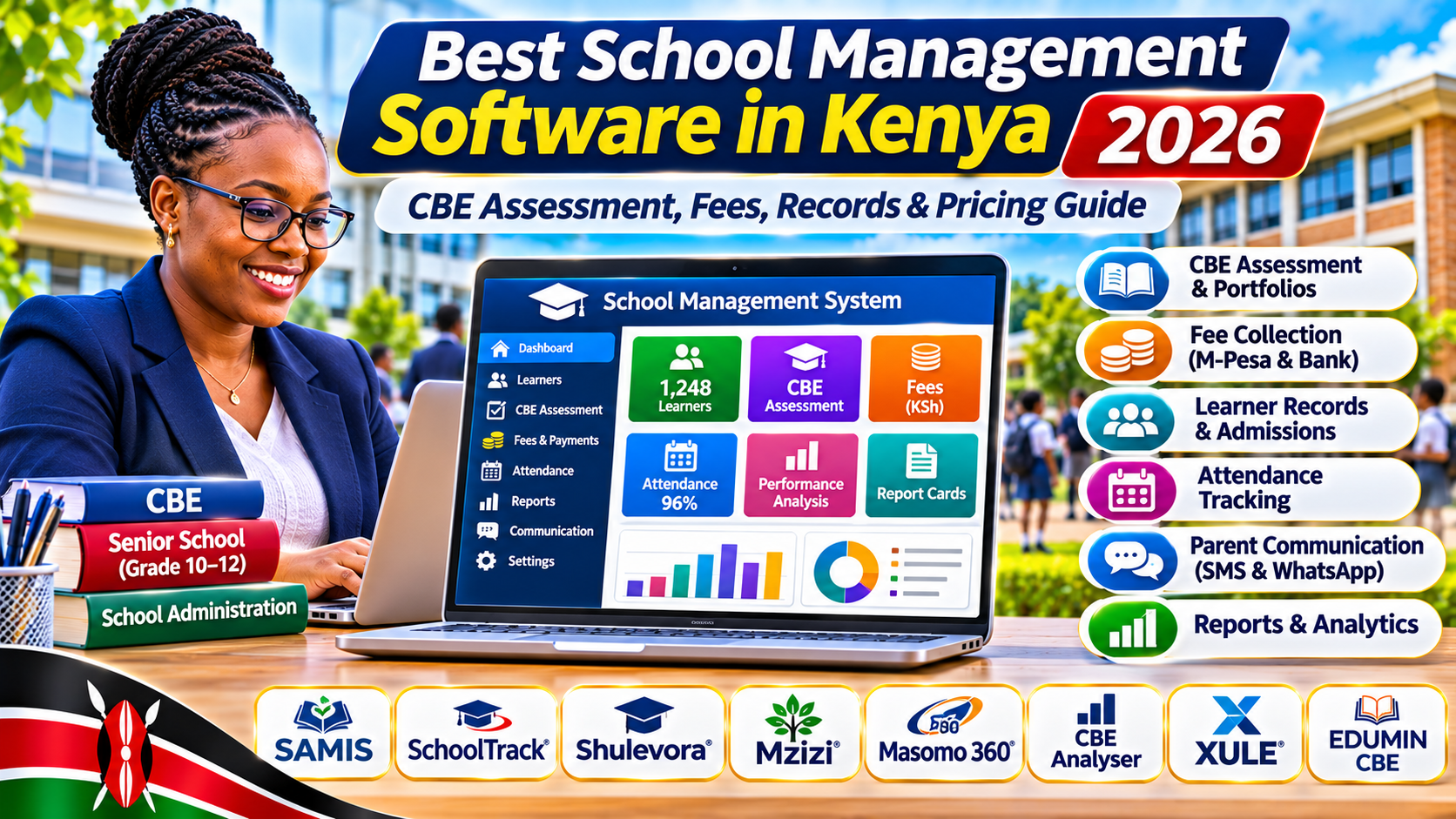
The transition to Competency-Based Education (CBE) has increased the need for reliable digital systems in Kenyan schools. Teachers are expected to record learner progress, assess competencies, maintain evidence of learning, prepare reports, and communicate with parents. At the same time, school administrators must manage admissions, attendance, fees, staff records, timetables, and financial reports.
Handling all these responsibilities using paper records and spreadsheets can become difficult, particularly in institutions with large learner populations.
A school management system can simplify these tasks by bringing academic records, CBE assessments, finance, attendance, and parent communication into one digital platform.
Some of the school management software platforms available to Kenyan institutions include SAMIS, SchoolTrack, Shulevora, Mzizi, Masomo 360, CBE Analyser, XULE, and EDUMIN CBE.
This guide compares their advertised features, published pricing where available, and important considerations before a school purchases a subscription.
Quick Answer: Which Is the Best School Management Software in Kenya?
The best system depends on the size of your institution, budget, curriculum requirements, and the features you need.
| School management system | Key advertised features | Pricing information |
|---|---|---|
| SAMIS | CBE assessment, finance, inventory, timetable, e-learning | Request a quotation |
| SchoolTrack | CBE portfolios, fees, M-Pesa, reports and parent portal | From KSh 100 per learner per term |
| Shulevora | Learner records, CBE, finance, timetable and reports | Free starter plan; paid plans available |
| Mzizi | School administration, assessment, fees and parent communication | Contact provider |
| Masomo 360 | CBE assessment, accounting, timetabling and administration | Request a demo and quotation |
| CBE Analyser | CBE assessment, analytics, finance and communication | Contact provider |
| XULE | Admissions, marksheets, fees, attendance and parent SMS | Request a demo |
| EDUMIN CBE | Student management, financial records and assessment tools | Published term-based plans |
Pricing and features are based on information displayed by the providers’ websites at the time of writing. Schools should confirm current charges, setup fees, taxes, support costs, and available modules directly with each provider.
1. What Is School Management Software?
School management software is a digital platform designed to help educational institutions coordinate their academic, administrative, financial, and communication activities.
Instead of maintaining separate files for admissions, examination results, fees, attendance, and staff records, a school can use one connected system.
Depending on the platform, the software may provide:
- Student registration and admission records.
- Teacher and staff management.
- CBE assessment and learner progress tracking.
- Examination marks entry and analysis.
- Digital report cards.
- School fees management.
- M-Pesa and bank payment reconciliation.
- Timetable preparation.
- Attendance monitoring.
- Parent communication through SMS or WhatsApp.
- Library and inventory management.
- Financial reports and accounting.
For Kenyan schools, the most important consideration is whether the software supports the country’s current curriculum and assessment requirements.
2. Why Kenyan Schools Need CBE Assessment Software
Competency-Based Education requires schools to monitor more than examination marks.
Learners demonstrate their abilities through practical activities, projects, presentations, written tasks, discussions, and other learning experiences. Teachers need systems that help them document performance and provide meaningful feedback.
The Kenya National Examinations Council (KNEC) explains that Competency-Based Assessment involves gathering information from multiple sources to determine what learners know, what they need to learn, and what they can do.
A digital CBE assessment platform can support this process by allowing teachers to:
- Record assessment results.
- Assess learners against relevant competencies.
- Document strands and sub-strands.
- Upload evidence of learning where supported.
- Track individual learner progress.
- Generate learner progress reports.
- Identify areas requiring additional support.
- Share relevant progress information with parents.
Schools should remember that software supports assessment administration; it does not replace professional teacher judgment or official KNEC assessment procedures.
3. Best School Management Software in Kenya
1. SAMIS School Management System
SAMIS is a school management platform offering academic, financial, inventory, timetable, and e-learning modules.
Its website advertises support for both the 8-4-4 system and CBE, including CBE strands, competencies, portfolios, and rubrics.
Key advertised features include:
- Student admission and academic records.
- CBE assessment and learner portfolios.
- Examination marks entry.
- KNEC-related reporting tools.
- Fee structures and digital receipts.
- Inventory management.
- Timetable generation.
- Parent SMS communication.
- Mobile, web, and desktop access.
SAMIS also advertises offline functionality for selected modules. Schools should confirm which features work offline before implementation.
Best suited for: Institutions looking for a broad school management platform combining academics, finance, inventory, and communication.
Website: https://www.samis.co.ke/
2. SchoolTrack
SchoolTrack offers a school management platform with published per-learner pricing.
Its advertised Standard plan costs KSh 100 per learner per term, while the Advanced plan costs KSh 150 per learner per term. A Premier plan is listed at KSh 250 per learner per term.
The provider also states that a one-time setup fee applies.
Features advertised include:
- Learner records and guardian information.
- Attendance management.
- Fee collection and M-Pesa integration.
- CBE assessment rubrics.
- Learner evidence portfolios.
- KNEC School-Based Assessment support.
- Digital report cards with QR codes.
- SMS and WhatsApp communication.
- Parent portal.
- Examination analysis.
- Senior School pathways and Grade 10 intake on the Advanced plan.
The published pricing makes SchoolTrack worth considering for schools that prefer a per-learner subscription model.
Best suited for: Schools seeking published per-learner pricing and integrated academic and financial workflows.
Website: https://schooltrack.co.ke/
3. Shulevora School Management System
Shulevora provides school administration tools designed for Kenyan institutions.
Its advertised modules cover learner registration, attendance, fees, parent communication, timetabling, finance, and CBE-related administration.
The provider publishes several subscription options:
| Plan | Published pricing | Advertised capacity |
|---|---|---|
| Starter | Free | Up to 75 learners |
| Basic | KSh 2,000 + KSh 18 per learner per month | Up to 350 learners |
| Standard | KSh 5,500 + KSh 22 per learner per month | Up to 1,200 learners |
| Elite Enterprise | KSh 28,000 + KSh 45 per learner per month | Multi-campus and larger institutions |
Features vary by subscription. The Standard plan, for example, advertises M-Pesa and bank reconciliation, expense tracking, staff records, library management, and inventory management.
Schools should confirm the applicable billing period, onboarding charges, and whether the published prices include all required modules.
Best suited for: Schools comparing free entry-level options with more comprehensive paid management systems.
Website: https://shulevora.co.ke/
4. Mzizi School Management System
Mzizi is a school management platform developed for institutions in Kenya and the wider East African region.
Its website advertises support for multiple curricula, including CBE, 8-4-4, and IGCSE.
The platform highlights:
- Learner and parent records.
- Academic and assessment management.
- Fee collection and reconciliation.
- M-Pesa and bank payment workflows.
- Digital report cards.
- Parent communication through SMS and WhatsApp.
- School administration tools.
Mzizi also advertises a free 30-day trial, allowing schools to explore the platform before committing to a subscription.
Best suited for: Schools seeking a platform that combines academic administration, fee management, and parent engagement.
Website: https://www.mzizi.co.ke/
5. Masomo 360
Masomo 360 combines school administration with accounting and financial reporting.
Its advertised modules include admissions, examinations, CBE assessment, timetabling, parent communication, and financial management.
One of its distinguishing features is its emphasis on accounting workflows, including double-entry bookkeeping and financial reporting.
Other advertised capabilities include:
- Learner and staff management.
- CBE formative and summative assessment.
- Competency-based progress reports.
- KCSE grading and analysis.
- Timetable generation.
- M-Pesa payment integration.
- Financial records and accounting.
- Role-based access for different school departments.
Best suited for: Schools that want academic management and more extensive accounting functionality within one platform.
Website: https://www.masomo360.com/
6. CBE Analyser
CBE Analyser is a platform focused on school administration and competency-based assessment.
Its website advertises modules for academic management, learner records, teacher management, finance, timetabling, and parent communication.
Its features include:
- CBE assessment and report forms.
- Marks entry and merit lists.
- Learner and teacher management.
- Performance analytics.
- Fee management with M-Pesa.
- Bulk SMS.
- Timetable management.
- Android application access.
The platform is particularly relevant to schools looking for assessment and performance analysis tools.
Best suited for: Institutions prioritizing CBE assessment, learner progress reports, and academic analytics.
Website: https://cbeanalyser.com/
7. XULE School Information Management System
XULE provides a school information management system designed for different levels of Kenyan education.
Its website lists support for:
- Pre-primary.
- Primary.
- Junior School.
- Senior School.
- The remaining 8-4-4 school structures during the transition.
Advertised features include:
- Admissions and learner records.
- CBE assessment and marksheets.
- Examination reports.
- Fees and receipts.
- Attendance tracking.
- Cashbook records.
- Parent SMS notifications.
- Role-based access for school administrators, teachers, parents, and bursars.
Best suited for: Schools looking for a connected system for academic records, fee management, attendance, and parent communication.
Website: https://xule.co.ke/
8. EDUMIN CBE
EDUMIN CBE provides digital management tools for schools implementing competency-based education.
Its published pricing page lists a Junior School plan at KSh 3,500 for Term 1, KSh 3,000 for Term 2, and KSh 2,500 for Term 3.
The provider also advertises a Junior and Primary package with additional modules.
Features include:
- Student management.
- Teacher and staff portals.
- Financial management.
- Academic records.
- CBE assessment tools.
- Parent communication.
- Reporting tools.
- Timetabling and analytics on selected plans.
Best suited for: Schools seeking term-based subscription options for academic and administrative management.
Website: https://www.edumin.co.ke/
4. Comparison: Which School Management System Should You Choose?
The following comparison summarizes the main advertised strengths of the platforms discussed.
| Software | CBE assessment | Finance and fees | Parent communication | Published pricing |
|---|---|---|---|---|
| SAMIS | Yes | Yes | Yes | Contact provider |
| SchoolTrack | Yes | Yes | Yes | Yes |
| Shulevora | Yes | Yes | Yes | Yes |
| Mzizi | Yes | Yes | Yes | Contact provider |
| Masomo 360 | Yes | Yes | Yes | Contact provider |
| CBE Analyser | Yes | Yes | Yes | Contact provider |
| XULE | Yes | Yes | Yes | Request details |
| EDUMIN CBE | Yes | Yes | Yes | Yes |
The best choice is not necessarily the software with the highest number of modules. A school should select a platform that solves its most pressing administrative and academic challenges.
5. Essential Features to Look for in CBE Assessment Software
Before purchasing a subscription, school administrators should evaluate the following features.
A. Competency-Based Assessment
The platform should support the school’s assessment requirements, including:
- Learning areas and subjects.
- Strands and sub-strands.
- Competency tracking.
- Assessment rubrics.
- Formative and summative assessment records.
- Evidence of learner achievement.
- Individual progress reporting.
Schools should confirm that the platform can accommodate the assessment structures relevant to their learners’ grades and pathways.
B. Digital Learner Portfolios
Learner portfolios help document work completed over time.
A useful platform should allow authorized teachers to store or reference evidence such as:
- Project photographs.
- Practical activity records.
- Written assignments.
- Research activities.
- Performance tasks.
- Teacher observations.
- Other relevant evidence of learning.
The system should also make it possible to retrieve records when preparing learner progress reports.
C. Examination Management
Schools still need to organize tests, examinations, marks entry, and academic analysis.
Useful examination features include:
- Marks entry by subject teachers.
- Class and stream analysis.
- Examination broadsheets.
- Report card generation.
- Performance comparisons.
- Moderation and approval workflows.
- Secure editing and locking of published results.
D. School Fees Management
A good school management system should simplify financial administration.
Look for:
- Customizable fee structures.
- Student fee statements.
- Payment receipts.
- M-Pesa integration.
- Bank payment recording.
- Arrears tracking.
- Financial reports.
- Payment reminders.
The school should also confirm whether the system supports the school’s actual payment collection procedures.
E. Parent and Guardian Portal
Parents need timely and secure access to relevant information.
A parent portal may provide:
- Learner attendance.
- Academic reports.
- Assessment progress.
- Fee balances.
- Payment receipts.
- School announcements.
- Teacher communication.
A system should ensure that parents can only access information relating to learners they are authorized to view.
F. Grade 10–12 Senior School Support
With the implementation of Senior School, institutions should check whether their chosen software can handle:
- Grade 10, Grade 11, and Grade 12 learner records.
- Senior School pathways.
- Subject combinations.
- Class and stream organization.
- Teacher subject allocation.
- Assessment and progress reports.
- Learner transition records.
Do not assume that a system supporting primary and junior school automatically supports every Senior School workflow.
6. How Much Does School Management Software Cost in Kenya?
The cost depends on the provider, number of learners, subscription model, and modules selected.
Common pricing models include:
| Pricing model | How it works | What schools should check |
|---|---|---|
| Per learner per term | Payment depends on enrolment | Minimum learner charges and annual cost |
| Per learner per month | Monthly subscription based on enrolment | Billing frequency and learner limits |
| Fixed monthly fee | School pays a fixed subscription | Included modules and capacity |
| Per-term subscription | Payment is made each school term | Termly changes and renewal conditions |
| Custom quotation | Provider prepares a school-specific price | Setup, training, migration, and support fees |
For example, a school with 500 learners using a platform charging KSh 100 per learner per term would pay:
500 × KSh 100 = KSh 50,000 per term.
At KSh 150 per learner per term, the same school would pay KSh 75,000 per term.
These examples illustrate how per-learner pricing works; they are not quotations for every school management system.
Before signing a contract, request a written quotation showing the full cost of implementation and continued use.
7. How to Choose the Right School Management Software for Your School
A school should not purchase software simply because another institution is using it.
The selection process should begin with an assessment of the school’s needs.
Step 1: Identify the School’s Main Challenges
Determine whether the greatest problem is:
- CBE assessment and reporting.
- Fee collection and reconciliation.
- Examination management.
- Attendance monitoring.
- Parent communication.
- Inventory and financial management.
- Learner records.
This helps the school prioritize the modules it needs.
Step 2: Request a Live Demonstration
Ask the provider to demonstrate actual school workflows.
For example, a teacher should be able to show how to enter assessment results, while a bursar should demonstrate how to record payments and generate fee statements.
Avoid making a decision based only on promotional videos.
Step 3: Test the Software with Realistic Data
Where possible, request a trial account or demonstration environment.
Test the platform using sample learner records, subjects, classes, assessment activities, and fee structures.
Step 4: Check Mobile and Internet Compatibility
Teachers and parents increasingly access school information through smartphones.
Check whether the platform works properly on Android phones, tablets, laptops, and desktop computers.
Schools in areas with unreliable internet should ask whether selected functions can operate offline and synchronize when connectivity returns.
Step 5: Evaluate Training and Technical Support
A school management system is only useful when staff members know how to use it.
Confirm whether the subscription includes:
- Initial staff training.
- Administrator training.
- User manuals.
- Technical support.
- System updates.
- Data migration.
- Ongoing troubleshooting.
Step 6: Check Data Protection and Security
Schools handle sensitive information about learners, parents, teachers, and employees.
Before adopting a digital platform, administrators should establish:
- Who owns and controls the school data.
- Who can access learner records.
- Whether users have role-based permissions.
- How passwords and records are protected.
- Whether information is backed up.
- How data can be exported if the school changes providers.
- What happens when a subscription ends.
- How the provider handles data breaches and deletion requests.
Kenyan schools should consider the Data Protection Act, 2019, and guidance issued by the Office of the Data Protection Commissioner.
8. Data Protection: What Schools Must Consider Before Going Digital
Digital school records create convenience, but they also introduce privacy responsibilities.
A school management platform may process:
- Learner names and dates of birth.
- Parent and guardian contacts.
- Academic results.
- Attendance records.
- Medical information.
- Photographs and videos.
- Payment and fee records.
- Staff personal information.
The school should establish a lawful basis for processing personal data and ensure that information is collected for clear purposes.
It should also ensure that access is limited to authorized users.
For example, a parent should not be able to view another learner’s academic records or fee statements.
Schools should ask software providers for information about data hosting, backups, access controls, security procedures, data retention, and their responsibilities under Kenyan data protection requirements.
9. Can School Management Software Replace KNEC Assessment Portals?
No. School management software should not be treated as a replacement for official KNEC systems.
Private platforms can help teachers record, organize, analyze, and manage assessment information. However, schools must continue following official KNEC procedures and use the relevant official portals when required.
The KNEC CBA Portal provides official assessment-related services, including access for registered schools and authorized users.
Schools should verify the current assessment instructions, registration procedures, reporting requirements, and submission deadlines through official KNEC communication.
10. Frequently Asked Questions About School Management Software in Kenya
Which is the best school management software in Kenya?
There is no single best system for every school. SAMIS, SchoolTrack, Shulevora, Mzizi, Masomo 360, CBE Analyser, XULE, and EDUMIN CBE offer different combinations of academic, financial, and administrative features. Schools should compare their requirements, pricing, support, and data protection arrangements.
Which software supports CBE assessment in Kenya?
Several providers advertise CBE-related features, including SchoolTrack, SAMIS, Shulevora, Mzizi, Masomo 360, CBE Analyser, XULE, and EDUMIN CBE. Schools should request demonstrations to verify the specific assessment workflows available.
How much does school management software cost in Kenya?
Costs vary. Some providers charge per learner per term, others charge monthly or per term, while some prepare custom quotations. Published examples include SchoolTrack’s per-learner plans and Shulevora’s monthly subscription options.
Can teachers enter CBE assessment marks using a mobile phone?
Some platforms advertise mobile access and mobile marks entry. Schools should test the actual teacher interface before purchasing a subscription.
Can parents access examination results online?
Yes. Several platforms advertise parent portals or SMS and WhatsApp communication features through which authorized parents can receive academic updates.
Is school management software suitable for Senior Schools?
Some providers advertise support for Senior School administration and Grade 10 intake. Schools should confirm that the system supports their required Grade 10–12 records, subject combinations, pathways, and assessment workflows.
Can a school use school management software without internet?
Some systems offer offline functionality for selected modules. However, offline access is not universal. Schools should ask providers to demonstrate which activities work without internet and how records synchronize after connectivity returns.
11. Final Verdict: Is School Management Software Worth the Investment?
School management software can help Kenyan institutions reduce paperwork, improve financial accountability, organize academic records, and strengthen communication between teachers, parents, and administrators.
For schools implementing CBE, digital assessment tools can also make it easier to organize learner progress records, assessment evidence, and reports.
However, purchasing a platform should be a carefully considered institutional decision.
Before committing, compare at least three providers, request live demonstrations, test the assessment and finance modules, examine the total subscription cost, and review the provider’s data protection arrangements.
The right platform should make school administration easier while supporting teachers in their most important responsibility: facilitating learning and helping every learner develop the knowledge, skills, values, and competencies needed for the future.
For school administrators: Start by identifying the three administrative tasks that consume the most time in your institution. Use those tasks as the basis for comparing software demonstrations and subscription plans.
About the Author

Related posts:

TSC Salary Structure 2026/2027: How Much Will Newly Employed JSS and Replacement Teachers Earn?

IMPORTANT KJSEA UPDATES (2025–2026 Guide)

How to Teach CBC Practical Lessons with Zero Budget

Top Private Universities in Kenya 2026/2027: Tuition Fees, Accredited Courses and Admission Requirem...