
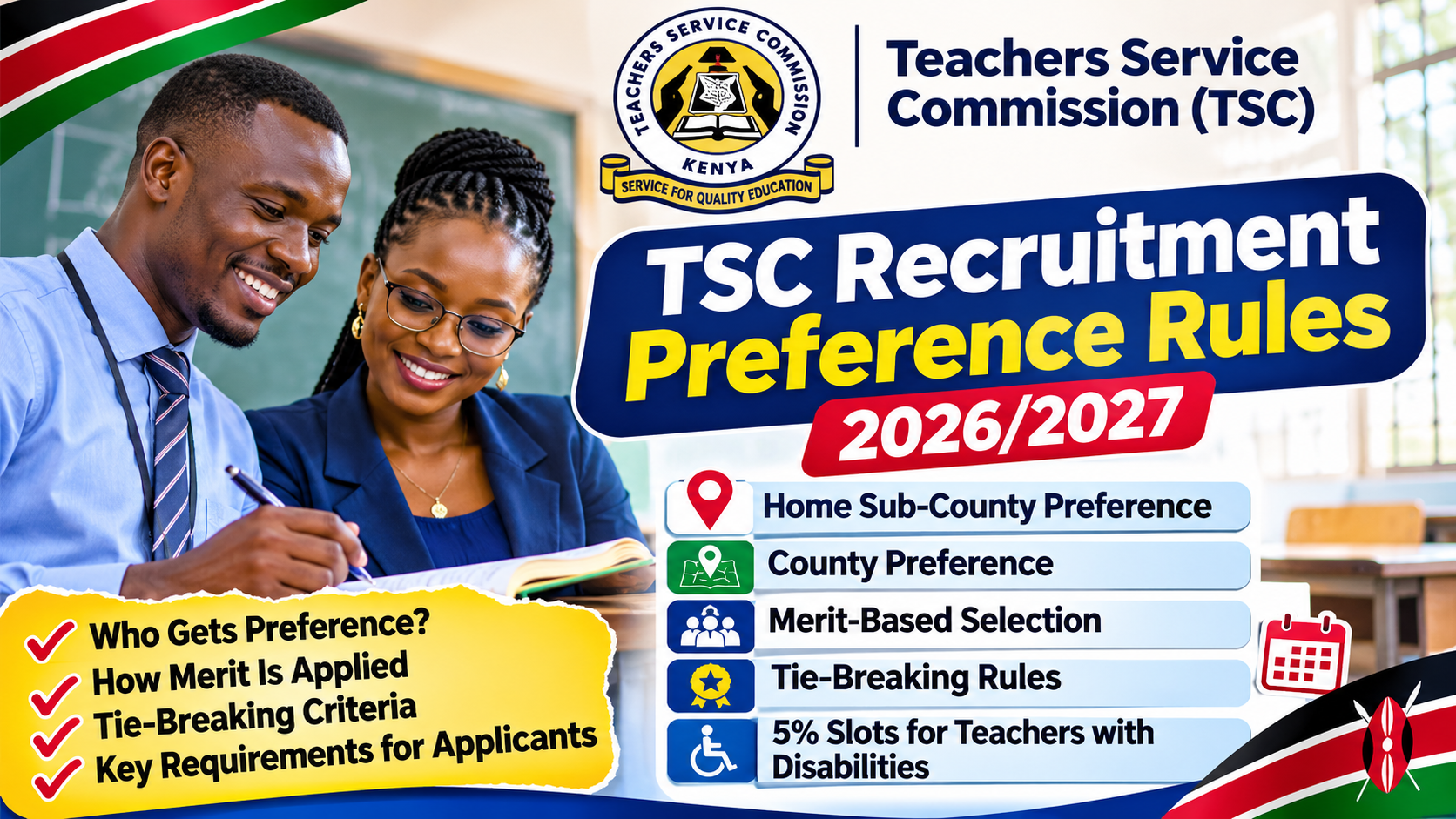
The Teachers Service Commission (TSC) has outlined important recruitment preference rules that will guide the selection of teachers during the 2026/2027 financial year recruitment exercise. The guidelines explain how applicants from different sub-counties and counties will be considered, the importance of merit, and the tie-breaking criteria used when candidates obtain equal scores.
The recruitment guidelines are particularly important for thousands of unemployed trained teachers seeking permanent and pensionable (P&P) employment following the Commission’s announcement of 7,720 replacement teaching vacancies in primary, junior and secondary schools.
According to the recruitment provisions, preference is given to applicants who have not previously been employed by TSC on permanent and pensionable terms. The selection process also considers applicants’ home sub-counties and counties, alongside their recruitment scores.
The applicable guidelines are contained in TSC Circular No. 20/2026 for primary school recruitment, dated 21 October 2026, and Circular No. 15/2026 for post-primary recruitment, dated 13 August 2026.
TSC Recruitment Preference Rules 2026: What Applicants Need to Know
The recruitment preference framework establishes how candidates are considered when filling advertised teaching vacancies.
The major considerations include:
- Applicants who have never been employed by TSC on permanent and pensionable terms receive preference.
- Applicants from the sub-county where the vacancy is advertised receive geographical preference.
- Applicants from the respective county are considered after the local sub-county applicants.
- Applicants from other counties may also be considered where necessary.
- Candidates are evaluated using the applicable recruitment score sheets and merit lists.
Importantly, geographical preference does not eliminate the requirement for merit-based recruitment. Candidates must satisfy the applicable qualifications and recruitment criteria.
1. Preference for Applicants Never Employed by TSC
One of the most important provisions in the 2026/2027 recruitment exercise concerns applicants who have never secured permanent and pensionable employment with the Teachers Service Commission.
TSC gives preference to candidates who have not previously been employed by the Commission on permanent and pensionable terms.
This provision is particularly significant for unemployed trained teachers who have been waiting for employment opportunities for several years.
However, applicants should distinguish between previous internship engagement and previous permanent and pensionable employment. The two are not necessarily treated equally under the recruitment guidelines.
For post-primary recruitment, internship experience with TSC is also an important scoring consideration.
2. Home Sub-County Preference in TSC Recruitment
The recruitment guidelines provide for geographical preference, beginning with applicants from the sub-county where the advertised vacancy is located.
For example, if TSC advertises a teaching vacancy in Mbeere North Sub-County, applicants whose home sub-county is Mbeere North may receive preference over applicants from other sub-counties, subject to the applicable merit and recruitment provisions.
This arrangement is intended to give consideration to teachers from the local communities where vacancies arise.
The selection panel records the following information:
- Applicant’s home county.
- Applicant’s home sub-county.
- County where the vacancy was advertised.
- Sub-county where the vacancy was advertised.
Applicants should therefore provide accurate personal and geographical information during the recruitment process.
3. County Preference in Teacher Recruitment
After considering applicants from the respective sub-county, the recruitment process provides for consideration of qualified applicants from the wider county.
For instance, where a vacancy is advertised in Makueni County, applicants from the respective sub-county are considered before other qualified applicants from Makueni County.
Where suitable applicants are unavailable or vacancies remain unfilled, applicants from other counties may also be considered under the applicable recruitment provisions.
This arrangement gives local applicants an opportunity while maintaining the Commission’s responsibility to fill advertised teaching positions.
4. How TSC Uses Merit Lists During Recruitment
Merit remains an important component of the recruitment process.
Applicants are evaluated using the official recruitment score sheets applicable to their respective teaching categories.
The recruitment panel considers academic and professional qualifications, age, length of stay since qualifying as a teacher and, for post-primary applicants, internship experience where applicable.
The scores obtained determine an applicant’s position on the relevant merit list.
The geographical preference provisions are then applied in accordance with the applicable circulars.
Applicants should therefore avoid assuming that being from the sub-county where a vacancy is advertised automatically guarantees employment.
Meeting the minimum qualifications and obtaining a competitive recruitment score remain essential.
5. TSC Recruitment Tie-Breaking Rules 2026
Another important provision concerns candidates who obtain equal marks during the recruitment exercise.
TSC has established tie-breaking criteria to guide selection where two or more applicants obtain identical scores.
The criteria include:
| Order | Primary Recruitment | Post-Primary Recruitment |
|---|---|---|
| 1 | Length of stay since graduation | Length of stay since graduation |
| 2 | Quality of academic certificates | Quality of academic certificates presented |
| 3 | Professional certificates presented | Quality of professional certificates presented |
| Further consideration | Aggregate KCSE grade or equivalent | Subject grades |
For post-primary recruitment, the year an applicant satisfactorily qualified as a teacher, in accordance with Commission policies, determines the length of stay.
The year appearing on the certificate is used for the relevant qualification scoring and should not automatically be confused with the year used to establish length of stay.
These provisions help the selection panels resolve situations where candidates obtain similar recruitment scores.
6. Special Consideration for Teachers with Disabilities
The Teachers Service Commission also provides for the inclusion of teachers with disabilities in the recruitment exercise.
At least 5% of advertised recruitment slots are reserved for teachers with disabilities, in accordance with the applicable recruitment guidelines.
Such applicants are evaluated using a separate score sheet.
For primary school recruitment, a separate merit list is also prepared for applicants with disabilities.
The Commission further provides for appropriate arrangements to facilitate participation in the recruitment process, including accessible interview venues and necessary assistance.
Eligible applicants should provide the relevant disability documentation during verification.
7. What Happens If an Applicant Provides False Information?
TSC requires applicants to provide accurate personal, academic and professional information throughout the recruitment process.
Providing misleading information about academic qualifications, professional certificates, home county or other application details can have serious consequences.
According to the recruitment guidelines, an application or offer of employment obtained through misleading information may be cancelled immediately.
Applicants should therefore ensure that all information submitted through the recruitment portal corresponds with their original documents.
8. Can TSC Post Successful Applicants Outside Their Home Counties?
Applicants should understand that receiving geographical preference during recruitment does not necessarily mean they will be posted to their home sub-counties.
The 2026/2027 recruitment advertisement states that successful applicants may be posted to any part of the country and not necessarily to the county or school where they were interviewed.
An important exception applies to junior school replacement vacancies, where successful teachers will be posted to the specific schools where the vacancies arose.
Therefore, applicants should distinguish between geographical preference during selection and the eventual deployment of successful teachers.
9. What Applicants Should Do Before Attending TSC Interviews
Teachers shortlisted for recruitment should prepare adequately for the document verification and selection exercise.
Applicants should ensure they have the following documents:
- Original national identification card.
- Original academic certificates.
- Original professional teaching certificates.
- TSC registration certificate or relevant registration details.
- KCSE certificate and other relevant examination documents.
- KCPE certificate, where applicable.
- Relevant school leaving certificates and testimonials.
- NCPWD documentation for applicants with disabilities, where applicable.
Applicants should also ensure that their names are consistent across their identification documents and academic certificates.
Where there are differences in names, the appropriate supporting documentation, such as an affidavit, should be provided in accordance with TSC requirements.
10. TSC 2026/2027 Recruitment: Important Dates and Vacancies
The Teachers Service Commission announced 7,720 replacement teaching vacancies for the 2026/2027 financial year.
The vacancies are distributed as follows:
| Teaching Category | Number of Vacancies |
|---|---|
| Primary Schools | 5,609 |
| Junior Schools | 25 |
| Secondary Schools | 2,086 |
| Total | 7,720 |
The recruitment exercise commenced on 10 November 2026.
The application deadline is 23 November 2026 at midnight.
Applications must be submitted online through the official TSC recruitment platform.
Applicants are advised to confirm the specific vacancies available in their preferred counties and sub-counties before submitting applications.
Conclusion
The 2026/2027 TSC recruitment preference rules provide an important framework for selecting teachers for permanent and pensionable employment.
The preference for applicants who have never previously secured P&P employment, consideration of home sub-counties and counties, merit-based selection and established tie-breaking criteria will all influence the recruitment process.
However, applicants should remember that geographical preference does not guarantee employment. Academic qualifications, professional requirements, recruitment scores and the applicable selection guidelines remain important.
All candidates are encouraged to submit accurate applications, prepare their original documents and follow official TSC recruitment announcements.
Important: TSC recruitment is free of charge. Applicants should avoid individuals demanding money in exchange for employment opportunities or promising to influence recruitment outcomes.
About the Author

Related posts:

Senior School Education Implementation Guidelines (MoE, 2025)
Best Makueni County Senior Schools { C1 National, C2 Extra-County, C3 County and C4 Sub-County
Best Bomet County Senior Schools { C1 National, C2 Extra-County, C3 County and C4 Sub-County

How AI is Transforming Competency-Based Education