Let’s be honest: one of the biggest challenges with the Competency-Based Curriculum (CBC) in Kenya is the cost of practical learning materials. Every week, teachers need items for Agriculture, Science, and Art activities. If your school has a limited budget, or if parents are tired of buying expensive supplies, planning these lessons can feel overwhelming.
But here is the good news: CBC is about learning skills, not buying expensive items.
You do not need a fancy science lab or pricey store-bought materials to host a great lesson. You can teach highly engaging, high-scoring practical lessons using free, everyday things found right around your local community.
Here are four simple ways to teach CBC practicals with zero budget.
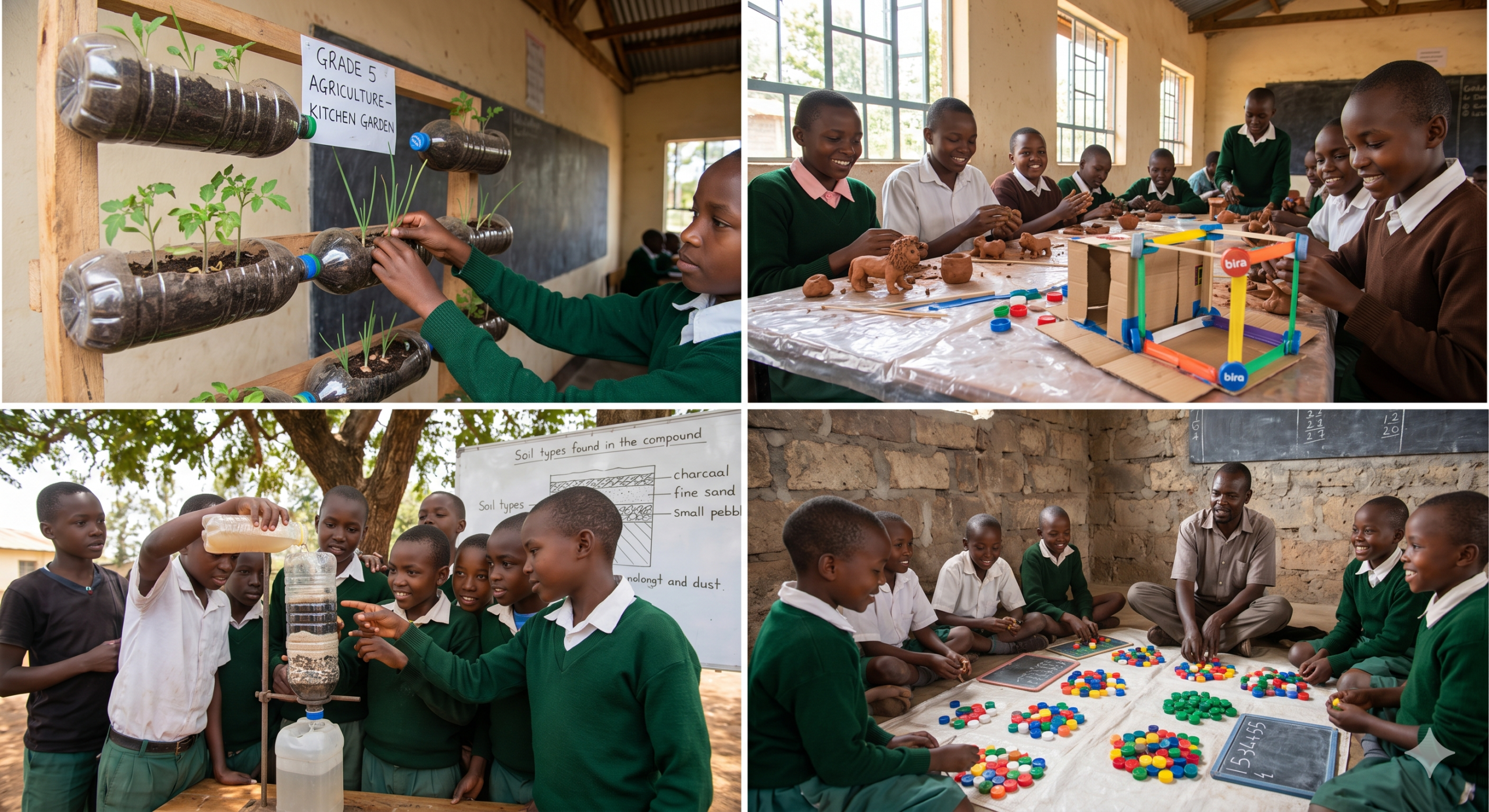
1. Agriculture: Use Plastic Jerrycans and Kitchen Waste
You do not need a large farm plot or expensive seed packets to teach Upper Primary and Junior School Agriculture.
-
The Free Material: Ask learners to bring empty 5-litre plastic jerrycans, plastic bottles, or old containers from home.
-
The Lesson: Cut the containers in half to make simple vertical gardens or hanging pots. Instead of buying seeds from a shop, have learners harvest seeds directly from local kitchen waste like tomatoes, peppers, or onions.
-
The Core Competency: Learners practice environmental conservation by recycling plastic and learn real food-production skills without spending a single shilling.
2. Art and Craft: Use Local Clay and Used Cartons
When the curriculum requires modeling, sculpting, or building structures, avoid asking parents to buy expensive playdough or pristine manila papers.
-
The Free Material: Local riverbed clay, old cardboard boxes from local shops, and discarded bottle caps (bira).
-
The Lesson: Use local clay for modeling animals, pots, or kitchen utensils. For design and construction lessons, cut up old boxes to build geometric shapes, letters, or house models.
-
The Core Competency: This nurtures local creativity. Learners learn to appreciate and use the raw materials available in their immediate environment.
3. Science and Technology: Turn the School Compound into a Lab
Many basic science concepts can be observed and tested right outside your classroom door without textbook kits.
-
The Free Material: Soil samples, local plants, and empty clear plastic bottles.
-
The Lesson: Teaching about soil types (sand, loam, clay)? Simply collect samples from different corners of the school compound. Teaching about plant parts or types of roots? Walk outside and observe the local weeds and trees. For lessons on filtering water, use a clean plastic bottle filled with layers of charcoal, sand, and small stones collected by the learners.
-
The Core Competency: This encourages critical thinking and active observation, showing learners that science happens in real life, not just inside expensive laboratory equipment.
4. Mathematics: Use Bottle Tops and Cardboard Gadgets
Counting, charting, and understanding tech layouts do not require digital screens or expensive plastic counters.
-
The Free Material: Collected bottle tops, old newspapers, and sticks.
-
The Lesson: Use bottle tops for counting, grouping, and teaching fractions or multiplication to lower primary learners. If you are teaching digital literacy or keyboard layouts but your school lacks laptops, draw a full-sized keyboard on a large piece of flat cardboard. Let learners take turns “typing” on the cardboard to memorize the finger positions and keys.
-
The Core Competency: It builds communication, collaboration, and basic math skills through physical touch and group teamwork.
Teacher Pro-Tip for the Term: At the start of the term, set up a “Resource Box” in the corner of your classroom. Ask learners to safely collect clean bottle caps, empty plastic containers, cardboard boxes, and old newspapers whenever they find them at home. By week three, you will have a fully stocked, free teaching kit ready for any practical lesson!
Summary for Educators
CBC values how a learner solves problems using their hands and minds, not how much money was spent on the final project. By using locally available materials, you save money for your school and parents while teaching your learners how to be innovative, real-world problem solvers.
About the Author

Related posts:
TSC Projected Salary scale Notches Effective July 2026 Under CBA Phase II

Schools Suspend Learning Ahead of Planned Nationwide Demonstrations

How AI is Transforming Competency-Based Education
From 8-4-4 to CBE – Why Kenya Decided to Change Its Education System