The Pioneer Grade 10 Cohort and the 52% STEM Boom
The year 2026 will be remembered as a landmark moment in Kenya’s educational history. For the first time since the implementation of Competency-Based Education (CBE), learners entered Senior School and selected pathways aligned with their talents, interests, and career aspirations.
What surprised many education experts, policymakers, and industry leaders was not merely the successful transition into Senior School—it was the overwhelming preference for Science, Technology, Engineering, and Mathematics (STEM).
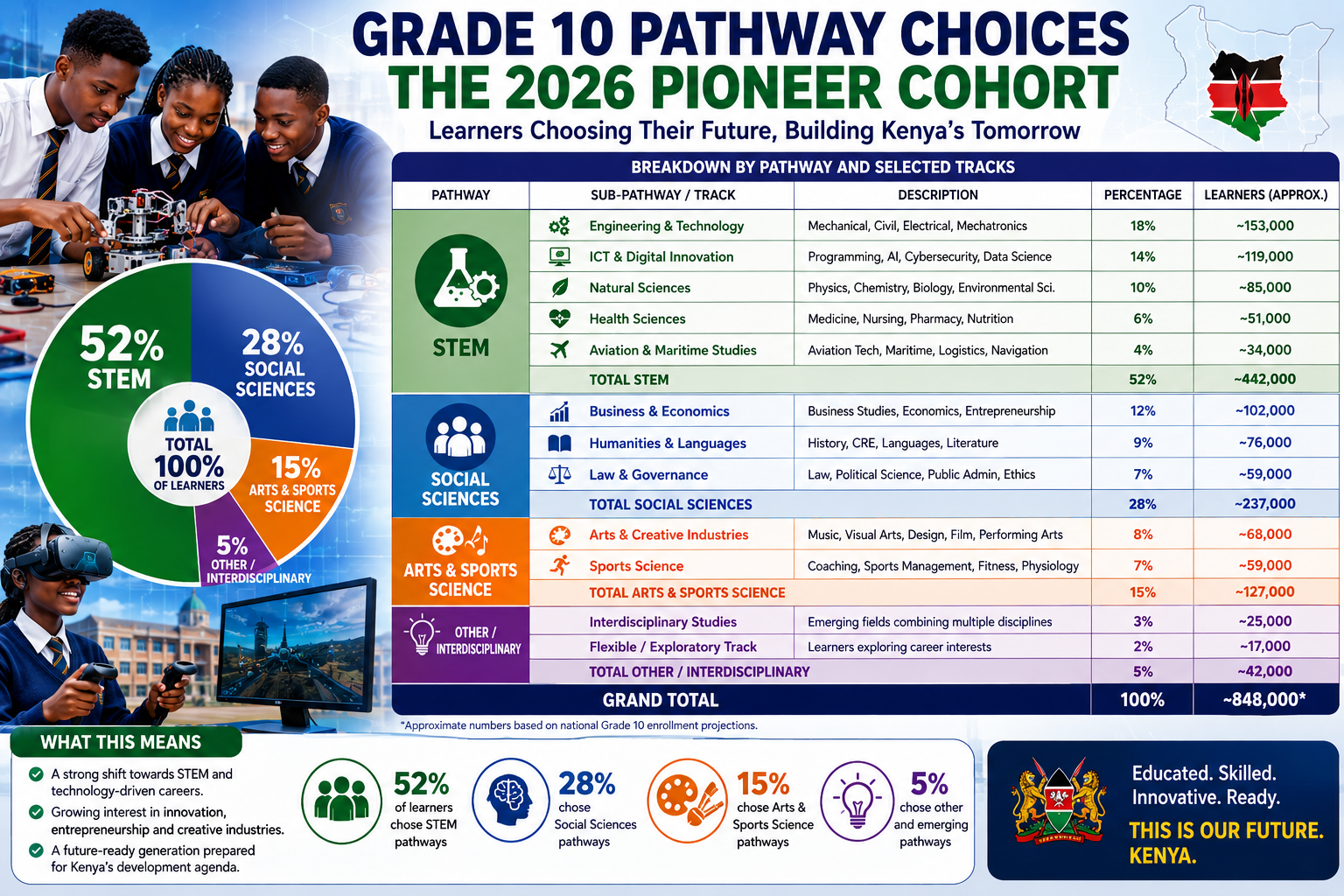
According to figures announced during the Madaraka Day celebrations, approximately 52% of Grade 10 learners selected the STEM pathway, making it the most popular choice among Kenya’s pioneer Senior School cohort.
This statistic signals more than a curriculum preference. It reflects a changing national mindset about education, careers, innovation, and economic development.
A Historic Milestone for Competency-Based Education
For decades, educational pathways in Kenya largely followed a uniform route. Students studied nearly identical subjects regardless of their talents, interests, or future ambitions.
Under the new Senior School structure, learners are now empowered to choose pathways that best align with their strengths.
The pioneer Grade 10 cohort represents the first generation to experience this level of educational specialization.
Their decisions provide valuable insight into the future direction of Kenya’s workforce.
Kenya’s Pioneer Grade 10 Cohort


The pathway selections reveal a generation increasingly attracted to technology, innovation, engineering, and scientific advancement.
Understanding the 52% STEM Enrollment
The STEM pathway emerged as the leading choice among learners.
+------------------------------------------------+
|        GRADE 10 PATHWAY SELECTIONS             |
+------------------------------------------------+
|                                                |
| STEM                               52%         |
| ██████████████████████████████               |
|                                                |
| Social Sciences + Arts & Sports    48%         |
| ██████████████████████████                    |
|                                                |
+------------------------------------------------+
For education planners, this is both exciting and challenging.
On one hand, it demonstrates growing enthusiasm for science and technology.
On the other hand, it creates an urgent need for:
- Laboratories
- Digital infrastructure
- STEM teachers
- Simulation technologies
- Modern learning resources
Why Learners Are Choosing STEM
Several factors have contributed to the popularity of STEM among Kenya’s first Senior School learners.
1. The Rise of Technology Careers
Today’s learners are growing up in a digital world.
Unlike previous generations, they are constantly exposed to:
- Smartphones
- Artificial Intelligence
- Robotics
- Social Media
- Coding Platforms
- Smart Devices
As a result, many learners associate STEM with exciting future opportunities.
The Digital Generation


Students recognize this reality.
2. Increased Awareness of Emerging Careers
Under previous educational models, many learners primarily knew about careers such as:
- Teaching
- Medicine
- Law
- Engineering
Today’s learners are exposed to a much wider range of professions.
Emerging careers include:
- Artificial Intelligence Engineer
- Data Scientist
- Cybersecurity Analyst
- Robotics Engineer
- Renewable Energy Specialist
- Software Developer
- Drone Technician
- Aviation Systems Engineer
These professions often appear attractive because they combine innovation, creativity, and strong employment prospects.
3. Government Emphasis on Industrialization
Kenya’s development agenda increasingly focuses on:
- Manufacturing
- Digital Economy
- Renewable Energy
- Infrastructure Development
- Innovation Ecosystems
These sectors require a highly skilled STEM workforce.
Learners are beginning to recognize that science and technology skills will play a major role in future economic opportunities.
4. Influence of Global Technology Leaders
Young people are inspired by innovators who have transformed industries through technology.
Examples include entrepreneurs, scientists, engineers, and inventors whose work influences everyday life.
The success of technology-driven companies has helped elevate the status of STEM careers globally.
Future Innovators in the Making


Many learners now view STEM as a pathway to becoming inventors and problem-solvers.
How Competency-Based Education Encourages STEM Growth
One reason for the STEM boom is that CBE makes science and technology more engaging.
Traditional science education often focused heavily on:
- Theory
- Memorization
- Examination preparation
Under CBE, STEM learning emphasizes:
- Practical application
- Investigation
- Experimentation
- Innovation
Students are encouraged to learn by doing.
Learning Through Projects
Instead of simply reading about engineering concepts, learners can:
- Build models
- Design prototypes
- Create software applications
- Develop solutions to community problems
This hands-on approach increases motivation and understanding.
Simulation-Based Learning
One of the most transformative innovations supporting STEM education is simulation technology.
Simulators allow learners to experience real-world environments without the high costs associated with physical training facilities.
Examples include:
Aviation Simulators
Students can learn:
- Flight controls
- Aircraft systems
- Airport operations
Maritime Simulators
Learners practice:
- Navigation
- Shipping logistics
- Marine safety
Engineering Simulators
Students explore:
- Structural design
- Mechanical systems
- Electrical circuits
Simulation Technology in STEM Education


These technologies bridge the gap between classroom theory and real-world practice.
What the STEM Boom Means for Schools
The high STEM enrollment presents significant opportunities but also introduces major responsibilities.
Schools must now prepare to support increasing numbers of STEM learners.
This requires investments in:
Laboratories
Schools need modern facilities for:
- Physics
- Chemistry
- Biology
- Engineering activities
Technology Infrastructure
Essential resources include:
- Computers
- Internet connectivity
- Digital platforms
- Simulation software
Teacher Development
Teachers must continuously update their skills to keep pace with emerging technologies.
Challenges Facing the STEM Expansion
While the 52% enrollment figure is encouraging, several challenges remain.
Infrastructure Gaps
Many schools still lack:
- Science laboratories
- Reliable electricity
- Internet access
- Digital learning equipment
Addressing these gaps will be essential for successful implementation.
Teacher Shortages
Specialized STEM instruction requires qualified educators.
The growing number of STEM learners may increase demand for teachers in:
- Mathematics
- Physics
- Computer Science
- Engineering-related subjects
Building STEM Capacity


Investment in both infrastructure and human resources will be critical.
Opportunities Created by the STEM Boom
Despite the challenges, the opportunities are enormous.
A strong STEM workforce can support national goals in:
Manufacturing
Increasing industrial productivity.
Renewable Energy
Supporting sustainable development.
Healthcare
Improving medical innovation and service delivery.
Agriculture
Enhancing food security through technology.
Digital Economy
Driving software development, cybersecurity, and digital entrepreneurship.
The Long-Term Economic Impact
Countries that invest heavily in STEM education often experience:
- Increased innovation
- Higher productivity
- Stronger economic growth
- Greater global competitiveness
Examples include nations that transformed themselves through strategic investments in science and technology education.
Kenya now has an opportunity to follow a similar path.
The Future STEM Workforce


The pioneer Grade 10 cohort may become the engineers, innovators, researchers, and entrepreneurs who shape Kenya’s future economy.
The Bigger Picture
The significance of the 52% STEM enrollment extends beyond education.
It suggests that young Kenyans increasingly recognize the importance of science, technology, and innovation in addressing national challenges.
Future STEM graduates may contribute solutions in areas such as:
- Climate change
- Food security
- Energy access
- Healthcare
- Transportation
- Digital transformation
This makes the STEM boom not just an educational trend but a national development opportunity.
Conclusion
The decision by more than half of Kenya’s pioneer Grade 10 learners to select the STEM pathway marks a defining moment in the country’s educational transformation.
It reflects growing confidence in science, technology, engineering, and mathematics as engines of personal success and national development.
However, sustaining this momentum will require significant investment in infrastructure, teacher training, laboratories, digital technologies, and educational simulators.
If successfully implemented, the STEM boom could become one of the most important catalysts for Kenya’s transition into a globally competitive knowledge economy.
About the Author