TSC CPG Review 2026: What the Proposed ST8–ST1 Career Structure Means for Teachers in Kenya
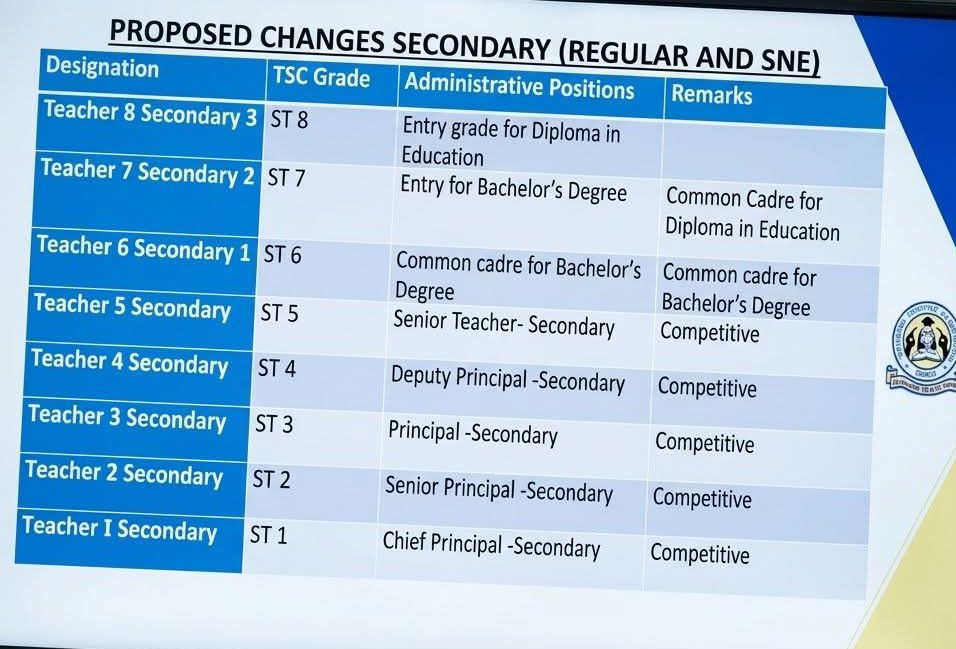
The teaching profession in Kenya is on the verge of a major transformation following stakeholder discussions on the proposed review of the Teachers Service Commission (TSC) Career Progression Guidelines (CPG). The proposed framework seeks to replace the current grading structure with a simplified Standards (ST) system ranging from ST8 to ST1.
The reforms aim to streamline promotions, recognize professional qualifications, strengthen merit-based leadership appointments, and provide clearer career progression pathways for teachers in Junior and Senior Schools.
Proposed Secondary School Career Structure
Summary of the Proposed Structure
| Designation | Grade | Administrative Position |
|---|---|---|
| Teacher 8 Secondary 3 | ST8 | Entry Grade for Diploma Teachers |
| Teacher 7 Secondary 2 | ST7 | Entry Grade for Bachelor’s Degree Holders |
| Teacher 6 Secondary 1 | ST6 | Common Cadre for Bachelor’s Degree Holders |
| Teacher 5 Secondary | ST5 | Senior Teacher |
| Teacher 4 Secondary | ST4 | Deputy Principal |
| Teacher 3 Secondary | ST3 | Principal |
| Teacher 2 Secondary | ST2 | Senior Principal |
| Teacher 1 Secondary | ST1 | Chief Principal |
Why TSC Is Considering a New Career Structure
Since the introduction of the Career Progression Guidelines in 2018, teachers have raised concerns regarding:
- Delayed promotions.
- Grade stagnation.
- Limited leadership opportunities.
- Complex promotion procedures.
- Inadequate recognition of higher academic qualifications.
The proposed ST framework seeks to address these concerns through a more streamlined and transparent progression system.
Understanding the ST Grades
ST8 – Teacher 8 Secondary 3
This would be the entry level for diploma teachers entering the profession. Teachers at this level would focus on classroom instruction, learner assessment, and professional induction.
ST7 – Teacher 7 Secondary 2
This grade would serve as the entry point for teachers holding Bachelor’s Degrees in Education.
ST6 – Teacher 6 Secondary 1
A common cadre for Bachelor’s Degree holders where teachers build professional competence, experience, and leadership potential.
ST5 – Senior Teacher
This marks the beginning of the leadership ladder. Teachers at this level may coordinate departments, mentor colleagues, and support curriculum implementation.
ST4 – Deputy Principal
Responsible for assisting in school administration, academic supervision, discipline management, and institutional planning.
ST3 – Principal
The chief administrator of a secondary school responsible for strategic leadership, resource management, and academic performance.
ST2 – Senior Principal
Expected to oversee larger institutions, including extra-county and national schools.
ST1 – Chief Principal
The highest administrative level within secondary education, reserved for highly experienced and accomplished school leaders.
The Proposed Administrative Pathway
One of the most notable aspects of the proposed reforms is the creation of a clear administrative progression ladder:
- Senior Teacher (ST5)
- Deputy Principal (ST4)
- Principal (ST3)
- Senior Principal (ST2)
- Chief Principal (ST1)
All leadership appointments are expected to be competitive and merit-based.
Possible Elimination of D4 and D5 Grades
Stakeholder discussions suggest that D4 and D5 grades may be removed under the new structure.
Potential benefits include:
- Reduced promotion bottlenecks.
- Simpler career progression.
- Improved motivation among teachers.
- Greater transparency in promotions.
However, TSC would need to provide clear transition guidelines for affected teachers.
The Growing Importance of Academic Qualifications
The proposed framework indicates that future promotions may place greater emphasis on academic achievement.
Bachelor’s Degree
Remains the minimum requirement for most teaching positions.
Master’s Degree
May provide additional merit points during promotion interviews.
PhD Qualification
Could significantly enhance competitiveness for senior leadership positions.
TPAD and Professional Performance
Teacher Performance Appraisal and Development (TPAD) is expected to play an increasingly important role in career progression.
Key performance indicators may include:
- Lesson preparation.
- Teaching effectiveness.
- Learner achievement.
- Professional conduct.
- Innovation in teaching.
Teachers with consistently high TPAD ratings may enjoy an advantage during interviews.
Recognition of Co-Curricular Excellence
The proposed review also highlights the importance of co-curricular activities.
Teachers who actively support learners in:
- Sports
- Music festivals
- Drama festivals
- Science and engineering fairs
- Debate competitions
may receive additional recognition during promotion processes.
Benefits of the Proposed ST Framework
Clear Career Pathways
Teachers can easily understand the progression route from entry-level positions to senior leadership.
Improved Recognition of Qualifications
Advanced academic credentials may receive greater consideration.
Merit-Based Leadership
Leadership appointments may become more transparent and competitive.
Reduced Grade Congestion
The simplified structure could reduce stagnation in promotions.
Enhanced Professional Motivation
Teachers may be encouraged to pursue continuous professional development.
Potential Challenges
Despite the anticipated benefits, several concerns remain:
Increased Competition
Leadership positions may become more competitive.
Interview Dependence
Teachers may need to excel in interviews in addition to classroom performance.
Transition Uncertainty
Questions remain regarding salary conversion and placement of teachers currently in D grades.
Academic Pressure
Teachers may feel compelled to pursue postgraduate qualifications to remain competitive.
How Teachers Should Prepare
To remain competitive under the proposed framework, teachers may consider:
- Improving TPAD performance.
- Pursuing Master’s and PhD qualifications.
- Participating actively in co-curricular activities.
- Developing leadership skills.
- Maintaining professional portfolios.
- Engaging in continuous professional development.
Frequently Asked Questions
Is the ST8–ST1 structure already approved?
No. The proposals emerged from stakeholder discussions and remain subject to official approval by TSC.
Will salaries change?
No official salary structure has been released.
Will D4 and D5 grades be abolished?
This remains a proposal and has not yet been formally adopted.
Will Master’s Degrees matter more?
Stakeholder discussions suggest that postgraduate qualifications may receive increased consideration during promotions.
Will interviews become mandatory for leadership positions?
Current proposals indicate that administrative appointments would be competitive.
Conclusion
The proposed ST8–ST1 grading structure represents a bold attempt to modernize teacher career progression in Kenya. By emphasizing qualifications, performance, leadership, and co-curricular achievements, the reforms could create a more dynamic and merit-based profession.
While many details remain subject to official confirmation, teachers who invest in professional growth, strong TPAD performance, leadership development, and continuous learning are likely to be best positioned to benefit from any future reforms adopted by the Teachers Service Commission.
About the Author

Related posts:

KNEC Opens Digital Learning Portal.

TSC Launches Nationwide ICT Training for All JSS Teachers (June 2026)
A Deep dive into the 2026 Knec projects grade 3 to Grade 8

Best Meru County Senior SchooL: C1 National, C2 Extra-County, C3 County and C4 Sub-County