The Definitive Guide to Kenya’s New Competency-Based Teacher Grading Framework
The Teachers Service Commission (TSC) has initiated one of the most radical institutional transformations since the implementation of the Career Progression Guidelines (CPG). In response to the nationwide paradigm shift toward Competency-Based Education (CBE), the commission has proposed a streamlined, structural overhaul of teacher job groups, grading alignments, and salary scales planned for implementation in 2026.
This comprehensive operational framework introduces the ST8 to ST1 grading system, designed specifically to eliminate structural redundancy, resolve severe promotion bottlenecks within Junior and Senior secondary schools, and align teacher compensation directly with the operational realities of the modern Kenyan classroom. This document serves as the absolute blueprint for school administrators, classroom teachers, union delegates, and education policy stakeholders across Kenya’s 47 counties.
Section 1: The Strategic Catalyst Behind the 2026 TSC Grading Review
The transition from the traditional 8-4-4 system to the Competency-Based Curriculum (CBC) and subsequently into the broader Competency-Based Education (CBE) continuous paradigm has fundamentally fractured the historical justification for the current TSC grading matrices. Under the legacy structure, teacher grading scales were rigidly siloed into Primary (Regular), Junior Secondary (JSS), Secondary, and Advanced institutional categories.
The operational framework of CBE demands highly dynamic, multi-pathway instruction. With Pre-Primary expanding, Junior School consolidating grades 7 through 9, and Senior School establishing specialized pathways (STEM, Social Sciences, Arts and Sports), the traditional boundaries between “Secondary Teacher” and “Primary Teacher” have blurred. TSC’s legacy system created administrative duplication, characterized by overlapping scales and persistent promotion ceilings.
🎯 Core Strategic Objectives of the ST Framework:
Structural Modernization: Aligning institutional titles with the three clear tiers of basic education: Early Years Education, Junior School, and Senior School.
Elimination of Career Bottlenecks: Dismantling historical stagnation points, particularly at the C3 and C4 thresholds, where thousands of educators have remained stranded without upward mobility.
Administrative Consolidation: Replacing complex, non-linear progression pathways with an optimized, 8-tier vertical continuum ranging from Teacher 8 (ST8) to Teacher 1 (ST1).
Pathway Optimization: Ensuring that specialized Senior School educators teaching technical and scientific tracks are properly incentivized and advanced within a clear professional growth path.
The financial architecture supporting this transition is aligned with the ongoing commitments of the multi-phase Collective Bargaining Agreement (CBA) frameworks, ensuring that statutory protections regarding basic salary maintenance are respected while opening wide doors for structural advancement.
Section 2: Complete Structural Mapping — The C1-D5 to ST8-ST1 Transition
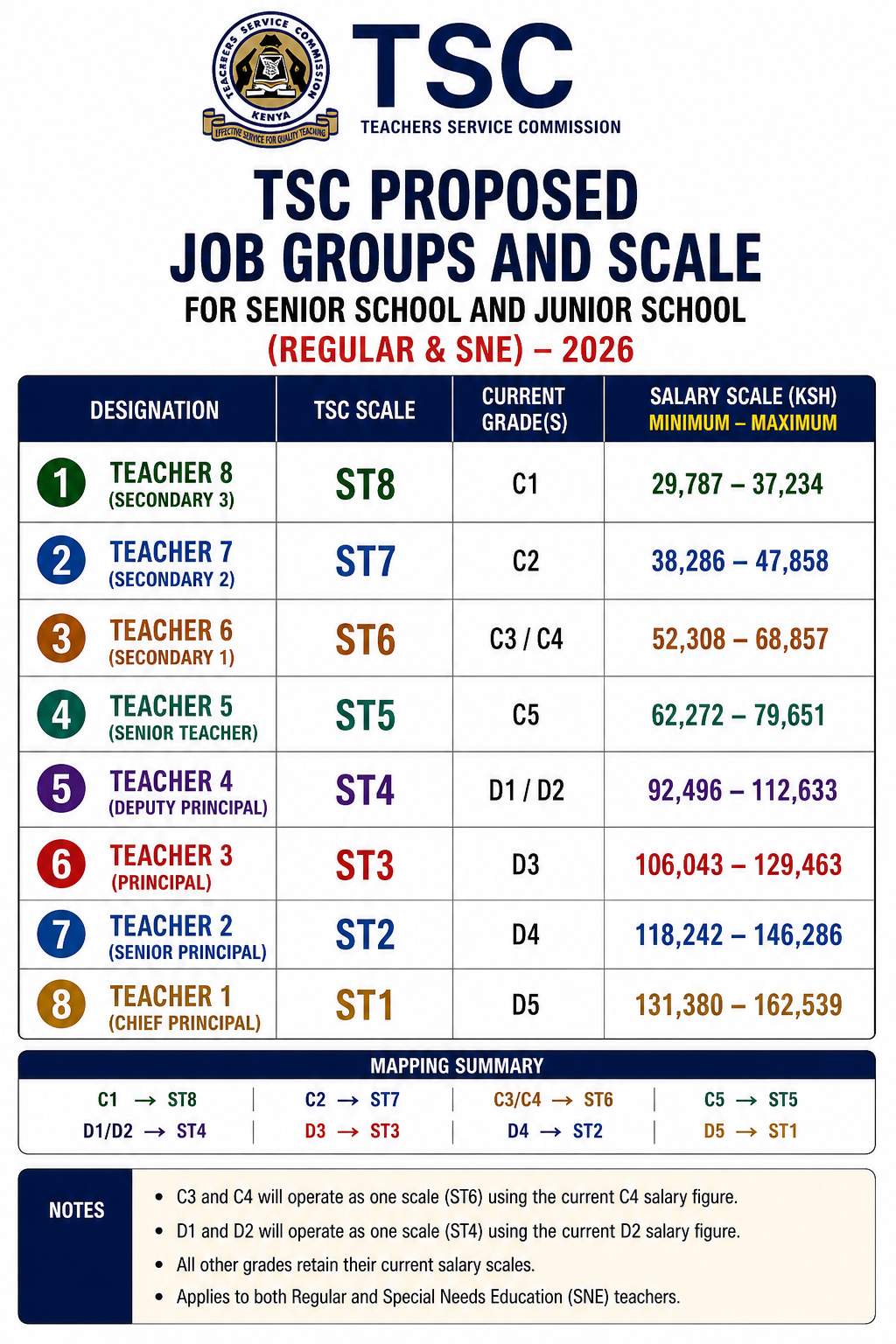
The core of the 2026 proposal lies in its clean mapping mechanism. By reducing the number of administrative layers, the commission aims to create a more fluid trajectory for career progression. Below is the official structural transition blueprint defining how current TSC grades translate directly into the proposed ST scales.
📊 Official TSC 2026 Structural Transition Matrix
| Current Grade | Proposed Scale | Equivalent Professional Title & Role Matrix | Basic Salary Scale (KSh Range) |
| C1 | ST8 | Secondary Teacher III / Junior School Teacher III (Graduate Entry Level) | 29,787 – 37,234 |
| C2 | ST7 | Secondary Teacher II / Junior School Teacher II (First Promotion Stage) | 38,286 – 47,858 |
| C3 / C4 | ST6 | Senior Classroom Practitioner / Departmental Head (Merged Scale) | 52,308 – 68,857 |
| C5 | ST5 | Senior Teacher / Primary Headteacher / Sub-Departmental Administrator | 62,272 – 79,651 |
| D1 / D2 | ST4 | Deputy Principal / Senior Institutional Administrator (Merged Scale) | 92,496 – 112,633 |
| D3 | ST3 | Principal / Institutional Leader (Medium-Capacity Schools) | 106,043 – 129,463 |
| D4 | ST2 | Senior Principal / Sub-County Educational Administrator | 118,242 – 146,286 |
| D5 | ST1 | Chief Principal / National & Regional Educational Director | 131,380 – 162,539 |
🛠️ Visual Hierarchy Blueprint (Search Engine Indexable)
Plaintext
[LEVEL 1: CHIEF PRINCIPAL] ---------> Scale ST1 <--- (Legacy Grade D5)
         ▲
[LEVEL 2: SENIOR PRINCIPAL] --------> Scale ST2 <--- (Legacy Grade D4)
         ▲
[LEVEL 3: PRINCIPAL] ---------------> Scale ST3 <--- (Legacy Grade D3)
         ▲
[LEVEL 4: DEPUTY PRINCIPAL] --------> Scale ST4 <--- (Merged Legacy D1 & D2)
         ▲
[LEVEL 5: SENIOR TEACHER] ----------> Scale ST5 <--- (Legacy Grade C5)
         ▲
[LEVEL 6: MASTER PRACTITIONER] -----> Scale ST6 <--- (Merged Legacy C3 & C4)
         ▲
[LEVEL 7: CLASSROOM TEACHER II] ----> Scale ST7 <--- (Legacy Grade C2)
         ▲
[LEVEL 8: GRADUATE ENTRY LEVEL] ----> Scale ST8 <--- (Legacy Grade C1)
Section 3: Granular Breakdown of Individual Proposed Scales
Teacher 8 (ST8) — The Entry-Level Graduate Horizon
Positioned explicitly as the entry scale for newly deployed graduate teachers within Junior and Senior Secondary institutions, ST8 corresponds directly to the legacy C1 grade. Financially, it commands a basic salary range of KSh 29,787 to KSh 37,234. The core mandate for educators within this band involves direct classroom instructional delivery, formative and summative assessment execution under the Kenya National Examinations Council (KNEC) guidelines, and standard cross-curricular coordination.
Teacher 7 (ST7) — The Intermediate Instructional Anchor
Representing the critical first formal promotion step for classroom practitioners, ST7 aligns with the current C2 grade, offering a salary progression band of KSh 38,286 to KSh 47,858. Educators at this tier are transitioned into key instructional design tasks, mentoring newly deployed intern teachers, and driving local implementation of school-based assessment programs.
Teacher 6 (ST6) — The Master Practitioner & Merged Solution
As one of the most structurally disruptive components of the 2026 proposal, ST6 represents the complete administrative merger of the current C3 and C4 scales. With a salary range extending from KSh 52,308 to KSh 68,857, ST6 is designed to serve as a broad financial home for master classroom practitioners and subject heads. This integration ensures that teachers do not face delayed promotion timelines while waiting to transition across arbitrary administrative barriers.
Plaintext
========================================================================
             THE STRATEGIC ST6 GRADE OPTIMIZATION DESIGN
========================================================================
[OLD LEGACY SYSTEM]
  Grade C3 (Stagnation) ===> [BARRIER / NO VACANCIES] ===> Grade C4

[NEW 2026 DESIGN]
  Unified Scale ST6 (Broad-Band Career Runway)
  * Seamless internal step increments from KSh 52,308 to KSh 68,857
  * No external promotional interviews or regulatory testing barriers
========================================================================
Teacher 5 (ST5) — The Management Liaison Scale
Corresponding directly to Grade C5, the ST5 scale (KSh 62,272 – KSh 79,651) is reserved for Senior Teachers and institutional department heads who oversee academic program synchronization and direct quality assurance measures within institutional settings.
Teacher 4 (ST4) — Unified Administrative Command
Mirroring the structural efficiency of ST6, the ST4 scale consolidates current administrative levels D1 and D2 into a unified pay and command tier. Offering a salary range from KSh 92,496 to KSh 112,633, this scale provides Deputy Principals with a broad career runway, reducing overlapping role descriptions and streamlining internal institutional leadership.
Teacher 3 to Teacher 1 (ST3, ST2, ST1) — The Executive Leadership Tiers
These three high-level tiers are tailored specifically for institutional heads managing complex educational structures across the country:
-
ST3 (Grade D3 — Principal): Controls a salary scale of KSh 106,043 to KSh 129,463, managing operations in sub-county and county-level institutions.
-
ST2 (Grade D4 — Senior Principal): Commands a salary range of KSh 118,242 to KSh 146,286, driving policy coordination in major urban and national schools.
-
ST1 (Grade D5 — Chief Principal): Represents the ultimate professional apex within the commission’s service. Commanding a salary scale of KSh 131,380 to KSh 162,539, these executives direct national institutions, drive massive regional resource allocations, and advise the Ministry of Education on strategic local implementations.
Section 4: Impact Assessment — Junior and Senior School Implementations
Junior Secondary School educators have operated under temporary, often challenging deployment guidelines since the initial rollout of the CBC framework. The absence of a customized, specialized grading tier created widespread structural ambiguity regarding career progression. The proposed 2026 framework remedies this by introducing explicit roles tailored to Junior School settings under the ST8, ST7, and ST6 designations.
Similarly, Senior School pathways require specialized instructors capable of steering advanced academic tracks. The consolidation of C3 and C4 into ST6 guarantees that highly qualified secondary school instructors are compensated for their specialization without forcing them to move into administrative paths simply to receive a pay raise.
⚠️ Critical Operational Protections for Active Educators
A key element embedded in the 2026 proposal is the Salaries Non-Diminution Protection Directive. The Teachers Service Commission has explicitly guaranteed that the realignment into the ST framework will not result in any downward revision of basic salaries or loss of earned pensionable benefits. Active teachers will transition into their corresponding ST tiers at a step level that either matches or enhances their current basic pay scale.
Section 5: Legislative Timelines and Next Steps toward Finalization
The 2026 TSC Proposed Job Groups and Salary Scales framework is currently undergoing multi-lateral review. Before becoming law, it must pass several key institutional stages:
-
Stakeholder Consultation and Feedback Review: Active engagement with major teacher unions, including the Kenya National Union of Teachers (KNUT) and the Kenya Union of Post-Primary Education Teachers (KUPPET), to refine the promotion matrices.
-
Parliamentary Committee Review: Review by the National Assembly’s Departmental Committee on Education and Research to secure necessary budgetary allocations.
-
Official Gazettement and CPG Addendum: Formal publication of the new framework in the Kenya Gazette, alongside an official update to the Career Progression Guidelines.
Educators and institutional leaders across Kenya are encouraged to track official circulars issued directly by the Teachers Service Commission Secretariat to stay informed about final transition dates and implementation schedules.
About the Author

Related posts:

. BASIC INFRASTRUCTURE FOR SENIOR SCHOOL

Schools Suspend Learning Ahead of Planned Nationwide Demonstrations
KJSEA & Senior School Admission Criteria (2025 Guide)
TSC Promotion Guidelines 2026/2027 PDF Download: Official Interview Scoring Guide, Eligibility & Pro...