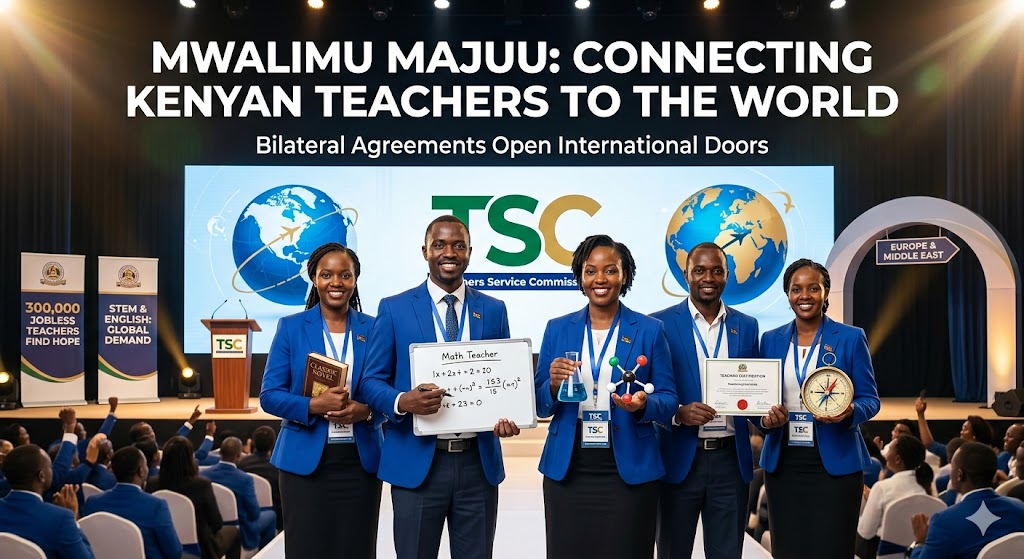
TSC Mwalimu Majuu Programme:
The Teachers Service Commission (TSC) has officially thrown a lifeline to over 300,000 unemployed trained educators across Kenya. In a historic consultative meeting held on June 17–18, 2026, senior officials from the TSC and the State Department for Diaspora Affairs formalized a bilateral labor agreement framework dubbed the Mwalimu Majuu Programme.
This initiative is specifically engineered to export Kenya’s surplus teaching talent to verified international labor markets across Europe, the Middle East, and Southeast Asia.
If you are a registered teacher looking for TSC jobs abroad, this comprehensive guide covers everything you need to know about the deployment framework, high-demand subjects, and how the government plans to facilitate your placement.
Why Has TSC Opened the Door to International Teaching Jobs?
The rollout of the Mwalimu Majuu initiative comes at a critical time when the domestic teaching market is facing severe financial constraints. Even with the National Treasury allocating a massive Sh424 billion to the TSC for the 2026/2027 financial year, local absorption remains low.
The current 2026/2027 TSC budget has set aside:
-
Sh4.9 Billion: To convert 20,000 intern teachers to permanent and pensionable terms in January 2027.
-
Sh8.2 Billion: To transition an additional 24,000 junior secondary school (JSS) and primary interns by July 2027.
While this absorbs 44,000 educators domestically, it leaves a residual pool of over 250,000 qualified teachers without active employment. The Mwalimu Majuu programme serves as a vital strategic release valve, enabling the state to convert this surplus labor into a robust economic engine via diaspora remittances.
Inside the Mwalimu Majuu Recruitment Framework
Historically, Kenyan teachers pursuing employment overseas fell victim to predatory, unaccredited recruitment agencies. The new G2G (Government-to-Government) arrangement under Diaspora Affairs Principal Secretary Roseline Njogu, TSC Chairperson Dr. Jamleck Muturi, and acting TSC CEO Evaleen Mitei fundamentally changes the recruitment process.
The Policy Framework for Teacher Engagement Outside Kenya
Under the updated 2024–2026 guidelines, the deployment pipeline incorporates strict safety parameters:
-
Verified Contracts: The State Department for Diaspora Affairs directly vets all foreign institutional employers to guarantee competitive salaries, health insurance, and safe housing.
-
Credential Clearinghouse: The TSC acts as the direct verifier of certificates and professional standing, eliminating bureaucratic delays when processing international licenses.
-
Diplomatic Backing: Deployed educators will receive consular support directly through Kenyan embassies in host nations under the global Kazi Majuu framework.
High-Demand Subjects and Target International Markets
International recruitment under the Mwalimu Majuu framework is strictly skills-based. The global teacher shortage is highly localized within technical, communication, and scientific disciplines.
| Target Region | High-Demand Teaching Subjects | Core Requirements |
| Western Europe (e.g., Germany, UK) | STEM (Physics, Chemistry, Biology, Mathematics), Technical & Vocational Skills | Language Proficiency (e.g., Goethe-Institut certification for Germany), Curriculum Harmonization |
| Middle East (GCC Countries) | English Language, Primary Education, Early Childhood Development (ECD), Mathematics | Native-level English competence, International Curriculum adaptation |
| Southeast Asia | English as a Second Language (ESL), ICT & Digital Learning Specialties | Degree in Education, TSC Registration Certificate |
The Curriculum Challenge: Preparing for IB and Cambridge
One of the foundational updates highlighted during the June 2026 TSC meetings is the focus on pedagogical alignment. A teacher trained solely under Kenya’s domestic curriculum—whether the legacy 8-4-4 or the current Competency-Based Curriculum (CBC)—must undergo specific transitions to become globally competitive.
To address this gap, the TSC is integrating short-term bridging courses into the pre-departure protocol. These programs are designed to familiarize Kenyan educators with:
-
International Baccalaureate (IB) Frameworks
-
Cambridge Assessment International Education (CAIE)
-
Advanced digital learning tools and interactive classroom management software.
Key Takeaway for Applicants: If you plan on applying for the upcoming TSC overseas slots, prioritizing certifications or short courses in international curricula will drastically increase your placement rating.
How to Prepare for the TSC International Jobs Application
While the official application portals are being synchronized between the TSC online services and the Diaspora Placement Agency (DPA) portal, educators are advised to begin organizing their compliance documents early.
Mandatory Document Checklist
-
TSC Registration Certificate: You must be in good professional standing with the commission as dictated by Section 23 of the TSC Act.
-
Academic Transcripts & Certificates: Certified copies of your Diploma or Bachelor of Education degree.
-
Chapter Six Compliance Documents: Clean records including a valid Certificate of Good Conduct (DCI), HELB clearance, and an EACC clearance form.
-
Valid Passport: Ensure your passport has at least 18 months of validity remaining from the time of anticipated travel.
Frequently Asked Questions (FAQs)
1. What is the TSC Mwalimu Majuu Programme?
It is a joint state initiative between the Teachers Service Commission and the State Department for Diaspora Affairs designed to securely recruit and deploy unemployed Kenyan teachers to international labor markets like Europe and the Middle East.
2. When will the application portal open for TSC jobs abroad?
Following the high-level planning meetings on June 17–18, 2026, the commission is currently finalizing the deployment portals. Official recruitment schedules and link updates will be posted directly onto the official TSC website (services.tsc.go.ke) and the Diaspora Affairs platform.
3. Do intern teachers qualify for the overseas jobs deal?
Yes. The program is open to all qualified, registered Kenyan teachers who meet the subject criteria and language requirements of the specific destination countries.
About the Author

Related posts:
Senior School Education Implementation Guidelines (MoE, 2025)

The 30,000 TSC Promotions Dilemma
How to Apply for TSC Promotion Vacancies 2026 Quickly
How Virtual Learning Environments Are Transforming Competency-Based Education