Introduction
Choosing the right Competency-Based Education (CBE) pathway for Grade 10 is one of the most important decisions learners and parents must make when transitioning from Junior School to Senior School in Kenya.
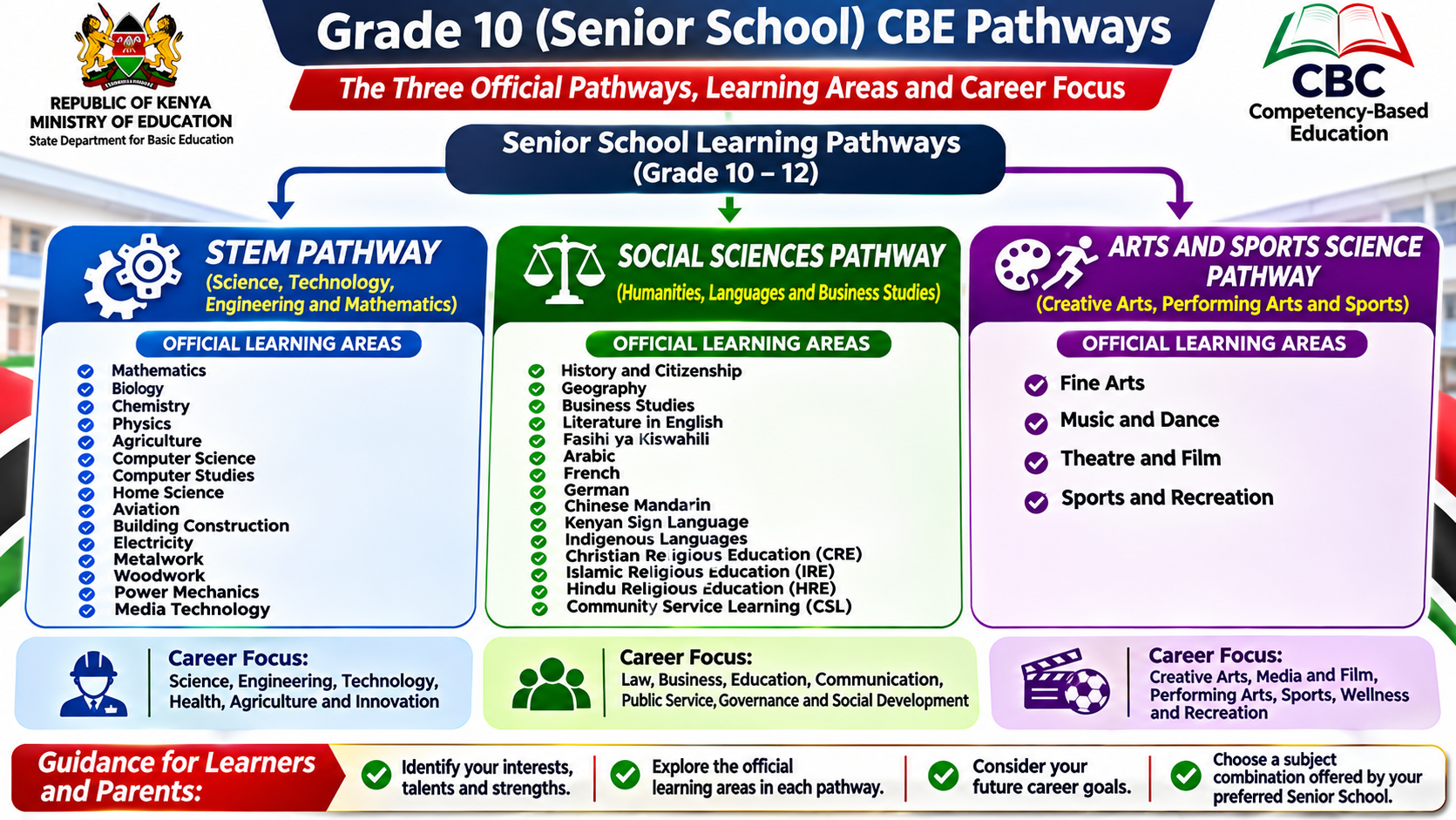
Under the CBE system, learners entering Senior School choose from three main pathways:
- Science, Technology, Engineering and Mathematics (STEM).
- Social Sciences.
- Arts and Sports Science.
Each pathway provides opportunities for learners to develop their talents, interests, abilities and career aspirations. However, selecting a pathway should not be based on popularity, pressure from parents or the belief that one pathway is more valuable than another.
A learner who enjoys scientific experiments, mathematics and technology may thrive in STEM. Another who demonstrates strong communication, leadership, language and business skills may perform better in Social Sciences. Learners with exceptional creative, performing or sporting abilities may find Arts and Sports Science more suitable.
The most important consideration is matching the learner’s demonstrated abilities and interests with the subjects and career opportunities available under each pathway.
This guide explains the differences between the three Grade 10 pathways, the subjects learners may encounter, possible career opportunities and practical factors parents should consider before making a decision.
What Are the Three CBE Pathways in Grade 10?
The Ministry of Education provides three pathways for learners transitioning into Senior School.
The pathways are designed to allow learners to pursue learning areas that match their abilities, interests and future ambitions.
| Pathway | Main Focus | Suitable Learners |
|---|---|---|
| STEM | Science, mathematics, technology and technical skills | Learners interested in science, engineering, agriculture and technology |
| Social Sciences | Humanities, languages, communication and business studies | Learners interested in law, business, education, languages and public service |
| Arts and Sports Science | Creative arts, performing arts and sports | Learners with interests in art, music, theatre, film and sports |
A pathway provides the broad direction of learning. Within each pathway, learners can explore specific tracks and approved subject combinations.
The final selection should therefore consider more than the pathway name. Parents and learners should examine the actual subjects offered in the selected combination and confirm that the preferred Senior School offers them.
1. STEM Pathway: Who Should Choose Science, Technology, Engineering and Mathematics?
STEM is designed for learners interested in scientific investigation, innovation, mathematics, engineering, technology and practical problem-solving.
It provides opportunities for learners to develop scientific knowledge and technical competencies that can support further education and careers in science-related fields.
STEM is particularly suitable for learners who enjoy:
- Mathematics and logical reasoning.
- Conducting scientific experiments.
- Designing and constructing models.
- Computer programming and digital technology.
- Agricultural innovation.
- Engineering and technical activities.
- Solving practical problems in society.
STEM Pathway Tracks
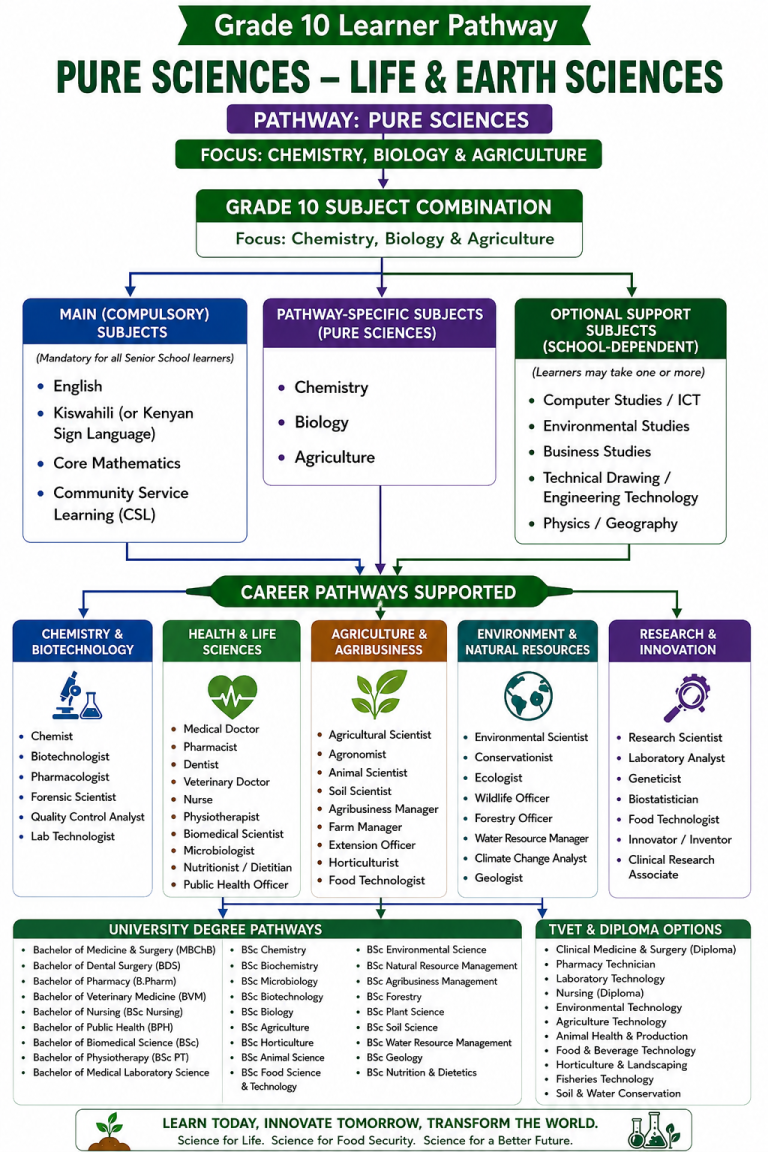
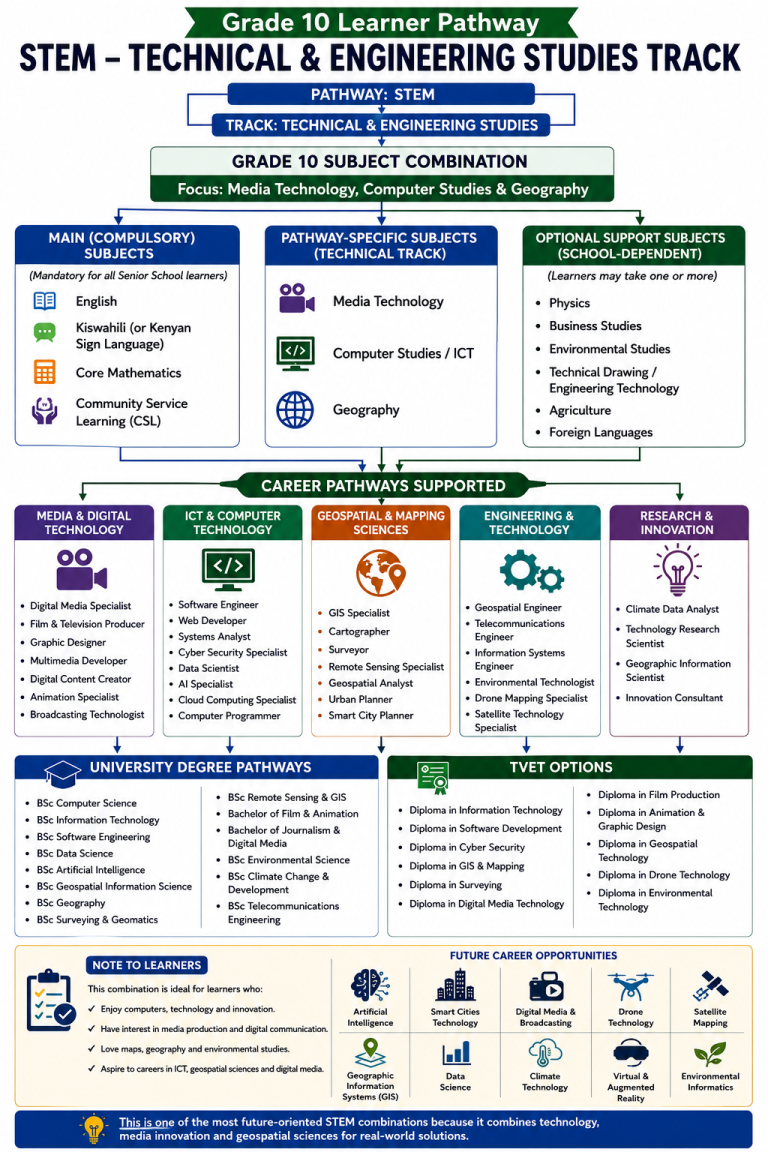
STEM includes different learning areas and tracks, including pure sciences, applied sciences and technical studies.
Examples of learning areas include:
| Learning Area | Practical Application |
|---|---|
| Biology | Understanding living organisms, health and agriculture |
| Chemistry | Studying materials, chemical reactions and industrial processes |
| Physics | Understanding energy, electricity, motion and machines |
| Core Mathematics | Developing advanced mathematical and analytical skills |
| Agriculture | Food production, agribusiness and sustainable farming |
| Computer Science | Programming, software and digital innovation |
| Computer Studies | Computer applications and digital skills |
| Home Science | Nutrition, textiles and household management |
| Aviation | Understanding aviation technology |
| Building Construction | Construction techniques and structural principles |
| Electricity | Electrical installation and technology |
| Metalwork | Metal fabrication and engineering skills |
| Woodwork | Design, construction and woodworking |
| Power Mechanics | Understanding engines and mechanical systems |
| Media Technology | Digital media production and technology |
The availability of particular subjects depends on approved combinations and what individual Senior Schools are equipped to offer.
Careers Associated with STEM
Learners who pursue STEM may later explore careers such as:
- Medicine and healthcare.
- Engineering.
- Architecture.
- Computer science.
- Software development.
- Agricultural science.
- Veterinary medicine.
- Biotechnology.
- Environmental science.
- Laboratory technology.
- Renewable energy technology.
- Aviation technology.
- Data science.
These are possible career directions, not automatic outcomes of selecting STEM. Further education, qualifications and professional requirements will determine the specific career opportunities available.
Who Should Choose STEM?
A learner should consider STEM when there is evidence of interest and ability in science, mathematics, technology or technical subjects.
For example, a learner who enjoys designing an automatic irrigation system, constructing an electronic security device or conducting agricultural experiments may find STEM particularly engaging.
Parents should avoid forcing learners into STEM simply because they believe it offers better employment opportunities. A learner who dislikes scientific and mathematical activities may struggle to remain motivated.
2. Social Sciences Pathway: Who Should Choose Humanities, Languages and Business Studies?
The Social Sciences pathway is designed for learners interested in understanding people, society, communication, history, business and human relationships.
It supports the development of communication, critical thinking, research, leadership and decision-making skills.
It is suitable for learners who enjoy reading, writing, public speaking, debating, analysing social issues and understanding how communities and institutions operate.
Social Sciences Pathway Tracks
The pathway includes learning areas associated with languages and literature, as well as humanities and business studies.
Examples include:
| Learning Area | Main Focus |
|---|---|
| History and Citizenship | Historical events, governance and citizenship |
| Geography | People, environments and geographical processes |
| Business Studies | Business operations and entrepreneurship |
| Literature in English | Literary analysis and creative expression |
| Fasihi ya Kiswahili | Kiswahili literature and cultural expression |
| Arabic | Arabic language and communication |
| French | French language and communication |
| German | German language and communication |
| Chinese Mandarin | Chinese language and communication |
| Indigenous Languages | Local languages and cultural heritage |
| Christian Religious Education | Religious values and understanding |
| Islamic Religious Education | Islamic teachings and values |
| Hindu Religious Education | Hindu teachings and values |
| Community Service Learning | Community engagement and practical service |
The actual subject combination must be checked against the approved selection options.
Careers Associated with Social Sciences
Learners interested in Social Sciences may explore future careers in:
- Law.
- Business management.
- Journalism.
- Public administration.
- International relations.
- Diplomacy.
- Teaching.
- Economics.
- Entrepreneurship.
- Human resource management.
- Social work.
- Marketing.
- Communication and public relations.
- Political science.
The pathway can provide a foundation for different university and professional programmes, subject to their admission requirements.
Who Should Choose Social Sciences?
Social Sciences may be appropriate for learners who demonstrate strengths in communication, writing, leadership, languages, business activities and understanding social issues.
For instance, a learner who enjoys debating, organising school activities, writing articles or developing business ideas may find this pathway suitable.
A learner interested in becoming a lawyer should also investigate the relevant future university admission requirements rather than assuming that selecting one particular subject combination automatically guarantees admission to a law programme.
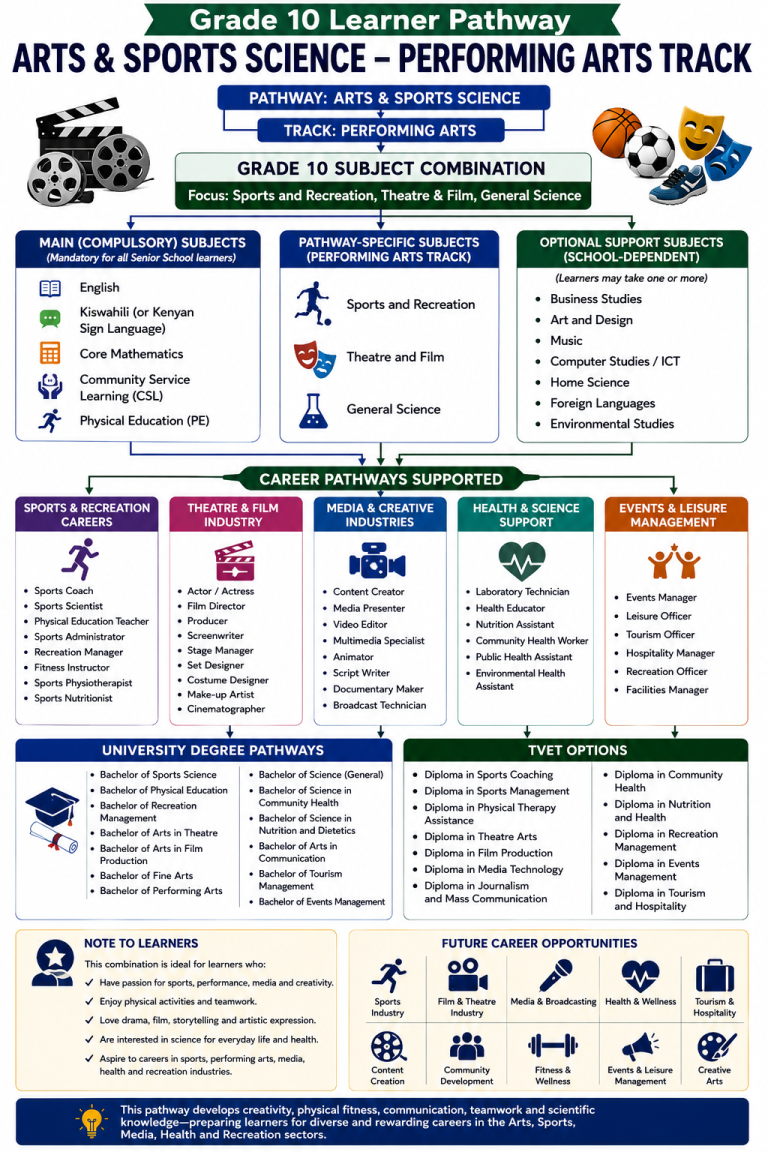
3. Arts and Sports Science Pathway: Who Should Choose Creative Arts and Sports?
Arts and Sports Science recognises the importance of creativity, artistic expression, physical performance and sporting talent.
It provides opportunities for learners to develop practical skills in creative production, performance, artistic design and sports-related activities.
This pathway is suitable for learners who demonstrate interest or ability in:
- Drawing and painting.
- Graphic design.
- Music and dance.
- Theatre and drama.
- Film production.
- Photography and visual storytelling.
- Athletics.
- Ball games.
- Physical fitness and sports performance.
- Creative entrepreneurship.
Arts and Sports Science Learning Areas
Examples of learning areas include:
| Learning Area | Main Focus |
|---|---|
| Fine Arts | Drawing, painting and visual creativity |
| Music and Dance | Musical performance and movement |
| Theatre and Film | Acting, production and storytelling |
| Sports and Recreation | Physical activities and sporting performance |
The pathway gives learners opportunities to develop practical competencies that can support further training and careers in the creative and sports industries.
Careers Associated with Arts and Sports Science
Possible career directions include:
- Graphic designer.
- Fine artist.
- Musician.
- Music producer.
- Actor.
- Film director.
- Video editor.
- Photographer.
- Theatre producer.
- Sports coach.
- Sports administrator.
- Fitness instructor.
- Sports entrepreneur.
- Creative arts educator.
As with other pathways, career progression depends on further training, qualifications, experience and professional opportunities.
Who Should Choose Arts and Sports Science?
Learners who demonstrate strong artistic, musical, performing or sporting abilities should consider this pathway.
For example, a learner who regularly participates in athletics, performs well in music and dance, enjoys painting or produces creative videos may find Arts and Sports Science rewarding.
Parents should recognise that artistic and sporting abilities can form the foundation of serious academic and professional careers.
The pathway should not be treated as an alternative for learners who perform poorly in science or mathematics. It is a specialised learning direction with its own competencies and opportunities.
STEM vs Social Sciences vs Arts and Sports: Which Is Better?
There is no universally superior pathway under CBE. The most suitable pathway depends on the learner’s strengths, interests, ambitions and available subject combinations.
The following comparison can help parents and learners understand the differences.
| Comparison Area | STEM | Social Sciences | Arts and Sports Science |
|---|---|---|---|
| Main interest | Science and technology | Society, languages and business | Creativity and physical performance |
| Key skills | Investigation, analysis and innovation | Communication, research and critical thinking | Creativity, performance and physical skills |
| Practical activities | Experiments, design and technical projects | Research, debates and business activities | Artistic production and sports |
| Possible careers | Engineering, medicine and technology | Law, business and journalism | Design, film, music and sports |
| Suitable learner | Scientific and technical thinker | Communicator and social analyst | Creative or sporting talent |
The best pathway is the one in which a learner can develop their abilities and maintain motivation throughout Senior School.
How Parents Should Help Learners Choose the Right Grade 10 Pathway
Parents play an important role in guiding learners through pathway selection. However, the final decision should reflect the learner’s abilities and aspirations.
The following considerations can help families make informed decisions.
1. Examine the Learner’s Strengths
Review the learner’s performance and participation in different learning areas during Junior School.
Look beyond examination scores. Consider practical activities, classroom participation, creativity, projects and demonstrated competencies.
A learner who consistently performs well in scientific investigations may be suited to STEM. Another who demonstrates exceptional communication and leadership skills may prefer Social Sciences.
2. Consider Personal Interests
Ask the learner about activities they genuinely enjoy.
Does the learner enjoy conducting experiments, developing technology, reading, debating, drawing, performing music or participating in sports?
A pathway should provide opportunities to develop these interests into practical competencies.
3. Research Future Career Interests
Parents and learners should identify possible career areas and investigate the subjects required for further education.
For example:
| Career Interest | Pathway to Explore |
|---|---|
| Medicine | STEM |
| Engineering | STEM |
| Software Development | STEM |
| Agricultural Science | STEM |
| Law | Social Sciences |
| Journalism | Social Sciences |
| Business Management | Social Sciences |
| Graphic Design | Arts and Sports Science |
| Film Production | Arts and Sports Science |
| Sports Coaching | Arts and Sports Science |
These are general pathway suggestions. Specific university and professional programmes may have additional or different subject requirements.
4. Check the Available Subject Combinations
Do not select a pathway without examining the actual subject combinations available.
A learner may prefer a particular combination, but the preferred school must offer it.
The official Grade 10 selection and placement platform provides information to help learners explore pathways, subject combinations and Senior Schools.
5. Consider School Facilities and Teacher Availability
A school offering a particular pathway should have the facilities, equipment and teaching capacity required to support the selected learning areas.
For STEM, this may include laboratories, workshops, computers and appropriate practical learning resources.
For Arts and Sports Science, learners may require suitable creative spaces, sports facilities and equipment.
For Social Sciences, access to learning resources, libraries and opportunities for research and communication is important.
6. Avoid Choosing Based on Peer Pressure
Learners should not select STEM because their friends are choosing it or because it is considered prestigious.
Similarly, parents should not discourage learners from selecting Arts and Sports Science or Social Sciences because of misconceptions about employment opportunities.
The decision should be based on evidence of ability, interest and informed career guidance.
Understanding Grade 10 Subject Combinations Under CBE
One important issue that parents should understand is the difference between a pathway, a track and a subject combination.
A pathway provides the broad learning direction. A track narrows the learning focus, while a subject combination identifies the specific learning areas a learner will study.
For example, STEM contains different tracks, including pure sciences, applied sciences and technical studies.
A learner interested in medicine may investigate suitable pure science combinations, while a learner interested in engineering may explore relevant science or technical combinations.
A learner interested in business may investigate suitable Social Sciences combinations.
The exact combinations available should be confirmed through the official selection platform.
Parents should also understand that subject registration rules apply. For example, the Kenya National Examinations Council issued 2026 instructions concerning the registration of Grade 10 subjects, including requirements relating to General Science, pure sciences and mathematics options.
Learners and schools should follow the applicable official registration instructions rather than relying on unofficial subject lists circulating online.
Can a Learner Change Their Grade 10 Pathway?
Pathway changes and placement adjustments should not be assumed to be automatic.
The Ministry of Education manages the Senior School selection and placement process through the official system. The process involves learner selections, review and placement.
Parents who wish to request a change should consult the learner’s school and the relevant Ministry of Education procedures.
Before requesting any adjustment, establish:
- Whether the preferred pathway is available at the intended school.
- Whether the desired subject combination is offered.
- Whether the school has capacity.
- Whether the requested change is permitted under the applicable Ministry guidelines.
- Whether the learner meets the relevant subject and placement requirements.
Parents should rely on official communication rather than paying individuals who claim they can guarantee a particular placement.
Common Mistakes to Avoid When Choosing a CBE Pathway
Choosing STEM Because It Is Considered More Prestigious
STEM is important, but it is not the only pathway with valuable career opportunities. Social Sciences and Arts and Sports Science also develop important competencies.
Selecting a Pathway Without Checking Subject Combinations
The pathway alone does not tell the complete story. Learners must examine the actual learning areas in the proposed combination.
Allowing Parents to Make the Entire Decision
Parents should guide learners but should not ignore their interests, abilities and demonstrated talents.
Ignoring School Capacity
A school may not offer every subject combination. Always verify the available options before finalising selections.
Choosing a Career Without Researching Entry Requirements
Career interests should be supported by information about the subjects and qualifications required for further education.
Practical Advice for Grade 9 Learners Preparing for Senior School in 2027
Learners preparing to transition into Grade 10 should use the period before joining Senior School to understand their preferred pathway.
The following activities can help:
- Identify three learning areas in which you demonstrate strong interest and ability.
- Discuss your strengths with teachers and career guidance personnel.
- Research careers connected to your preferred learning areas.
- Compare available subject combinations.
- Identify Senior Schools offering your preferred combination.
- Discuss the available options with your parents or guardians.
- Confirm your selections using official Ministry of Education channels.
Learners interested in STEM can participate in science projects, coding activities, agricultural experiments and innovation fairs.
Those interested in Social Sciences can develop communication, research, entrepreneurship and leadership skills.
Learners interested in Arts and Sports Science can build portfolios of their creative work, participate in performances and develop sporting competencies.
The objective is to make an informed decision that supports future learning and personal development.
Frequently Asked Questions About Grade 10 CBE Pathways in Kenya
1. What are the three CBE pathways in Grade 10?
The three Senior School pathways are STEM, Social Sciences, and Arts and Sports Science.
2. Which Grade 10 pathway is best in Kenya?
There is no single best pathway for every learner. The right choice depends on individual abilities, interests, career aspirations and available subject combinations.
3. Can a learner who is good in mathematics choose Social Sciences?
Learners should examine the approved subject combinations and applicable mathematics requirements. Mathematics options and registration rules should be confirmed through official guidance.
4. Can a learner interested in medicine choose Social Sciences?
A learner intending to pursue medicine should carefully investigate the relevant university admission requirements and suitable Senior School subject combinations. STEM is generally the relevant pathway to explore for medical and science-based careers.
5. Is Arts and Sports Science a good pathway?
Yes. It provides opportunities for learners interested in creative arts, performing arts and sports to develop practical competencies and pursue further education and careers in these areas.
6. Can a learner become a lawyer after choosing Social Sciences?
Social Sciences can provide a relevant foundation for learners interested in law. However, admission to a law programme depends on the applicable university entry requirements.
7. Does every Senior School offer all three pathways?
No. The pathways and subject combinations available vary by school. Learners should verify the actual offerings before making selections.
8. Where can parents check Grade 10 subject combinations and Senior Schools?
Parents and learners can use the official Ministry of Education Grade 10 Selection and Placement platform to explore pathways, subject combinations and participating schools.
Official portal: https://selection-placement.kemis.go.ke/
Conclusion: Choose a Pathway That Matches the Learner’s Potential
Choosing between STEM, Social Sciences and Arts and Sports Science is an important step in a learner’s educational journey.
However, the decision should not be driven by pressure, misconceptions or assumptions that one pathway is automatically better than another.
STEM provides opportunities for scientific, mathematical and technological development. Social Sciences supports communication, humanities, business and understanding society. Arts and Sports Science develops creative, artistic and sporting competencies.
Parents, teachers and learners should work together to identify the most appropriate pathway by examining demonstrated abilities, interests, career aspirations and the subject combinations available in Senior Schools.
The ultimate goal of CBE is to support learners in developing their potential and acquiring competencies that can help them contribute meaningfully to society.
Official reference resources
- Ministry of Education: https://education.go.ke/
- Grade 10 Selection and Placement Portal: https://selection-placement.kemis.go.ke/
- Kenya National Examinations Council: https://www.knec.ac.ke/
- Kenya Institute of Curriculum Development: https://kicd.ac.ke/
About the Author

Related posts:

complete guide to navigating the Grade 10 school selection and placement process
Grade 9 subject selection 12 School Choices in Kenya: A Complete Guide for Parents and Learners
Grade 10 Learner Pathway STEM – TECHNICAL AND ENGINEERING STUDIES TRACK
Grade 9 Subject Selection Guide: Chemistry, Biology and Business Studies Combination