From 8-4-4 to CBE – Why Kenya Decided to Change Its Education System
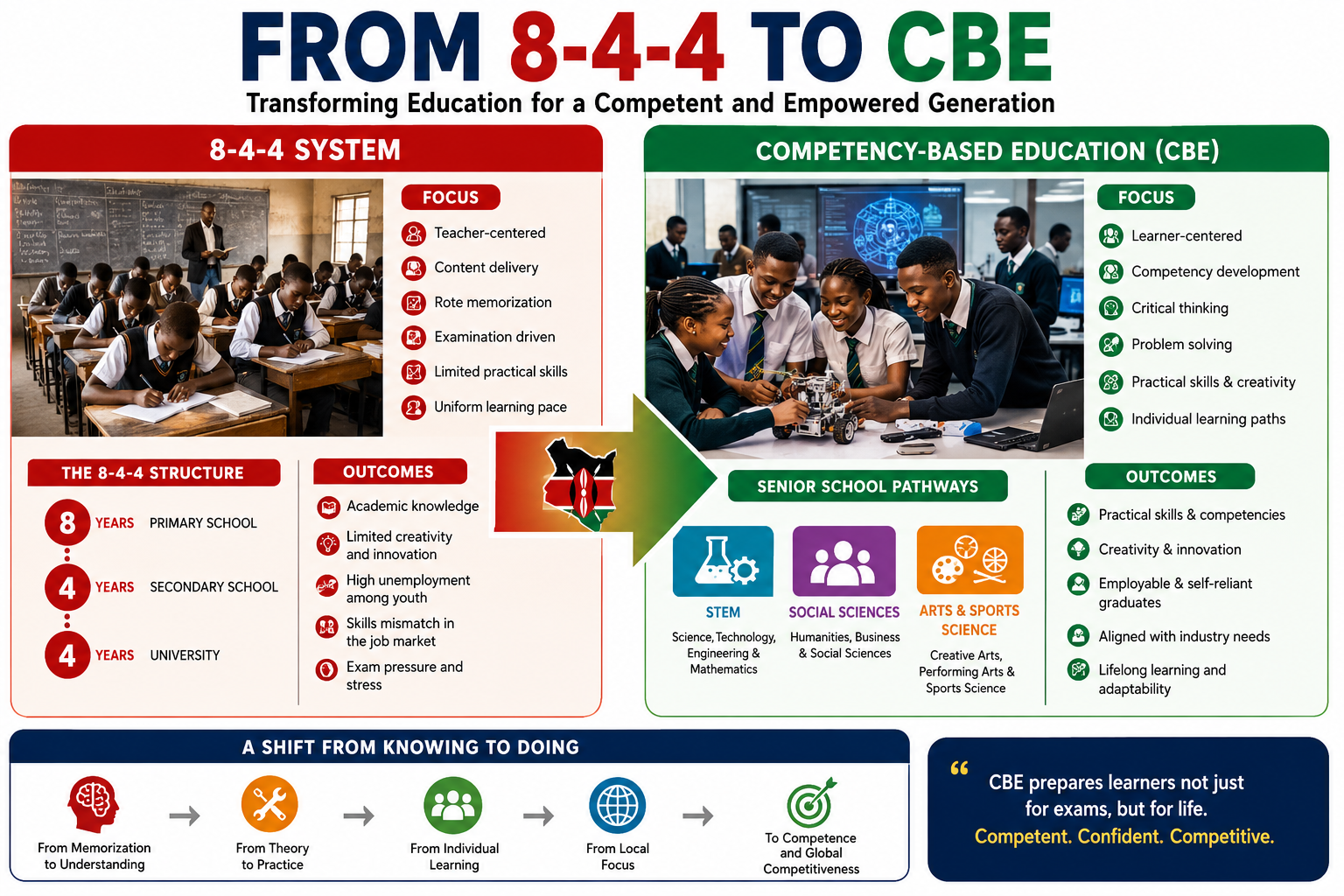
For over three decades, the 8-4-4 education system shaped the lives of millions of Kenyans. Introduced in 1985, it became one of the most recognizable educational structures in Africa and produced doctors, engineers, teachers, lawyers, scientists, entrepreneurs, and political leaders who contributed significantly to national development.
Yet despite these achievements, growing concerns emerged regarding whether the system was adequately preparing learners for the rapidly evolving world of the 21st century.
As technology transformed industries and employers demanded new skills, education stakeholders began asking difficult questions:
- Were learners leaving school with practical skills?
- Could graduates solve real-world problems?
- Were schools nurturing creativity and innovation?
- Was education preparing learners for future careers?
These questions eventually led to one of the most ambitious educational reforms in Kenya’s history—the transition from the 8-4-4 system to Competency-Based Education (CBE).
The Birth of the 8-4-4 System
The 8-4-4 system was officially introduced in 1985 to replace the 7-4-2-3 structure.
Its objectives included:
✔ Expanding access to education
✔ Promoting self-reliance
✔ Equipping learners with practical skills
✔ Supporting national development goals
The structure consisted of:
| Level | Duration |
|---|---|
| Primary School | 8 Years |
| Secondary School | 4 Years |
| University | 4 Years |
At the time, the reform was considered progressive and innovative.
Kenya’s Educational Evolution


Initially, the curriculum incorporated practical subjects such as:
- Agriculture
- Home Science
- Business Education
- Woodwork
- Metalwork
- Art and Design
These subjects were intended to produce self-reliant graduates capable of creating employment opportunities rather than merely seeking jobs.
Early Successes of the 8-4-4 System
To understand why Kenya changed its education system, it is important to first recognize what worked well.
The 8-4-4 system achieved several notable successes.
Increased Literacy Levels
The system contributed significantly to improving literacy rates across the country.
Millions of learners acquired:
- Reading skills
- Writing skills
- Numeracy competencies
Education became more accessible than ever before.
Expansion of Educational Institutions
Kenya witnessed rapid growth in:
- Primary schools
- Secondary schools
- Teacher training colleges
- Universities
This expansion increased opportunities for learners nationwide.
Production of Skilled Professionals
The system produced generations of professionals who helped build the nation.
These included:
- Doctors
- Engineers
- Teachers
- Scientists
- Accountants
- Researchers
Many Kenyan professionals gained recognition globally.
Academic Excellence
Kenyan learners consistently demonstrated strong academic performance in international institutions.
The rigorous curriculum developed:
- Discipline
- Determination
- Work ethic
- Examination skills
Achievements of the 8-4-4 Era


Despite these achievements, emerging challenges gradually became more apparent.
The Growing Criticism of 8-4-4
As the global economy evolved, many stakeholders began questioning whether the education system remained fit for purpose.
Several weaknesses emerged.
1. Excessive Examination Pressure
One of the most common criticisms involved the heavy focus on examinations.
Success became largely determined by performance in national examinations.
Students often faced intense pressure to achieve high grades.
Schools increasingly prioritized:
- Test preparation
- Revision drills
- Memorization techniques
rather than genuine understanding.
The Examination Culture


In many schools, learning became synonymous with passing examinations.
This approach created learners who could reproduce information but sometimes struggled to apply knowledge practically.
2. Overemphasis on Memorization
The system rewarded learners who could recall information accurately.
Consequently, teaching often focused on:
- Notes
- Definitions
- Facts
- Formulas
Students frequently memorized content without fully understanding how to apply it in real-life situations.
For example:
A student might correctly explain the theory of flight but have no practical understanding of aircraft systems.
A learner could describe a business model but lack entrepreneurial experience.
3. Limited Creativity and Innovation
The modern economy rewards innovation.
However, critics argued that the examination-oriented nature of 8-4-4 discouraged:
- Creativity
- Experimentation
- Independent thinking
Students often focused on finding the “correct answer” rather than exploring multiple solutions.
Creativity vs Memorization


Modern industries increasingly seek individuals who can:
- Invent
- Design
- Adapt
- Create solutions
These skills are difficult to develop through memorization alone.
4. Skills Gap in the Job Market
Employers frequently reported that graduates lacked practical workplace skills.
Common complaints included:
- Poor communication
- Weak teamwork abilities
- Limited technical skills
- Inadequate problem-solving capabilities
This created a mismatch between educational outcomes and labor market requirements.
5. Rising Youth Unemployment
Kenya’s youth population continued to grow rapidly.
Each year thousands of graduates entered the labor market.
However, many struggled to secure employment because employers increasingly prioritized competencies rather than certificates alone.
The question became:
“Can you perform the task?” rather than “What grade did you score?”
The Employability Challenge


The emerging digital economy demanded new skill sets.
6. Limited Exposure to Technology
When 8-4-4 was introduced in 1985, technologies such as:
- Artificial Intelligence
- Robotics
- Virtual Reality
- Cloud Computing
did not exist in mainstream education.
As a result, many schools remained heavily dependent on:
- Chalkboards
- Printed textbooks
- Teacher-centered instruction
While effective in their time, these methods became increasingly insufficient for preparing learners for future careers.
The Global Shift Toward Competency-Based Education
Kenya was not alone in rethinking education.
Countries worldwide began introducing reforms aimed at developing competencies rather than simply delivering content.
Examples include:
- Finland
- Singapore
- Canada
- Australia
These nations increasingly emphasized:
- Critical thinking
- Collaboration
- Communication
- Creativity
- Digital literacy
Global Education Transformation


The focus shifted from:
“What does the learner know?”
to
“What can the learner do?”
Birth of Competency-Based Education (CBE)
Kenya responded by introducing Competency-Based Education.
CBE was designed around the principle that learners should acquire practical competencies that can be applied in everyday life.
Rather than concentrating solely on examination performance, CBE seeks to develop the whole learner.
The Seven Core Competencies
The curriculum emphasizes seven key competencies:
1. Communication and Collaboration
Learners develop the ability to:
- Work in teams
- Express ideas clearly
- Listen effectively
2. Critical Thinking and Problem Solving
Students learn to:
- Analyze situations
- Identify challenges
- Generate solutions
3. Creativity and Imagination
Learners are encouraged to:
- Innovate
- Design
- Create
4. Citizenship
Students develop:
- Responsibility
- Patriotism
- Ethical behavior
5. Digital Literacy
Learners acquire competencies in:
- Technology use
- Information management
- Digital communication
6. Learning to Learn
Students become lifelong learners capable of adapting to change.
7. Self-Efficacy
Learners build confidence and resilience.
The Core Competencies Framework


Why Senior School Became Necessary
Under CBE, learners eventually select pathways aligned with their interests and talents.
This allows greater specialization.
The pathways include:
STEM
Focused on:
- Engineering
- Science
- Technology
- Mathematics
Social Sciences
Focused on:
- Humanities
- Business
- Languages
Arts and Sports Science
Focused on:
- Performing Arts
- Sports
- Creative Industries
This pathway approach acknowledges that learners possess different talents and aspirations.
The Rise of Simulation-Based Learning
One of the most revolutionary developments under CBE is the integration of simulators into learning.
Instead of simply reading about industries, learners can experience them virtually.
Examples include:
- Aviation simulators
- Maritime simulators
- Industrial process simulators
- Robotics simulators
- Medical simulators
Simulation Technology in Education


These technologies help bridge the gap between theory and practice.
Students gain hands-on experience without requiring expensive physical facilities.
Conclusion
The transition from 8-4-4 to Competency-Based Education was not an admission of failure but rather a response to a changing world.
While the 8-4-4 system successfully expanded educational access and produced generations of professionals, emerging economic realities demanded a different approach.
CBE seeks to equip learners with the competencies required to thrive in a technology-driven, innovation-focused global economy.
The introduction of specialized pathways, digital technologies, and educational simulators represents a major step toward making learning more practical, relevant, and future-oriented.
About the Author

Related posts:
How AI is Transforming Competency-Based Education

How to Confirm KJSEA Placement Online
How to Apply for TSC Promotion Vacancies 2026 Quickly
Best Bomet County Senior Schools { C1 National, C2 Extra-County, C3 County and C4 Sub-County