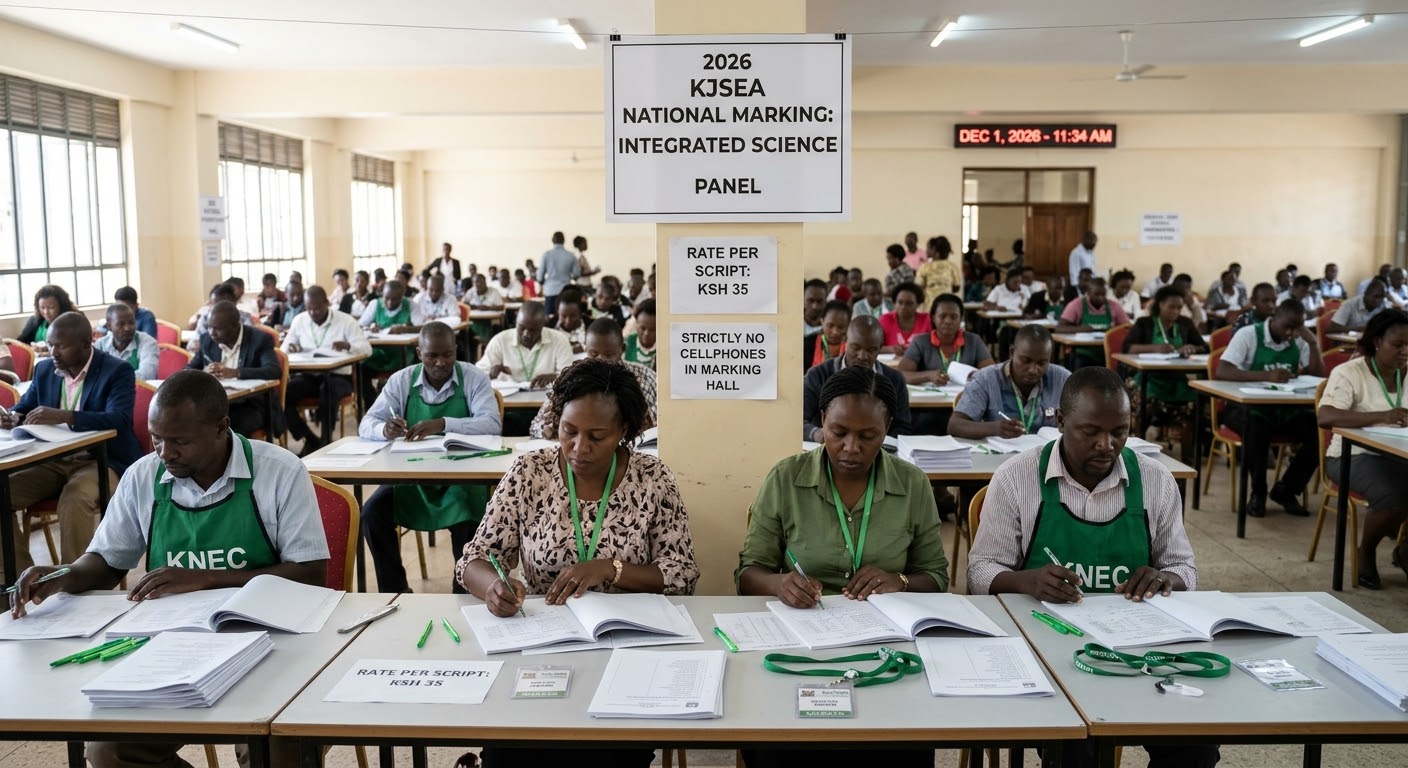
The Kenya National Examinations Council (KNEC) has officially activated the marking exercise for the 2026 Kenya Junior School Education Assessment (KJSEA). As Grade 9 learners prepare for transition into Senior School (Grade 10) under the Competency-Based Education (CBE) framework, hundreds of trained examiners are reporting to designated national marking centers.
Understanding how examiner remuneration works is crucial for planning logistics, offsetting earlier residential training fees, and maximizing total take-home pay. Here is the comprehensive breakdown of KNEC’s 2026 KJSEA payment model, illustrative earnings tables, and practical strategies to optimize your returns.
1. Core Structure: How 2026 KJSEA Marking Rates Work
KNEC calculates examiner pay using a hybrid structure comprising fixed baselines and variable piece-rate incentives. Human examiners handle open-ended and creative response sections, while multiple-choice sections are scored directly via Optical Mark Recognition (OMR) systems.
The published payment rates consist of three primary building blocks:
- Piece-Rate (Script Fee): KSh 35 per completed script. This represents the main earnings engine; total payout scales with output.
- Basic Allowance: A flat baseline fee of KSh 1,500 allocated to every deployed examiner.
- Daily Coordination Allowance: KSh 250 per day for the entire duration of active deployment at the marking center.
2. Estimated Earnings Illustration Table
Because script rates drive overall income, two markers at the same center can receive different final payouts depending on speed, accuracy, and total script quota handled.
Assuming a standard 14-day residential marking window (yielding KSh 3,500 in cumulative coordination fees), the projected gross earnings scale as follows:
| Scripts Marked | Script Earnings (KSh 35 / script) | Basic Allowance | Coordination Fee (14 Days @ KSh 250/day) | Projected Gross Total |
|---|---|---|---|---|
| 500 scripts | KSh 17,500 | KSh 1,500 | KSh 3,500 | KSh 22,500 |
| 800 scripts | KSh 28,000 | KSh 1,500 | KSh 3,500 | KSh 33,000 |
| 1,000 scripts | KSh 35,000 | KSh 1,500 | KSh 3,500 | KSh 40,000 |
| 1,200 scripts | KSh 42,000 | KSh 1,500 | KSh 3,500 | KSh 47,000 |
| 1,500 scripts | KSh 52,500 | KSh 1,500 | KSh 3,500 | KSh 57,500 |
Note: Projections represent gross earnings before statutory tax withholdings or individual transport and subsistence overheads. Every additional 100 scripts completed adds KSh 3,500 directly to your total.
3. Historical Trends Across Learning Areas
Earnings vary across subject panels due to differences in paper structure, student attempt volume, and total time required per script. Historical assessment data indicates that practical and high-volume open-response subjects tend to yield higher gross returns per marker:
- High-Volume Benchmarks: Creative Arts & Sports (~KSh 75,000), Integrated Science Paper 2 (~KSh 57,000), and English (~KSh 48,000).
- Mid-Tier Benchmarks: Pre-Technical Studies (~KSh 45,000), Agriculture (~KSh 42,000), and Mathematics (~KSh 37,000).
- Standard-Tier Benchmarks: Social Studies (~KSh 36,000), Kiswahili (~KSh 35,000), and Religious Education (CRE/IRE) (~KSh 33,000).
4. Key Strategies to Maximize Net Marking Income
- Master Assessment Rubrics Early: Revisit training guidelines from previous briefing sessions. Examiners who internalize marking schemes quickly minimize hesitation, reduce queries from Senior Examiners, and maintain a steady pace.
- Prioritize Accuracy Over Pure Speed: While piece-rates reward high output, KNEC quality-assurance cross-checks flag irregular scoring. Scripts requiring re-marking waste time and risk your standing on the active KNEC database.
- Maintain Full Attendance: Ensure daily register sign-ins to capture the complete KSh 250/day coordination fee across the entire 14-day schedule.
- Log Daily Output: Keep an independent tally of marked script batch numbers and daily totals to verify against KNEC’s final payment reconciliations.
- Beware of Payment Scams: KNEC does not solicit money or fees to release marking payments or issue station deployments. Official communication is dispatched strictly via official SMS notifications and the KNEC Examiner Portal.
About the Author

Related posts:
A Deep dive into the 2026 Knec projects grade 3 to Grade 8

TSC Replacement Teacher Vacancies 2026/2027: November Recruitment Advert, January Interviews and Feb...

How Pathway Selection is Shaping the Future of Kenya's Competency-Based Education (CBE)

The 30,000 TSC Promotions Dilemma