The transition from Grade 9 to Grade 10 is a major step in Kenya’s Competency-Based Education (CBE) system.
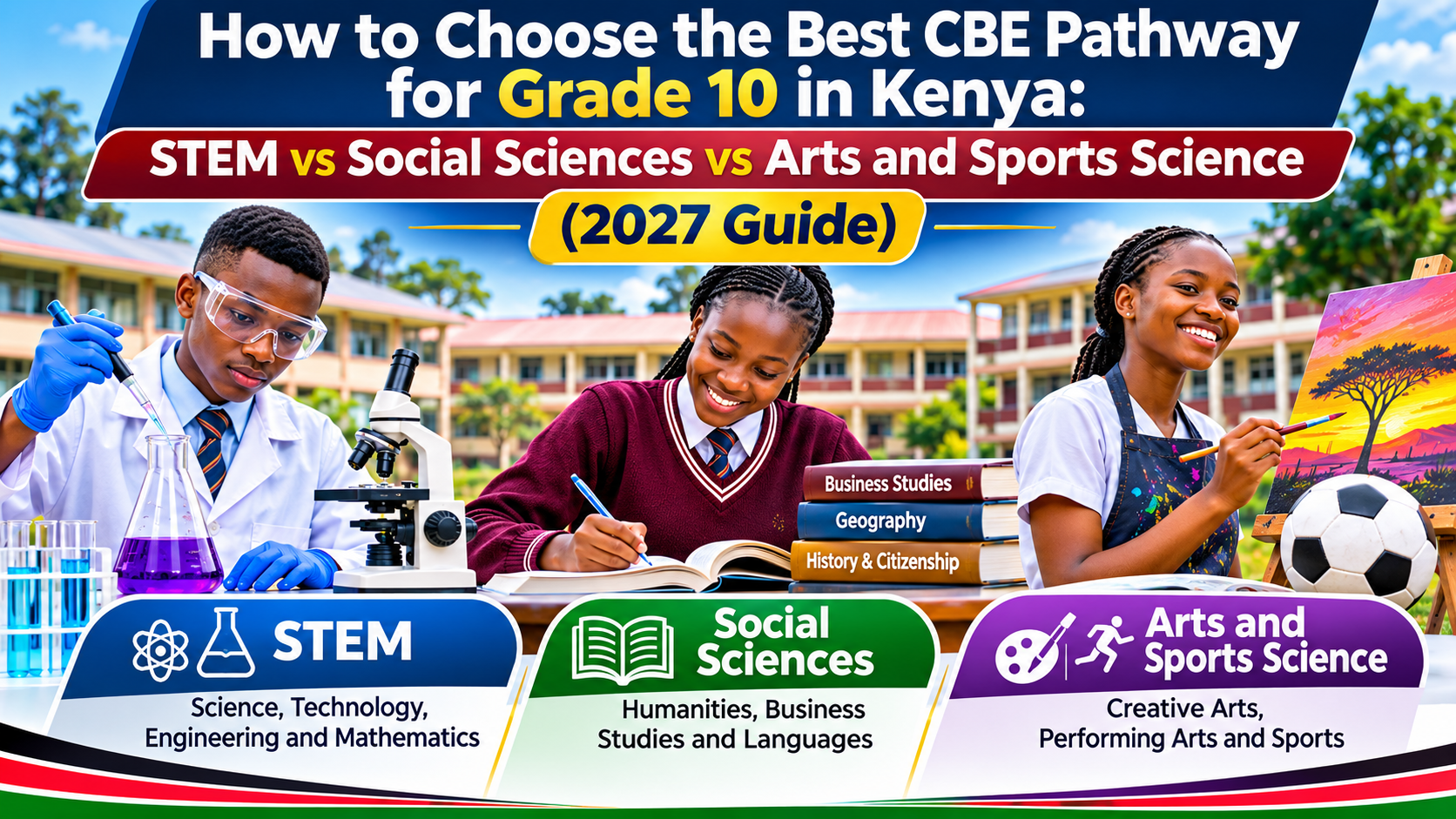
Senior School is organised around three broad pathways: Science, Technology, Engineering and Mathematics (STEM), Social Sciences, and Arts and Sports Science.
The choice helps learners focus on learning areas that connect with their interests, demonstrated strengths and future aspirations.
For parents, the decision can feel complicated. Some are unsure whether STEM is the best route to a successful career, whether Social Sciences offers strong university opportunities, or whether a learner talented in music, visual arts or sport can build a sustainable future through Arts and Sports Science.
This guide explains the three pathways, gives examples of learning areas and possible career directions, and sets out practical steps families can take before confirming a learner’s choices.
It is particularly useful for parents and learners preparing for the 2027 academic year.
1. Understanding the Three CBE Pathways
A pathway is the broad learning direction a learner follows in Senior School.
A track is a specialised branch within a pathway, while a subject combination is the particular group of optional learning areas selected from approved combinations.
The three pathways are:
- STEM – Science, Technology, Engineering and Mathematics.
- Social Sciences.
- Arts and Sports Science.
STEM includes Pure Sciences, Applied Sciences and Technical Studies.
Social Sciences includes Humanities and Business Studies, and Languages and Literature.
Arts and Sports Science provides opportunities for learners interested in creative arts, performing arts and sports-related learning.
2. STEM Pathway: Subjects and Career Opportunities
STEM is designed for learners interested in scientific investigations, mathematics, technology, engineering and solving practical problems.
Pure Sciences
Depending on the approved combination, learning areas may include:
- Biology
- Chemistry
- Physics
- Computer Studies
- Mathematics
Possible future study areas include medicine, pharmacy, veterinary-related programmes, biological sciences, chemistry, physics and laboratory science.
Applied Sciences
Applied Sciences connects scientific knowledge with practical needs.
Learning areas may include Agriculture, Biology, Chemistry, Home Science and Geography, depending on the approved combination.
Possible career directions include:
- Agricultural science
- Food technology
- Agribusiness
- Environmental science
- Biotechnology
- Horticulture
- Animal-related studies
Technical Studies
Technical Studies is suitable for learners interested in designing, constructing, repairing and improving equipment and systems.
Learning areas may include:
- Building and Construction
- Electricity
- Metal Technology
- Power Mechanics
- Wood Technology
- Aviation Technology
- Drawing and Design
- Media Technology
Possible progression areas include electrical engineering, mechanical engineering, construction technology, automotive technology, electronics and technical entrepreneurship.
Who Should Choose STEM?
STEM may suit learners who enjoy mathematics, science experiments, technology, practical innovation and logical problem-solving.
However, parents should not select STEM simply because it is perceived as more prestigious.
A learner’s interests and commitment are equally important.
3. Social Sciences Pathway: Subjects and Careers
Social Sciences is designed for learners interested in society, human behaviour, business, communication, languages, history, governance and public affairs.
Humanities and Business Studies
Possible learning areas include:
- Business Studies
- Geography
- History and Citizenship
- Computer Studies
- Religious Education
Possible career directions include law-related studies, business management, accounting, entrepreneurship, journalism, education, public administration and international relations.
Languages and Literature
This track is suitable for learners who enjoy reading, writing, communication and understanding different cultures.
Learning areas may include English Literature, Fasihi ya Kiswahili, French, German, Arabic, Mandarin, Indigenous Languages and Sign Language.
Possible career directions include:
- Journalism
- Translation and interpretation
- Teaching
- Public relations
- International relations
- Publishing
- Communication
- Creative writing
Social Sciences should not be treated as a second option for learners who do not choose STEM. It is an important academic pathway with its own opportunities.
4. Arts and Sports Science Pathway
Arts and Sports Science recognises the importance of creativity, artistic expression, physical performance and sporting talent.
Arts Track
Depending on approved combinations, learning areas may include:
- Fine Arts
- Music and Dance
- Theatre and Film
Possible career directions include graphic design, animation, photography, film production, music production, acting, fashion-related studies, interior design and digital content creation.
Sports and Recreation
This area is suitable for learners interested in sports, physical activity, performance and recreation.
Possible career directions include:
- Professional sports
- Sports coaching
- Sports management
- Physical education
- Sports journalism
- Fitness training
- Recreation management
Talent alone is not enough. Learners must develop discipline, practical skills, knowledge and professional experience.
5. Comparing the Three CBE Pathways
| Consideration | STEM | Social Sciences | Arts and Sports Science |
|---|---|---|---|
| Main focus | Science and technology | Society, business and languages | Creativity and sports |
| Main strength | Scientific problem-solving | Communication and analysis | Creativity and performance |
| Suitable interests | Experiments and innovation | Business, reading and debate | Music, art and sports |
| Career areas | Engineering, medicine and ICT | Law-related study, business and teaching | Design, film and sports |
No pathway guarantees employment, university admission or financial success.
The best choice depends on the learner’s abilities, selected subjects, performance and future qualifications.
6. Seven Steps to Choosing the Right Pathway
Step 1: Review Grade 9 performance.
Examine the learner’s performance in mathematics, science, languages, creative activities and practical learning.
Step 2: Identify interests.
Discuss activities the learner enjoys, including experiments, business, writing, music, design and sports.
Step 3: Consider future careers.
Identify possible career directions and research the subjects required for relevant university and college programmes.
Step 4: Check available combinations.
Confirm that the preferred subject combination is approved and offered by the selected school.
Step 5: Examine school facilities.
Consider laboratories, workshops, computers, sports facilities, art studios and teacher availability.
Step 6: Consider affordability.
Compare school fees, boarding arrangements, transport, accommodation and additional learning expenses.
Step 7: Consult teachers and career guidance personnel.
Involve the learner, parents, teachers and career guidance personnel before making the final decision.
7. Understanding Grade 10 Subject Combinations
The Senior School structure includes four core learning areas and three selected learning areas.
The four core areas are:
- English.
- Kiswahili or the applicable alternative.
- Mathematics.
- Community Service Learning.
Learners select three additional learning areas according to their interests, aptitude, career direction and approved subject combinations.
The Mathematics options include Core Mathematics and Essential Mathematics, with the applicable selection guided by the pathway and current official requirements.
For example, STEM combinations may include Biology, Chemistry, Physics, Agriculture and technical subjects.
Social Sciences combinations may include Business Studies, Geography, History and Citizenship, languages and literature.
Arts and Sports Science combinations may include Fine Arts, Music and Dance, Theatre and Film, and Sports and Recreation.
Parents should verify the actual combinations on the official selection platform.
8. How to Select a Grade 10 Senior School Online
The Ministry of Education provides an official Grade 10 Selection and Placement System.
Parents can access it here:
https://selection-placement.kemis.go.ke/
The general process involves:
- Accessing the official platform.
- Reviewing the available pathways.
- Identifying suitable subject combinations.
- Searching for senior schools offering those combinations.
- Comparing school options.
- Following the current selection instructions.
- Confirming the submitted choices.
- Keeping the confirmation slip.
Parents should follow the instructions published for the relevant selection cycle because deadlines and selection procedures can change.
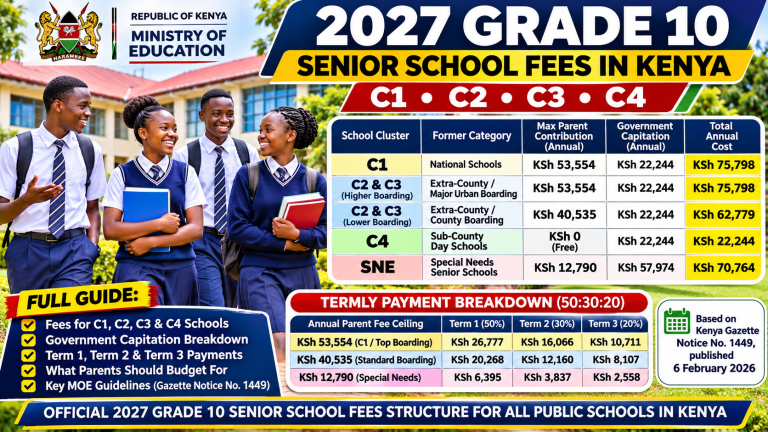
9. Understanding C1, C2, C3 and C4 Senior Schools
Parents may encounter C1, C2, C3 and C4 classifications when researching senior schools.
These categories form part of the Senior School classification and selection framework.
However, parents should not treat them as a simple ranking of educational quality.
A school’s suitability depends on:
- Available pathways.
- Approved subject combinations.
- Teaching staff.
- Learning facilities.
- School location.
- Boarding or day arrangements.
- Learner support.
- Affordability.
Before selecting a school, confirm its current classification and approved subject offerings through the official Ministry platform.
10. Can a Learner Change Their Pathway?
Some learners may discover that their selected pathway does not match their interests after joining Senior School.
A change should not be assumed to be automatic.
It may depend on school capacity, subject availability, applicable Ministry procedures, timing and approval by the relevant authorities.
Parents should consult the school principal and relevant education office before requesting a change.
11. What Should Parents Expect in Grade 11?
Grade 11 is the second year of Senior School.
Learners continue developing knowledge and competencies within their selected learning areas.
The focus includes:
- Advanced subject understanding.
- Practical learning.
- Research and investigations.
- Communication.
- Critical thinking.
- Collaboration.
- Digital literacy.
- Preparation for further education.
Parents should encourage consistent study habits, participation in practical activities and communication with teachers.
12. Frequently Asked Questions
Which is the best CBE pathway in Kenya?
There is no single best pathway for every learner. The right choice depends on interests, demonstrated strengths and future aspirations.
Is STEM compulsory for Grade 10 learners?
No. Learners can pursue STEM, Social Sciences or Arts and Sports Science.
Can Social Sciences learners join university?
Yes. They can progress to university and other training institutions where they meet the relevant admission requirements.
Can Arts and Sports Science lead to professional careers?
Yes. It can support further education and careers in creative, performing, media, sports and recreation fields.
Does choosing STEM guarantee admission to medicine?
No. University admission depends on the required subjects, grades and institutional entry criteria.
Can parents select the pathway for their children?
Parents should guide the process, but the learner’s abilities, interests and aspirations should remain central.
Where can parents check approved subject combinations?
Use the official Ministry of Education Grade 10 Selection and Placement System.
https://selection-placement.kemis.go.ke/
Conclusion: Choose a Pathway That Helps Your Child Thrive
The three CBE Senior School pathways give Kenyan learners different opportunities to develop their abilities and prepare for further education, training and employment.
STEM supports scientific and technical interests.
Social Sciences supports humanities, business and communication.
Arts and Sports Science supports creative, performing and sporting interests.
The strongest decision is not necessarily the most popular one. It is the decision made after reviewing the learner’s strengths, listening to their interests, checking subject requirements and comparing available schools.
The future of education is about identifying individual potential and providing opportunities for learners to develop their talents.
The best CBE pathway is the one that gives your child the opportunity to thrive.
Official Sources
- Ministry of Education: https://www.education.go.ke/
- Grade 10 Selection and Placement: https://selection-placement.kemis.go.ke/
- Kenya Institute of Curriculum Development: https://kicd.ac.ke/
- Kenya National Examinations Council: https://www.knec.ac.ke/.
About the Author

Related posts:
Best Kitui County Senior Schools { C1 National, C2 Extra-County, C3 County and C4 Sub-County
. BASIC INFRASTRUCTURE FOR SENIOR SCHOOL
How Pathway Selection is Shaping the Future of Kenya's Competency-Based Education (CBE)
Best Busia County Senior Schools { C1 National, C2 Extra-County, C3 County and C4 Sub-County}